How NAC works in PCOS
A left-to-right flow diagram. On the left, a box for NAC (N-acetylcysteine), described as an antioxidant and mild insulin sensitiser. Two arrows lead to two mechanism boxes: one for lower oxidative stress, one for improved insulin signalling. Both arrows converge on a central box for a healthier ovarian and uterine environment. From there, three outcome boxes show what the 2025 meta-analysis measured: higher progesterone, a thicker endometrium, and a shift in LH. A note at the bottom states that antioxidant-rich, insulin-friendly food supports the same pathway.
How NAC Works in PCOS
One supplement, two mechanisms, the outcomes trials measured
NAC
N-acetylcysteine
Antioxidant + insulin sensitiser
What is NAC (N-acetylcysteine)?
NAC is a stable, supplement form of the amino acid cysteine. Your body uses cysteine to build glutathione, which is the main antioxidant your cells make for themselves. Because glutathione is hard to absorb directly, giving cysteine as NAC is the efficient way to raise it.
NAC is not a new or fringe compound. It has been used in hospitals for decades to treat paracetamol overdose and to thin mucus in lung disease, so its safety at high doses is well characterised. In PMOS the interest is different. Here NAC is studied for two properties that map directly onto the biology of the condition: it lowers oxidative stress, and it improves how the body handles insulin. That combination is why it keeps appearing in fertility and metabolic trials.
How does NAC work for PCOS?
NAC works through two levers at once, and both matter for PMOS. Understanding them explains why the trial results land where they do.
The antioxidant lever
Ovaries under the stress of PMOS carry more oxidative damage than usual. Oxidative stress is the imbalance between reactive molecules and the antioxidants that neutralise them, and it interferes with how eggs mature and how follicles develop. By raising glutathione, NAC gives the ovary more antioxidant capacity, which supports a calmer environment for follicles to grow.
The insulin lever
Most PMOS runs on insulin resistance. Cells respond poorly to insulin, so the pancreas pumps out more of it, and that excess insulin pushes the ovaries to make more androgens. Diamanti-Kandarakis and Dunaif set out this insulin-first model of the syndrome in their 2012 review, and it remains the standard explanation. NAC acts as a mild insulin sensitiser, helping cells respond to insulin so the body needs less of it. Less circulating insulin means less drive on ovarian androgen production, which is the same target that metformin aims at.
What does the 2025 NAC meta-analysis actually show?
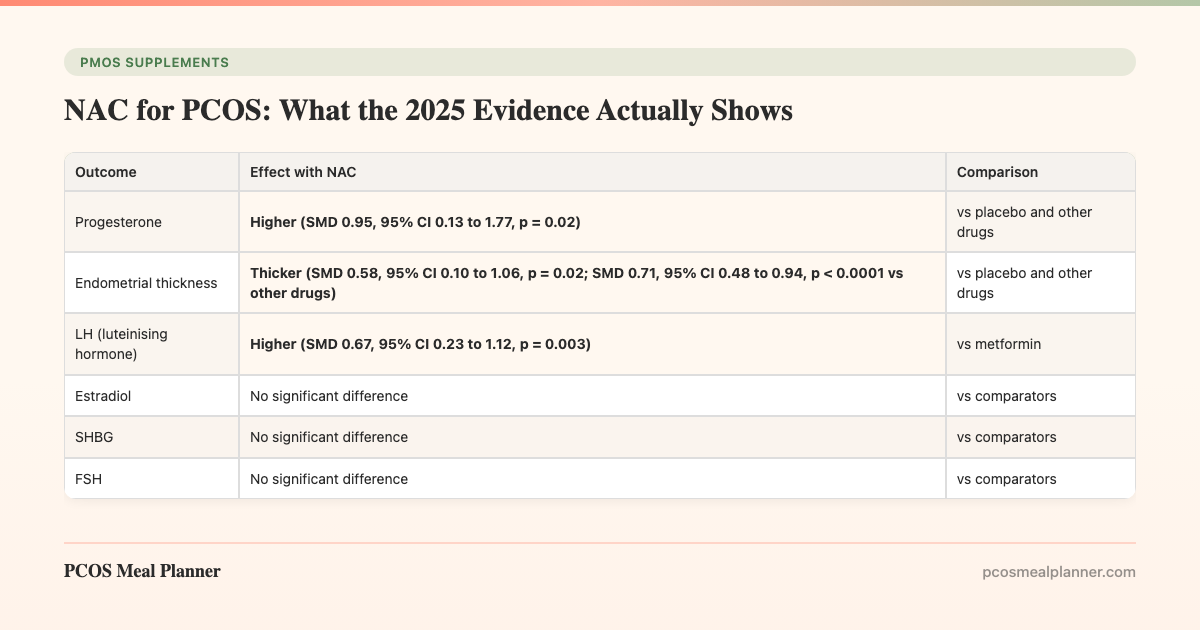
The strongest single piece of evidence is the 2025 meta-analysis by Vina and colleagues, published in Nutrients. It followed PRISMA standards, used the Cochrane risk-of-bias tool, and pooled 22 trials with 2,515 women, comparing NAC against metformin, clomiphene citrate and placebo. The pre-specified outcomes were follicular growth, endometrial thickness and hormone levels. Here is what reached statistical significance.
Outcome
Effect with NAC
Comparison
Progesterone
Higher (SMD 0.95, 95% CI 0.13 to 1.77, p = 0.02) vs placebo and other drugs
Endometrial thickness
Thicker (SMD 0.58, 95% CI 0.10 to 1.06, p = 0.02; SMD 0.71, 95% CI 0.48 to 0.94, p < 0.0001 vs other drugs) vs placebo and other drugs
LH (luteinising hormone)
Higher (SMD 0.67, 95% CI 0.23 to 1.12, p = 0.003) vs metformin
Estradiol
No significant difference
vs comparators
SHBG
No significant difference
vs comparators
FSH
No significant difference
vs comparators
The two most reproductively useful signals are the progesterone rise and the thicker endometrium. A meaningful progesterone increase is a marker that ovulation is happening, and a thicker endometrium is a more receptive lining for implantation. The authors concluded NAC had a major effect on progesterone, endometrial thickness and LH, and that it may be a potential treatment option. What the analysis did not find is also worth naming: estradiol, SHBG and FSH did not shift significantly, so NAC is not a blanket hormone reset.
NAC vs metformin for PCOS: how do they compare?
Metformin is the standard insulin-sensitising drug in PMOS, so the honest question is whether NAC measures up. In the 2025 meta-analysis, NAC matched metformin on most measured hormones and was linked to higher LH than metformin. It did not clearly outperform metformin across the board, because estradiol, SHBG and FSH did not change with either.
The practical difference is tolerability. Metformin commonly causes gut side effects, especially in the first weeks, and some people cannot stay on it. NAC's most common issue is occasional mild stomach upset. That gentler profile is a large part of why researchers keep testing NAC as an add-on or an alternative for women who do not get on with metformin.
The important caveat: metformin is a prescription medicine that a doctor selects and monitors, while NAC is a supplement. Comparable numbers in a trial do not make them interchangeable in your own care. This is a decision for you and your doctor, not a swap to make on your own. For a wider look at how insulin-focused supplements stack up, see our comparison of inositol versus berberine for PCOS .
What dose of NAC did PCOS studies use?
Trials in PMOS commonly used about 1.8 to 3 grams of NAC per day, usually split across two or three doses with meals. That is a concentrated amount, well beyond anything you would reach through food, which is why the effects seen in studies come from supplements rather than diet alone.
Treat that range as a description of what researchers used, not as a dose to copy. The right amount, the right form, and whether NAC suits you at all depend on your health history, your goals, and any medicines you take. NAC can interact with some drugs, so the starting point is a conversation with a doctor, not a bottle from the shelf. Our supplements hub, the best supplements for PMOS , puts NAC in context alongside the other options worth discussing.
Who should consider NAC for PCOS?
NAC is worth raising with your doctor if a few things describe you. The evidence points most clearly at women who are trying to conceive or who want better ovulation, since the standout findings were higher progesterone and a thicker endometrium. It is also a reasonable talking point if you have tried metformin and could not tolerate it, given the gentler side-effect profile.
NAC is not a magic switch. It did not move every hormone in the pooled data, and no supplement undoes the effect of a plate that keeps spiking insulin. It works with the underlying pattern, not against it. If your cycles are irregular, your androgen-driven symptoms are prominent, or insulin resistance has been flagged on bloods, NAC is one of the better-evidenced options to put on the list. For another antioxidant with fertility-focused evidence, our guide to CoQ10 for PCOS is a useful companion read.
Can you get NAC and antioxidants from food?
You cannot get supplement-level NAC from food, but you can feed the same pathway. NAC exists to raise glutathione, and your body builds glutathione from cysteine, which is plentiful in ordinary protein foods. Eggs, poultry, yoghurt, cottage cheese, fish and legumes all supply the cysteine your cells need. Alliums like garlic and onions, and cruciferous vegetables like broccoli and Brussels sprouts, contain sulphur compounds that support glutathione production too.
The wider antioxidant picture matters as much as cysteine. Colourful plants deliver polyphenols and vitamin C that reduce the oxidative stress NAC is aimed at. Berries, leafy greens, extra-virgin olive oil, nuts and green tea are the everyday staples that do this work. None of this replaces a studied dose of NAC, but it is the foundation the supplement sits on top of. A plate that is protein-forward, rich in colour, and gentle on blood sugar hits both of NAC's levers at once: it supplies antioxidant raw materials and it keeps insulin lower. That is why food comes first and supplements come second.
Is NAC safe?
NAC is generally well tolerated. The most common side effect is mild gastrointestinal upset, such as nausea or loose stools, which often eases when it is taken with food. It has a long medical track record, including at much higher hospital doses than the amounts used in PMOS trials.
Even so, NAC is not a substitute for medical care. It can interact with some medications, including certain nitrate and blood-pressure drugs, and its safety as a supplement in pregnancy has not been established. If you are pregnant, trying to conceive, or taking other medication, check with a doctor before starting. This article is educational and is not medical advice.
Where NAC fits in your PMOS plan
Think of NAC as a possible amplifier, not a foundation. The base of any PMOS plan is the way you eat every day, because food is what governs your insulin from morning to night. A supplement that improves insulin signalling by a modest amount is fighting an uphill battle if every meal spikes blood sugar. Get the plate right first, and NAC has a stable platform to work from.
That is exactly what the PCOS Meal Planner is built to do. It generates insulin-friendly, antioxidant-rich meals around your specific symptoms, so the daily foundation that NAC depends on is already in place. If you and your doctor decide NAC is worth trying, you want it landing on top of the right plate, not doing all the work alone. NAC for PCOS is most useful as one considered addition to an insulin-friendly, antioxidant-rich PMOS plate, and that plate is where the real leverage lives. Build your plan now .
Often asked questions
Is NAC good for PCOS?
The 2025 evidence is reasonably supportive. A meta-analysis of 22 trials and 2,515 women found NAC raised progesterone, thickened the endometrium, and raised LH compared with metformin, with no significant change in estradiol, SHBG or FSH. NAC is an antioxidant and a mild insulin sensitiser, so it targets two core drivers of PCOS. It is generally well tolerated, but it is not a substitute for medical care.
Share this answer
How does NAC work for PCOS?
Through two mechanisms. First, NAC is a building block for glutathione, the body's main internal antioxidant, so it lowers oxidative stress in the ovary. Second, it acts as a mild insulin sensitiser, helping cells respond to insulin so the pancreas makes less. Lower insulin means less drive on ovarian androgen production, which is why NAC sits alongside insulin-sensitising drugs like metformin.
Share this answer
What did the 2025 NAC meta-analysis find?
The 2025 Nutrients meta-analysis pooled 22 trials and 2,515 women. NAC significantly increased progesterone (SMD 0.95) and endometrial thickness (SMD 0.58; SMD 0.71 versus other drugs). LH was higher with NAC than metformin (SMD 0.67). Estradiol, SHBG and FSH did not change significantly. The authors concluded NAC may be a potential treatment option.
Share this answer
Is NAC better than metformin for PCOS?
Not clearly better, but competitive. In the 2025 meta-analysis NAC matched metformin on most measured hormones and was linked to higher LH. Its main advantage is tolerability, since metformin often causes gut side effects while NAC's worst is usually mild stomach upset. Metformin remains a first-line prescription option monitored by a doctor, so NAC is best seen as an add-on or alternative, not an automatic swap.
Share this answer
What is the typical NAC dosage used in PCOS studies?
Trials commonly used about 1.8 to 3 grams of NAC per day, usually split across two or three doses with meals. That is far more than food provides, which is why the study effects come from supplements. This is a description of what researchers used, not a dosing recommendation. The right amount and whether NAC suits you depend on your history and medications, so ask a doctor.
Share this answer
Is NAC safe to take for PCOS?
NAC is generally well tolerated, with mild gastrointestinal upset the most common side effect, often eased by taking it with food. It has a long medical track record at higher hospital doses. Even so, it can interact with some medications, and its safety in pregnancy as a supplement is not established. Check with a doctor before starting, especially if you are pregnant, trying to conceive, or on other medication.
Share this answer
Sources and further reading
The 2025 NAC meta-analysis
Insulin resistance in PCOS
Clinical guidelines and patient-facing summaries
Supplements work best on top of the right plate. NAC targets oxidative stress and insulin, but a plate that keeps spiking blood sugar undoes the effort. Our
AI PCOS Meal Planner builds insulin-friendly, antioxidant-rich meals around your symptoms, so anything you and your doctor add lands on a solid foundation.
Build your plan now .
How this article was made
The efficacy figures come from the 2025 systematic review and meta-analysis by Vina and colleagues in Nutrients (22 trials, n = 2,515), which compared NAC with metformin, clomiphene and placebo and reported the effects on progesterone, endometrial thickness and hormone levels quoted above. The insulin-resistance model of PCOS draws on Diamanti-Kandarakis and Dunaif 2012 in Endocrine Reviews. Framing aligns with the International Evidence-Based Guideline for PCOS and patient-facing summaries from the NHS and Mayo Clinic.
Trial dose ranges are reported as used in studies and are not a dosing recommendation. PMOS is the new name for PCOS as of 12 May 2026; the underlying biology is unchanged. This article is educational and is not medical advice. NAC is generally well tolerated, but it is not a substitute for medical care, and you should check with a doctor before starting, especially if you are pregnant or on other medication.
Related reading
Community Comments
Add a comment