Berberine vs metformin: shared AMPK target, different upstream paths
Both berberine and metformin activate AMPK (the master cellular energy switch), which improves insulin sensitivity and lowers hepatic glucose output. Metformin reaches AMPK via mitochondrial complex 1 inhibition. Berberine reaches AMPK via gut microbiome shifts and direct cytoplasmic activity. The shared downstream effect is why head-to-head trials show similar metabolic results.
METFORMIN
prescription, ~$4/month
Inhibits mitochondrial complex 1
The single head-to-head study most often cited is Yin J et al., published in Metabolism in 2008. The trial randomised 116 adults with type 2 diabetes to berberine 500 mg three times daily, metformin 500 mg three times daily, or placebo for 3 months. Berberine matched metformin on HbA1c reduction (both dropped HbA1c by 2.0 percentage points), fasting glucose, and postprandial glucose. Berberine slightly outperformed metformin on triglycerides and total cholesterol, with fewer GI side effects.
In PCOS specifically, the most cited trial is Wei W et al. in the European Journal of Endocrinology , 2012. Eighty-nine women with PCOS were randomised to berberine, metformin, or placebo. Both active treatments produced comparable improvements in waist-to-hip ratio, fasting insulin, total testosterone, and free androgen index. Berberine also improved the lipid panel slightly more than metformin.
The catch: metformin has decades of safety data and long-term outcome studies. Berberine has tens, not hundreds, of trials. For most chronic conditions, "longer-followed and better-known" beats "comparable in 3-month trials."
How does berberine work for PCOS?
Berberine is an alkaloid extracted from several plants (most commonly Berberis aristata and Coptis chinensis ). The mechanism most relevant for PCOS is activation of AMP-activated protein kinase (AMPK), the cellular energy sensor that also happens to be the main downstream target of metformin. AMPK activation produces three effects useful in PCOS:
Reduces hepatic glucose output , so fasting blood sugar falls.Improves muscle glucose uptake , so postprandial spikes are smaller.Lowers lipogenesis , which contributes to the lipid-panel improvements seen in trials.
Berberine also alters the gut microbiome significantly, with increases in short-chain-fatty-acid-producing bacteria like Akkermansia muciniphila . This microbiome shift is thought to contribute to the lipid and insulin effects independent of direct AMPK activity.
How does metformin work for PCOS?
Metformin (sold as Glucophage and several generics) is a biguanide that has been on the market for over 60 years. Its primary mechanism is inhibition of mitochondrial complex 1 in the liver, which:
Reduces hepatic gluconeogenesis , lowering fasting glucose.Activates AMPK indirectly, improving insulin sensitivity in liver, muscle, and fat.Reduces intestinal glucose absorption , blunting post-meal spikes.
For PCOS specifically, the 2023 International Evidence-Based Guideline and the 2023 Endocrine Society Clinical Practice Guideline both list metformin as a first-line pharmacological option for PCOS metabolic management, with additional indications in fertility and during pregnancy in select cases. It is one of the safest and most-prescribed medications worldwide.
Berberine vs metformin: side-by-side comparison
Dimension
Metformin
Berberine
Researched dose for PCOS
500-2,000 mg/day
1,500 mg/day (500 mg x 3)
Prescription required
Yes
No (OTC supplement)
Cost per month (US, 2026)
~$4 generic $15-45 depending on brand
HbA1c reduction (head-to-head, Yin 2008)
-2.0 percentage points
-2.0 percentage points (tie)
Weight loss at 12 weeks (Wei 2012)
-1.7 kg
-2.0 kg
Lipid panel improvement
Modest
Strong (triglycerides, total chol)
Common side effects
Diarrhea, nausea, metallic taste
Constipation, bloating, yellow tongue
Long-term safety data
60+ years, very strong ~20 years of trials, limited follow-up
Pregnancy use
Safe; often continued Contraindicated
Drug interaction risk
Low Moderate (CYP3A4 inhibitor)
FDA-approved for PCOS
No (off-label, widely used)
No (supplement, not regulated as drug)
Listed in PCOS guidelines
Yes (Monash, Endo Soc, ACOG) No
What is the right berberine dose for PCOS?
500 mg three times per day with meals (1,500 mg total daily) matches the dose used in the head-to-head metformin trials. Split dosing matters because berberine has a short half-life (~5 hours), so single daily dosing does not keep therapeutic blood levels. The standard ramp-up:
Week 1: 500 mg with the largest meal (usually dinner). Assess GI tolerance.Week 2: 500 mg twice daily with breakfast and dinner.Week 3 onward: 500 mg three times daily with each meal.
If you notice yellow tongue staining (a known cosmetic side effect of berberine), it is harmless and clears on stopping. If you notice constipation or bloating that does not resolve in 2 weeks, drop back to twice-daily dosing.
What is the right metformin dose for PCOS?
Standard prescribing is 500 mg with dinner for 1 week , then add 500 mg with breakfast (1,000 mg/day total), and titrate up to 1,500-2,000 mg/day split across 2-3 doses if needed and tolerated. Extended-release (ER or XR) metformin has 50% fewer GI side effects than the immediate-release version, but it does cost slightly more.
Most women with PCOS reach therapeutic benefit at 1,500 mg/day. Higher doses are often reserved for prediabetes or weight control. The exact dose and titration should come from your prescriber.
Side effects: how do they compare?
Both can cause GI side effects, but the pattern is different.
Metformin side effects are mostly GI, mostly in the first 2-4 weeks: diarrhea (most common), nausea, abdominal cramping, metallic taste. About 5% of users discontinue due to GI intolerance, which is why extended-release was developed. Long-term, metformin causes vitamin B12 depletion in 10-30% of users after 6-12 months, which is why B12 monitoring is recommended for any patient on it for more than a year.
Berberine side effects are also mostly GI but tend to be milder. Most common: constipation (the opposite of metformin), bloating, gas, and a benign yellowish tongue staining. Berberine inhibits CYP3A4, the enzyme that metabolizes many drugs, so the interaction profile is broader than metformin's. Always check with a pharmacist before starting berberine if you take cyclosporine, statins, certain blood pressure medications, or any drug listed as a CYP3A4 substrate.
Can I take berberine and metformin together?
Generally not recommended for most patients. Both activate the same downstream target (AMPK) and both can lower blood sugar. Combining them risks hypoglycemia and offers no proven additive benefit in published trials. Some doctors use low-dose metformin plus low-dose berberine in patients who could not tolerate either at full dose, but this is off-label and requires monitoring, not a DIY approach.
If you are switching from metformin to berberine , taper metformin over 1-2 weeks while starting berberine at the standard ramp. Do not stop metformin abruptly if you have been on it for more than 6 months. If you are switching from berberine to metformin, stop berberine the day you start metformin.
Which one should I start with?
Use this decision framework:
Are you pregnant, trying to conceive, or breastfeeding? Start with metformin. Berberine is contraindicated in pregnancy.Do you have moderate-to-severe insulin resistance (HOMA-IR > 4) or prediabetes? Start with metformin. It has decades of safety data and is the first-line choice in every major PCOS guideline.Did metformin already fail because of GI intolerance, lactic acidosis risk, or contraindicated kidney function? Berberine is the strongest alternative.Do you also need to address high cholesterol or triglycerides? Berberine has slightly stronger lipid-panel effects in the head-to-head trials.Is cost a major factor and do you not have insurance coverage? Metformin generic at ~$4/month beats any berberine option. With insurance, metformin is usually free or very cheap.Are you in a region where metformin requires a prescription you cannot easily get? Berberine is the practical OTC fallback.
When will I see results?
Timeframe
Metformin
Berberine
Week 1-2
Peak GI side effects; possibly slight glucose drop
No visible change; possibly mild constipation
Week 4-8
Fasting insulin and glucose trending down; cycles starting to regulate
Fasting insulin and glucose trending down; triglycerides start improving
Week 12 (3 months)
~25-30% drop in fasting insulin; ovulation restored in ~50% of anovulatory women
~25-30% drop in fasting insulin; 2 kg weight loss; lipids improved
Month 6+
Sustained metabolic gains; check B12 levels
Sustained gains likely; long-term data is limited
Common myths about berberine and metformin
Myth: Berberine is "nature's metformin" and is so safer.
Myth: You can stop berberine once your symptoms improve.
Myth: Metformin causes hair loss in PCOS.
Myth: Berberine is just for blood sugar.
Myth: Higher berberine doses work faster.
What to eat on metformin or berberine for PCOS
Both work better when paired with a protein-forward, low-glycemic eating pattern. The reason: both rely on AMPK activation in the liver and muscle, and AMPK activity is amplified when post-meal glucose excursions are smaller. Specifically:
30 g+ protein at every meal , especially breakfast. See the best cereal for PCOS guide for grocery-floor specifics.Low-glycemic carbs. See best breads for PCOS and our low-GI printable foods list .Healthy fats every meal (avocado, olive oil, nuts, fatty fish) to slow glucose absorption.Hydration , especially on berberine which can drive mild dehydration via GI changes.
The flip side is also true: metformin or berberine on a high-refined-carb diet will under-perform their trial results. Adherence to the dietary protocol is the bigger lever than the choice between the two molecules.
The PCOS Meal Planner approach
The medication-or-supplement decision is the smaller half of the PCOS picture. The bigger half is the daily food choices that determine your insulin exposure 18 hours of every day. The PCOS Meal Planner generates weekly meal plans matched to your specific PCOS symptoms and whichever insulin-sensitiser protocol you choose, so the food and the medication push in the same direction instead of working against each other. Most of our users who pair metformin or berberine with the right meal plan see measurable changes faster than either lever alone produces.
Often asked questions
Is berberine as effective as metformin for PCOS?
In head-to-head trials, yes. The 2008 Yin RCT showed berberine 500 mg three times daily matched metformin 500 mg three times daily on HbA1c, fasting glucose, and lipid panel at 3 months, with fewer GI side effects. The 2012 Wei PCOS-specific trial showed similar weight loss and free androgen reduction. Metformin still wins on breadth of evidence and long-term safety.
What is the right berberine dose for PCOS?
500 mg three times daily with meals (1,500 mg total). Split dosing matters because berberine's half-life is short. Ramp up over 3 weeks to manage GI tolerance.
Can I take berberine and metformin together for PCOS?
Generally not recommended. Both activate the same downstream target (AMPK) and combining them risks hypoglycemia without proven additive benefit. Some doctors use low-dose combinations for tolerance-limited patients, but it is off-label and needs monitoring.
Does berberine cause weight loss in PCOS?
Modestly, yes. The 2012 Wei trial showed berberine produced 2.0 kg weight loss at 3 months, comparable to metformin and significantly better than placebo. Driven by improved insulin sensitivity, not stimulant effects.
Is berberine safe during pregnancy with PCOS?
No. Berberine is contraindicated during pregnancy and breastfeeding. Women planning conception should use metformin or discuss with their OB-GYN.
What are the side effects of berberine vs metformin?
Both can cause GI side effects with different patterns. Metformin: diarrhea, nausea, metallic taste, B12 depletion long-term. Berberine: constipation, bloating, yellow tongue staining, and a broader drug-interaction profile (CYP3A4 inhibitor).
How long until berberine works for PCOS?
Fasting insulin and glucose often improve at 4-8 weeks. Cycle regularity at 8-12 weeks. Weight changes at 12 weeks+. If no movement at the full 1,500 mg/day dose by 12 weeks, it is unlikely berberine will work for you.
Which berberine brand is best for PCOS?
Look for third-party tested berberine HCl at 500 mg per capsule from Thorne, NOW Foods, Designs for Health, or Integrative Therapeutics. Avoid "dihydroberberine" or "berberine complex" formulations at sub-clinical doses.
Sources and further reading
This comparison draws on the published clinical trials of both agents, PCOS clinical practice guidelines, FDA prescribing details for metformin, and authoritative patient-facing summaries.
Head-to-head and PCOS-specific trials
Mechanism research
Long-term safety and pregnancy
PCOS clinical guidelines
Regulatory and patient-facing summaries
Get a meal plan that works with your PCOS. Our
AI PCOS Meal Planner generates personalised weekly plans matched to your symptoms, your medication or supplement protocol, and your food preferences.
Build your plan now .
How this article was made
This comparison was researched against the published head-to-head clinical trials of berberine and metformin (Yin 2008 in Metabolism, Wei 2012 in European Journal of Endocrinology), the relevant PCOS-specific systematic reviews and meta-analyses, the 2023 International Evidence-Based Guideline for PCOS from Monash University, the 2023 Endocrine Society Clinical Practice Guideline on PCOS, the 2020 Cochrane Review on insulin-sensitising drugs for PCOS, and the FDA prescribing details for metformin. Side-effect and drug-interaction profiles draw on NIH NCCIH, MedlinePlus, and the Mayo Clinic. The article is updated on a rolling cadence as new trial data appears.
Related reading
Are you actually insulin resistant? Find out in 30 seconds. Two numbers from your last blood test (fasting glucose and fasting insulin) give you a HOMA-IR score, the single most useful blood marker for insulin resistance in PCOS. Free PCOS HOMA-IR Calculator with PCOS-specific interpretation bands and a personalised next-steps list.
Open the HOMA-IR Calculator → Build your full PCOS stack in 60 seconds This guide covers one supplement. The free PCOS Supplement Stack Builder turns your symptom checkboxes + phenotype + metformin status into a complete protocol: foundational tier, symptom-targeted tier, doses, timings, evidence citations, monthly cost, and the honest "what we left out and why" list.
Open the Stack Builder → 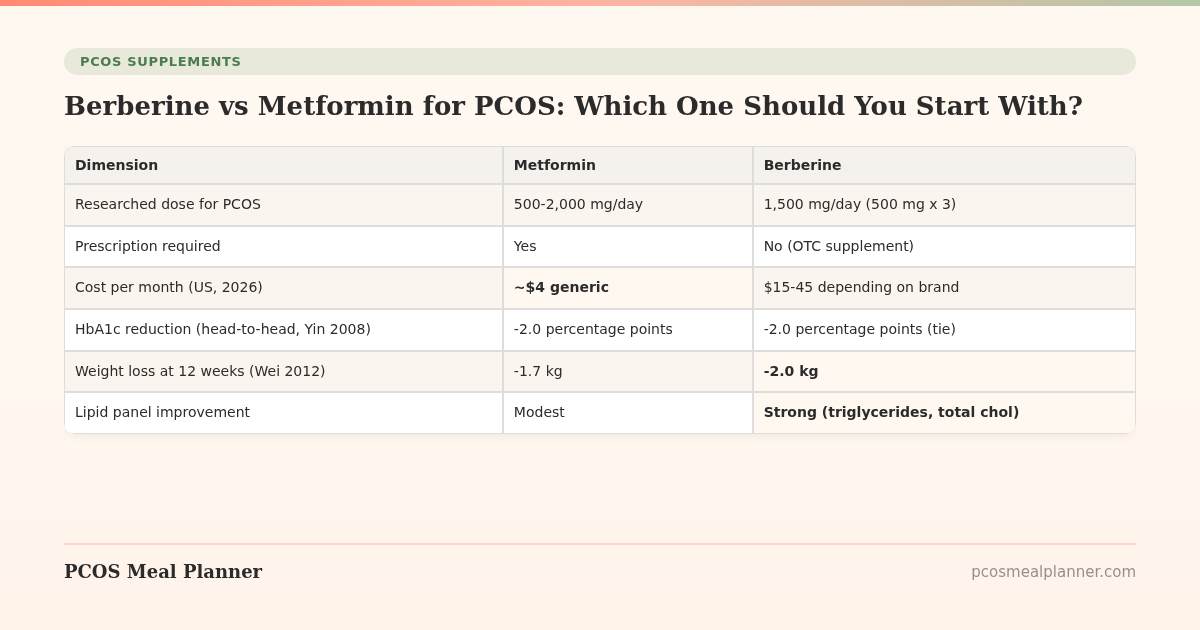
Community Comments
Add a comment