Last updated: July 27, 2026 · PMOS is the new name for PCOS as of 12 May 2026. Reviewed against current supplement research.
Quick answer
- Inositol is the broader first-line choice. It targets the core driver of PMOS (the new name for PCOS as of 12 May 2026), insulin resistance, and that ripples out to more regular cycles and ovulation. It has the largest randomized-trial evidence base of any PMOS supplement and is considered pregnancy-safe.
- CoQ10 is a strong metabolic and egg-quality add-on. A 2023 meta-analysis of 9 trials in 1,021 women found CoQ10 lowered insulin resistance (HOMA-IR down 0.67), raised FSH, lowered total testosterone, and improved cholesterol and triglycerides.
- They overlap on insulin but aim at different angles. Inositol leads on insulin signalling and cycles. CoQ10 leads on mitochondrial antioxidant support for egg quality, plus lipids and hormones.
- You can combine them. There is no known interaction and no large head-to-head trial, so the case for each rests on its own evidence. Many fertility clinics use both.
- Pick by goal. Cycles and insulin first, start with inositol. Egg quality or extra metabolic help, add CoQ10. Check with a doctor, especially in pregnancy or on blood thinners, since CoQ10 can interact with warfarin.
Supplements sit on top of the plate, not instead of it. Build an insulin-friendly PMOS meal plan.
What is inositol and how does it work for PCOS?
Inositol is a sugar alcohol that behaves like a B vitamin, sometimes called vitamin B8, though it is not a true vitamin. Your body makes it, and it also comes from foods like beans, citrus, and whole grains. The two forms that matter for PMOS are myo-inositol and D-chiro-inositol. They act as second messengers in the insulin signalling pathway, which is the exact piece that misfires in PMOS. When cells read insulin better, the ovaries make fewer androgens, and cycles tend to normalize.
The standard formulation combines the two forms in a 40 to 1 ratio of myo-inositol to D-chiro-inositol, which mirrors the ratio found in healthy plasma. A typical dose is 2 to 4 g of myo-inositol per day.
The evidence base is the broadest of any PMOS supplement. A randomized comparison in Gynecological Endocrinology found myo-inositol improved insulin sensitivity and normalized the menstrual cycle in about half of women with PMOS, with effects comparable to metformin but far fewer gut side effects. Because inositol is a naturally occurring compound and is used in pregnancy to help prevent gestational diabetes, it is generally regarded as pregnancy-safe. That combination of a core mechanism, a real cycle benefit, and a strong safety record is why inositol is often the first supplement doctors suggest.
What is CoQ10 and how does it work for PCOS?
CoQ10, coenzyme Q10, also called ubiquinone, is a fat-soluble compound your cells use to make energy inside mitochondria, and it doubles as an antioxidant. Levels fall with age and are often lower in women with insulin resistance. The rationale for supplementing is twofold: better mitochondrial function in insulin-sensitive tissues, and antioxidant protection in cells with high energy demand, including the developing egg.
The evidence firmed up in 2023. A systematic review and meta-analysis in Reproductive Sciences pooled 9 randomized trials covering 1,021 women with PMOS. CoQ10 improved insulin resistance (HOMA-IR down 0.67, fasting insulin down 1.75, fasting glucose down about 5.2 mg per dL), raised FSH, lowered total testosterone, and improved the lipid panel, with triglycerides, total cholesterol, and LDL down and HDL up. It was well tolerated, with no adverse effects reported in the trial that tracked them.
So CoQ10 is not only a fertility supplement. It moves metabolic and hormonal markers too. Its standout angle is egg quality, because eggs are among the most mitochondria-dense cells in the body.
CoQ10 vs inositol for PCOS: the side-by-side
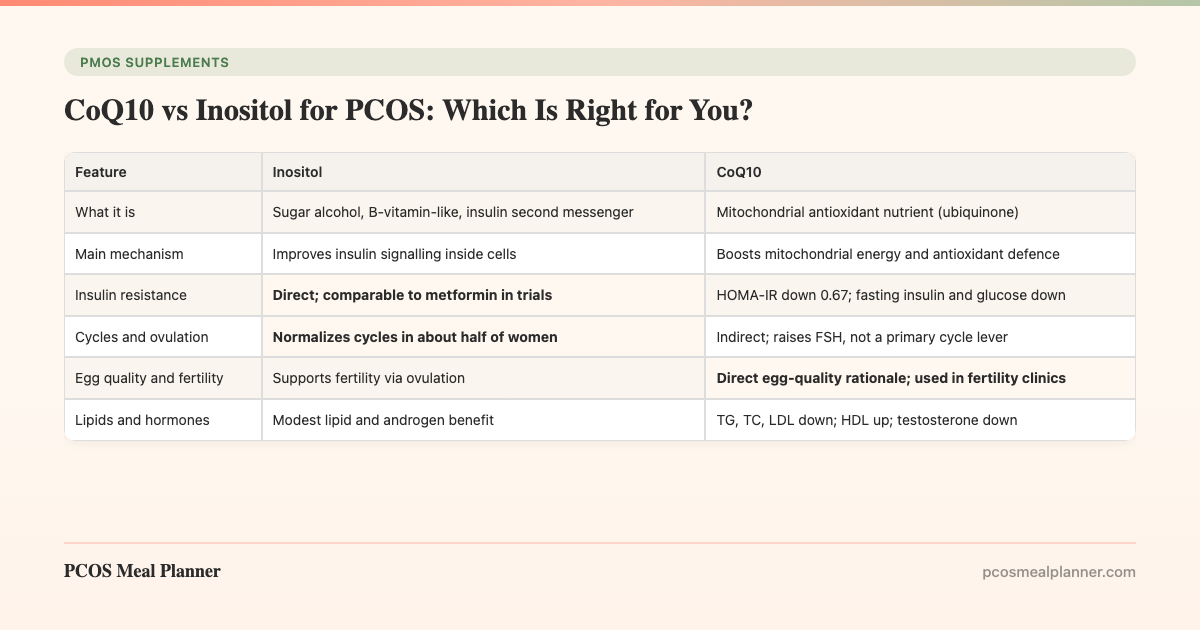
The table below sets the two supplements next to each other on the questions people actually ask. Read down the column that matches your main goal.
| Feature | Inositol | CoQ10 |
|---|---|---|
| What it is | Sugar alcohol, B-vitamin-like, insulin second messenger | Mitochondrial antioxidant nutrient (ubiquinone) |
| Main mechanism | Improves insulin signalling inside cells | Boosts mitochondrial energy and antioxidant defence |
| Insulin resistance | Direct; comparable to metformin in trials | HOMA-IR down 0.67; fasting insulin and glucose down |
| Cycles and ovulation | Normalizes cycles in about half of women | Indirect; raises FSH, not a primary cycle lever |
| Egg quality and fertility | Supports fertility via ovulation | Direct egg-quality rationale; used in fertility clinics |
| Lipids and hormones | Modest lipid and androgen benefit | TG, TC, LDL down; HDL up; testosterone down |
| Evidence strength | Broadest RCT base of any PMOS supplement | Solid: 9 RCTs, 1,021 women (2023 meta-analysis) |
| Pregnancy safety | Considered safe; used in pregnancy | Less pregnancy data; check with a doctor |
| Side effects and interactions | Mild; loose stools at high doses | Well tolerated; interacts with blood thinners (warfarin) |
| Typical dose | 2 to 4 g myo-inositol daily (40:1 with D-chiro) | 100 to 200 mg daily (often as ubiquinol) |
| Best for whom | Insulin, irregular cycles, first-line, trying to conceive | Egg quality, metabolic and lipid focus, add-on |
Which is better for insulin resistance?
Both help, and inositol is the more direct lever. Inositol works as a second messenger right inside the insulin pathway, so improving insulin sensitivity is its main job. In the Gynecological Endocrinology comparison, myo-inositol matched metformin on insulin sensitivity with far fewer gut side effects.
CoQ10 also improves insulin resistance, which surprises people who think of it as fertility-only. The 2023 meta-analysis found a HOMA-IR reduction of 0.67, a fasting insulin drop of 1.75, and a fasting glucose fall of about 5.2 mg per dL across 9 trials.
There is no head-to-head trial pitting CoQ10 against inositol for insulin resistance, so no study crowns a winner. On mechanism and evidence weight, inositol is the first-line insulin lever, and CoQ10 is a reasonable add-on when you want extra metabolic help. Insulin resistance drives most PMOS symptoms, so this is the lever most women should pull first. For how inositol stacks up against another popular insulin option, see our comparison of inositol vs berberine for PCOS.
Which is better for cycles and ovulation?
Inositol wins clearly here. Restoring regular cycles is one of its best-documented effects. In the randomized comparison, myo-inositol normalized the menstrual cycle in about half of women with PMOS. The mechanism is logical: lower insulin means lower ovarian androgen output, which lets ovulation resume.
CoQ10 is not a primary cycle treatment. The 2023 meta-analysis did show CoQ10 raised FSH, a hormone involved in follicle development, but that is an indirect signal, not evidence that CoQ10 regulates cycles on its own. If irregular or missing periods are your main concern, inositol is the better-supported choice. Our deeper guide on inositol for PMOS covers dose and timing in detail.
Which is better for egg quality and fertility?
CoQ10 has the stronger egg-quality rationale. Eggs are among the most mitochondria-rich cells in the body, and egg quality depends heavily on mitochondrial function. Because CoQ10 fuels mitochondria and buffers oxidative stress, it is widely used in fertility clinics to support egg quality, especially as women get older.
Inositol supports fertility mainly by fixing the upstream problem. It restores ovulation, so there is an egg to fertilize on a predictable schedule. Both angles matter for trying to conceive, which is why many fertility teams use inositol and CoQ10 together: inositol to get you ovulating, CoQ10 to support the quality of what you release.
Inositol is pregnancy-safe. CoQ10 has less pregnancy data, so time it with your fertility team's guidance. For the full CoQ10 picture, see our guide to CoQ10 for PCOS.
Can you take CoQ10 and inositol together?
Yes, and it is a common pairing. There is no known interaction between them, and they work through different mechanisms, so they stack rather than clash. Inositol handles insulin signalling and cycles. CoQ10 adds mitochondrial antioxidant support for egg quality, lipids, and hormones.
One honest caveat: there is no large trial testing this exact combination in PMOS, so the case for combining rests on their separate evidence, not on a study of the two together. That is a fair rationale, but it is worth stating plainly rather than implying a proven synergy.
Practical note: CoQ10 can interact with blood thinners like warfarin and may modestly lower blood pressure, so clear the combination with a doctor if you take medication.
Which one should you choose?
Match the supplement to your goal.
- Choose inositol first if your priorities are insulin resistance, irregular or missing cycles, or getting ovulation back. It is the broadest-evidence, pregnancy-safe, first-line option.
- Choose CoQ10, or add it, if your focus is egg quality for fertility, or you want extra help with lipids and metabolic markers on top of insulin.
- Use both if you are trying to conceive and want to cover ovulation and egg quality at once.
None of this replaces medical care. If you are pregnant, breastfeeding, on blood thinners, or managing another condition, run your plan past a doctor first. For a wider view of where these two sit among all the options, see our guide to the best supplements for PMOS in 2026.
Are CoQ10 and inositol safe?
Both are generally well tolerated, with a few things to know. Inositol at 2 to 4 g of myo-inositol daily rarely causes more than mild loose stools at the top of the dose range, and it is considered safe in pregnancy, where it is even used to help prevent gestational diabetes. CoQ10 was well tolerated across the trials in the 2023 meta-analysis, with no adverse effects reported where they were tracked. The two cautions worth repeating: CoQ10 can interact with blood thinners such as warfarin, and it may slightly lower blood pressure.
Neither supplement replaces prescribed treatment or a diagnosis. This article is educational, not medical advice. Check with a doctor before starting either one, especially during pregnancy or alongside medication.
Food first: the plate both supplements sit on
Supplements are the last 10 percent, not the first. Both inositol and CoQ10 work best on top of an eating pattern that already keeps insulin steady, because insulin resistance is the shared driver behind almost every PMOS symptom. An insulin-friendly, antioxidant-rich plate is the foundation, and the capsules are the fine-tuning.
That plate looks like protein-first meals, plenty of fibre, slow carbs instead of refined ones, and a Mediterranean fat profile of olive oil, nuts, and oily fish, which happen to be food sources of CoQ10. Beans, citrus, and whole grains supply inositol in food form. So the same plate that steadies insulin also delivers small amounts of both compounds naturally.
This is where a system beats a pile of pills. The PCOS Meal Planner builds that insulin-friendly, antioxidant-rich plate around your symptoms, so your supplements have a foundation to work on rather than doing the whole job alone. When you weigh up CoQ10 vs inositol for PCOS, remember the food carries most of the load. Build your PMOS meal plan now.
Often asked questions
What is the difference between CoQ10 and inositol for PCOS?
Inositol is a B-vitamin-like sugar alcohol that mainly improves insulin sensitivity, which restores cycles and ovulation in many women. It has the broadest trial base of any PMOS supplement and is pregnancy-safe. CoQ10 is a mitochondrial antioxidant nutrient that mainly improves metabolic markers and egg quality. They overlap on insulin but aim at different angles.
Should I take inositol or CoQ10 for PCOS?
For most women, inositol is the sensible first choice, because it targets insulin resistance and helps cycles and ovulation, with the largest evidence base and pregnancy safety. Choose CoQ10, or add it, if your focus is egg quality or extra metabolic help. Talk to a doctor first, especially in pregnancy or on medication.
Can you take CoQ10 and inositol together for PCOS?
Yes. There is no known interaction and they work through different mechanisms, so combining is reasonable and common in fertility settings. Inositol handles insulin and cycles, CoQ10 adds antioxidant support for egg quality and metabolic markers. No large trial tests the exact combination, so the case rests on their separate evidence. CoQ10 interacts with warfarin, so check first.
Is CoQ10 or inositol better for fertility and egg quality with PCOS?
CoQ10 has the more direct egg-quality rationale, since eggs are among the most mitochondria-rich cells and CoQ10 fuels mitochondria. It is widely used in fertility clinics, especially with age. Inositol supports fertility by restoring ovulation, normalizing cycles in about half of women. Many teams use both. Inositol is pregnancy-safe; time CoQ10 with your fertility team.
Is CoQ10 or inositol better for insulin resistance?
Both help, through different routes. Inositol acts inside the insulin pathway, so it improves sensitivity directly and rivalled metformin in a trial. CoQ10 helps too: the 2023 meta-analysis found HOMA-IR down 0.67, fasting insulin down 1.75, and fasting glucose down about 5.2 mg per dL across 9 trials. No head-to-head trial exists. Inositol is the usual first-line lever, CoQ10 a reasonable add-on.
Are CoQ10 and inositol safe to take with PCOS?
Both are generally well tolerated. Inositol at 2 to 4 g of myo-inositol daily has mild side effects at most, usually loose stools at high doses, and is considered safe in pregnancy. CoQ10 was well tolerated in trials, but it can interact with blood thinners like warfarin and may slightly lower blood pressure. Neither replaces prescribed care. Check with a doctor before starting.
Sources and further reading
CoQ10 in PCOS: meta-analysis
Inositol in PCOS: randomized comparison
PCOS / PMOS pathophysiology
Clinical guidelines and patient-facing summaries
- International Evidence-Based Guideline for PCOS (Monash, 2023)
- NHS: Polycystic ovary syndrome (PCOS)
- Mayo Clinic: PCOS
How this article was made
The CoQ10 effect sizes come from a 2023 systematic review and meta-analysis of coenzyme Q10 in PCOS (Zhang et al., Reproductive Sciences) covering 9 randomized trials and 1,021 women. The inositol figures, improved insulin sensitivity and normalization of cycles in about half of women, come from a randomized comparison of myo-inositol and metformin in Gynecological Endocrinology (2017). Mechanism draws on Diamanti-Kandarakis and Dunaif (Endocrine Reviews, 2012). Framing is aligned with the 2023 International Evidence-Based Guideline for PCOS and patient summaries from the NHS and Mayo Clinic.
No large trial has directly compared CoQ10 with inositol, or tested the two together, so each is compared on its own evidence. PMOS is the new name for PCOS as of 12 May 2026; the underlying biology is unchanged. This article is educational and not medical advice. Both supplements are generally well tolerated, but CoQ10 can interact with blood thinners, so check with a doctor before starting, especially in pregnancy or when taking other medication.
Community Comments
Add a comment