Last updated: July 19, 2026 · PMOS is the new name for PCOS as of 12 May 2026. Compared against current evidence on inositol and berberine, including a 2026 combination study.
Quick answer
- For most women with PCOS, inositol is the better first choice. It has the strongest research base, it improves insulin sensitivity, and it helps restore regular cycles and ovulation. It is also considered safe long-term and in pregnancy.
- Berberine is the trend, not the gold standard. Social media calls it "nature's Ozempic" because it lowers blood sugar and can support weight loss. It can help insulin resistance, but the PCOS evidence is weaker and shorter-term than inositol's.
- Berberine comes with real cautions. It is usually cycled with breaks, it can cause GI upset, it can lower blood sugar and interact with medications, and it should not be taken in pregnancy or breastfeeding.
- They may work better together than alone. A 2026 study in Cell Growth found inositol plus berberine outperformed either supplement on its own in a PCOS mouse model. That result is preclinical (animal only), so it is promising, not proven in humans yet.
- Neither replaces the food. Both supplements target insulin resistance, and so does an insulin-friendly PMOS plate. The plate is the foundation; supplements are the add-on. Talk to your doctor before starting either.
Supplements work best on top of an insulin-friendly plan. Build your PMOS meal plan first.
For most women, inositol is the better first choice: it has the strongest research, it improves insulin sensitivity, cycles and ovulation, and it is considered safe long-term and even in pregnancy. Berberine can help insulin resistance and weight, but the evidence is weaker and shorter-term, it is usually cycled, and it should not be used in pregnancy. A 2026 study suggests the two may be complementary. Here is the full comparison, goal by goal.
Inositol vs berberine for PCOS: the short answer
Inositol is the safer, better-evidenced starting point. Berberine is the stronger blood-sugar lever with more strings attached. If you want one line: start with inositol and food, and only consider adding berberine later, with a doctor, if insulin resistance or weight are still your main problem and you are not trying to conceive.
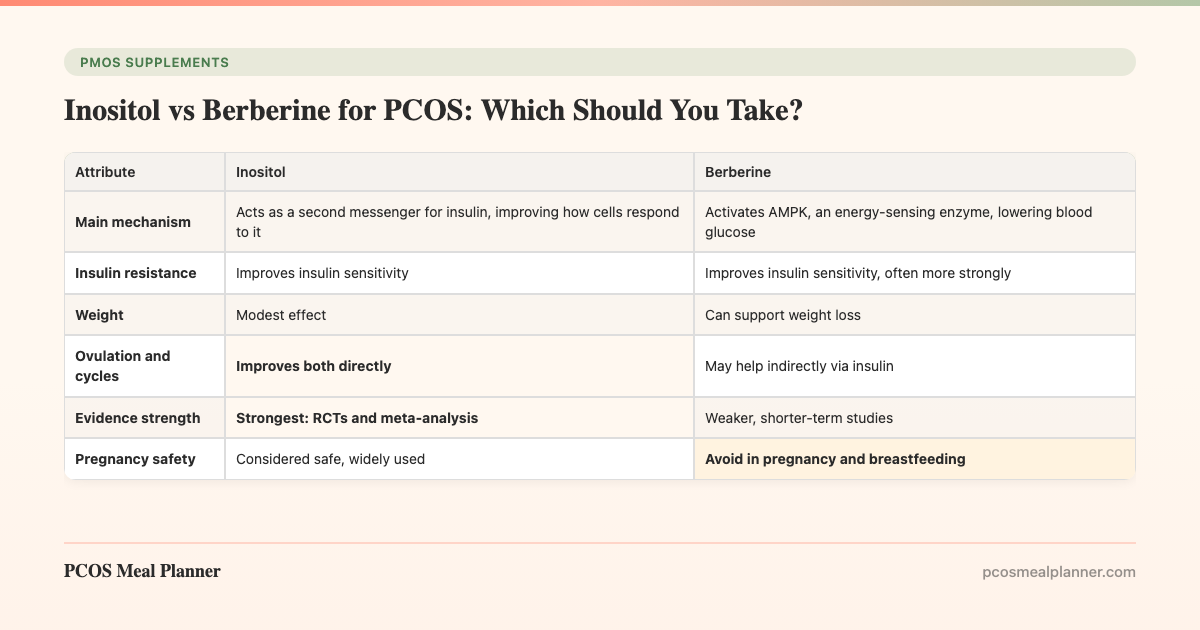
Both supplements target the same root problem in PCOS, which is insulin resistance. They just get there by different routes and carry different risks. The table below sets them side by side.
| Attribute | Inositol | Berberine |
|---|---|---|
| Main mechanism | Acts as a second messenger for insulin, improving how cells respond to it | Activates AMPK, an energy-sensing enzyme, lowering blood glucose |
| Insulin resistance | Improves insulin sensitivity | Improves insulin sensitivity, often more strongly |
| Weight | Modest effect | Can support weight loss |
| Ovulation and cycles | Improves both directly | May help indirectly via insulin |
| Evidence strength | Strongest: RCTs and meta-analysis | Weaker, shorter-term studies |
| Pregnancy safety | Considered safe, widely used | Avoid in pregnancy and breastfeeding |
| Side effects | Mild, mostly GI at high doses | GI upset common; can lower blood sugar; drug interactions |
| Cost and cycling | Low cost, take daily, no cycling | Low cost, but usually cycled with breaks |
What is inositol, and how does it work for PCOS?
Inositol is a B-vitamin-like compound that acts as a messenger inside cells for the hormone insulin. In PCOS, cells respond poorly to insulin, so the body pumps out more of it, and that excess insulin drives the ovaries to make more androgens. Inositol helps the insulin signal work properly again, which lowers that cascade at the source.
The two forms that matter are myo-inositol and D-chiro-inositol, usually combined in a 40 to 1 ratio that mirrors how the body naturally uses them. Better insulin signalling means lower androgens, which is why inositol tends to improve the whole PCOS picture: more regular cycles, more predictable ovulation, and often calmer skin over a few months.
The evidence is the reason inositol sits at the front of the queue. A meta-analysis of randomised controlled trials by Unfer and colleagues found myo-inositol improved both metabolic and reproductive measures in women with PCOS. Because insulin resistance is a core driver of PCOS, as Diamanti-Kandarakis and Dunaif set out in their landmark review, a supplement that improves insulin signalling acts on the root, not just the symptoms. Inositol is also well tolerated and is one of the few PCOS supplements considered safe to continue in pregnancy. For a deeper look, see our guide on inositol for PMOS.
What is berberine, and why is it called "nature's Ozempic"?
Berberine is a plant alkaloid found in shrubs like barberry, goldenseal and Oregon grape. It works mainly by activating AMPK, an enzyme that acts like a fuel gauge for the cell. Switching on AMPK tells the body to pull glucose out of the blood and use it, which is why berberine lowers blood sugar and can improve insulin resistance.
That blood-sugar effect, plus a modest impact on weight and cholesterol, is why social media started calling berberine "nature's Ozempic." The nickname is catchy but misleading. Ozempic is a prescription GLP-1 medicine with large, well-documented effects on appetite and weight. Berberine is a supplement with much smaller effects and a much thinner research base. It is not a natural version of a weight-loss drug, and it is not a substitute for one.
For PCOS specifically, berberine can help insulin resistance and may support weight loss, but the studies are smaller and shorter than the inositol research. That makes it a reasonable add-on for some people, not a proven first-line choice. We cover the detail, including how it stacks up against a prescription option, in berberine for PCOS and berberine vs metformin for PCOS.
Head-to-head: which wins for each PCOS goal?
There is no single winner, because the right answer depends on what you are trying to fix. Here is how they compare by goal.
- Insulin resistance: Both help. Berberine often has the more noticeable effect on fasting glucose, while inositol works on the insulin signalling pathway. If blood sugar is your primary lab problem, berberine is the stronger lever, with the cautions below.
- Cycles and ovulation: Inositol wins. Its effect on restoring regular cycles and ovulation is the best-evidenced benefit of any PCOS supplement. Berberine may help indirectly by improving insulin, but it is not primarily a cycle-and-ovulation supplement.
- Fertility and trying to conceive: Inositol wins clearly, and it is the only sensible choice here. It supports ovulation and is pregnancy-safe. Berberine is contraindicated when trying to conceive.
- Weight: Berberine edges ahead. Neither is powerful, but berberine has the more consistent signal for modest weight loss. The diet still does most of the work.
- Androgen symptoms (acne, unwanted hair): Inositol has the more direct route, because lowering insulin lowers the androgen drive. Both act slowly over months, not days.
Notice the pattern: inositol wins the reproductive and safety categories, berberine wins the raw blood-sugar-and-weight category. That is exactly why the next question comes up so often.
Can you take inositol and berberine together? The 2026 synergy study
The most interesting recent finding is that you may not have to choose. A 2026 study published in Cell Growth tested inositol combined with berberine against each one alone. In a PCOS mouse model, the combination outperformed either single supplement. It restored sex-steroid balance, normalised the LH to FSH ratio, improved estrous cyclicity, reduced ovarian cysts and enhanced fertility. At the cell level, it improved mitochondrial function in the ovary and reprogrammed the metabolism of granulosa cells, the cells that support a developing egg.
The mechanism makes sense. Inositol improves the insulin signal, and berberine activates AMPK, so the two hit insulin resistance from different angles. The authors concluded that the pair acts through coordinated endocrine, ovarian and metabolic effects, and they described it as a promising strategy.
Read this before you rush out to buy both. That 2026 study was preclinical, meaning it was done in mice, not people. Preclinical results are a reason for optimism and further trials, not proof that the same combination works or is safe in humans. Combining two supplements that both affect blood sugar also raises the chance of side effects and interactions. If you want to try both, do it with a doctor, not as a DIY stack.
Who should choose inositol, and who might add berberine?
Match the supplement to your situation. These are general patterns, not personal medical advice.
- Trying to conceive, pregnant, or breastfeeding: Inositol only. Berberine is off the table here.
- Main goal is regular cycles or ovulation: Inositol. This is its strongest, best-proven benefit.
- Main goal is insulin resistance or weight, and pregnancy is not a factor: Inositol remains a solid base, and berberine is a reasonable add-on to discuss with your doctor, ideally cycled.
- Already taking metformin or other medications: Talk to your doctor first. Berberine can add to blood-sugar lowering and interacts with many drugs. Inositol is generally the easier fit alongside medication, but still confirm it.
- You want the simplest, lowest-risk option: Inositol, taken daily, no cycling required.
How long does each take to work?
Neither supplement works overnight, and that is worth knowing before you judge it. Both act on insulin resistance and hormone balance, which shift over weeks and months, not days. If you start one and see nothing in the first fortnight, that is normal, not failure.
For inositol, most trials run for three to six months, and cycle regularity or ovulation tends to improve over that window rather than in the first few weeks. Give it a full three months at a consistent daily dose before deciding whether it helps you. Berberine shows changes in blood-sugar markers faster, often within a few weeks, but its cycled use means you are not taking it continuously, so the reproductive benefits are less predictable.
The practical rule: pick one, take it consistently alongside an insulin-friendly plate, and reassess at the three-month mark with your doctor. Chopping and changing every two weeks tells you nothing, because neither supplement has had time to act.
Safety, side effects, and cautions
This is where the two supplements differ most, and it is the part worth reading twice.
Inositol is well tolerated. The main side effect is mild digestive upset, and only at higher doses. It is considered safe for long-term daily use and is one of the few PCOS supplements generally regarded as safe in pregnancy. For most people it is a low-risk choice.
Berberine needs more care. It commonly causes GI upset, including cramping, constipation or diarrhoea, especially early on or at higher doses. It is usually cycled, meaning you take it for a stretch and then take a break, because long-term human safety data is limited. It can lower blood sugar, so combined with other glucose-lowering agents it raises the risk of going too low.
It also affects how the liver processes many medications, so it can change the levels of drugs you take. And it must not be used in pregnancy or breastfeeding. None of this makes berberine dangerous when used sensibly, but it does mean it belongs in a conversation with your doctor or pharmacist, not an impulse buy. This article is educational and is not a substitute for individual medical advice.
Supplements do not replace the PMOS plate
Here is the point both supplements share, and the one the "nature's Ozempic" hype tends to bury. Inositol and berberine both target insulin resistance. So does the food on your plate, and the food does far more of the work. A supplement can nudge your numbers. An insulin-friendly eating pattern moves them.
The pattern that helps PCOS is consistent: protein at every meal, plenty of fibre from vegetables and legumes, slow low-GI carbs instead of refined ones, and healthy fats. Eating protein and vegetables before the carb portion of a meal blunts the blood-sugar spike, which is the same target berberine chases with a capsule. Build that plate first, and a supplement becomes a small bonus rather than a crutch you lean on because the diet is not there yet.
This is the "system, not another plan" idea in practice. You do not need to choose the perfect pill. You need a repeatable, insulin-friendly way of eating, with any supplement sitting on top of it. If you are weighing inositol against other options, our comparison of inositol vs spearmint tea for PCOS is a useful next read.
How the PCOS Meal Planner fits in
Inositol vs berberine for PCOS is the wrong first question if the plate is not sorted yet. The higher-leverage move is the eating pattern, because it drives the insulin resistance that both supplements are trying to reach. The PCOS Meal Planner builds an insulin-friendly week around your symptoms, with the protein-first, higher-fibre structure that lowers post-meal glucose. Get that foundation in place, then layer a supplement on top with your doctor if you want to. Build your PMOS plan now and make any supplement the finishing touch, not the whole plan. And if you are new to the name change, here is the background on why PCOS is now called PMOS.
Often asked questions
Should I take inositol or berberine for PCOS?
For most women, inositol is the better first choice. It has the strongest evidence, improves insulin sensitivity, cycles and ovulation, and is considered safe long-term and in pregnancy. Berberine can help insulin and weight, but the evidence is weaker, it is cycled, and it is not for pregnancy. Start with inositol and food; consider berberine later, with a doctor.
Is berberine really "nature's Ozempic" and does it work for PCOS?
The nickname is overstated. Berberine lowers blood sugar and can support modest weight loss by activating AMPK, but Ozempic is a prescription GLP-1 drug with far larger effects. Berberine can improve insulin resistance in PCOS, but the trials are smaller and shorter than the inositol research, so treat it as a possible add-on, never as a replacement for a prescribed medicine.
Can you take inositol and berberine together for PCOS?
Possibly, under medical guidance. A 2026 Cell Growth study found inositol plus berberine outperformed either alone in a PCOS mouse model, improving cycles and reducing ovarian cysts. That result is preclinical, so it is promising, not proven in humans. Both affect blood sugar and berberine interacts with medications, so combine them with a doctor, not as a DIY stack.
Do you have to cycle berberine, and is it safe long-term?
Berberine is usually cycled: you take it for a period, then take a break, because long-term human safety data is limited. It can also cause GI side effects like cramping or diarrhoea. Inositol is different: it is well tolerated and considered safe for long-term daily use, including in pregnancy. If you want something you can simply take every day without cycling, inositol is the more straightforward option.
Can you take berberine while pregnant or trying to conceive?
No. Berberine should not be used in pregnancy or breastfeeding, and it is avoided when trying to conceive, because it can cross the placenta and there are safety concerns for the baby. Inositol is the opposite: it is considered safe in pregnancy and supports ovulation, so it is the sensible supplement to focus on for fertility. Always confirm any supplement plan with your doctor when trying to conceive.
Which is better for weight loss with PCOS, inositol or berberine?
Berberine tends to have the more noticeable effect on weight and blood sugar, which is where the nature's Ozempic label comes from. Inositol's strengths are insulin sensitivity, cycle regularity and ovulation, with a more modest weight effect. But neither produces large weight loss alone, and both are far weaker than an insulin-friendly, higher-protein, higher-fibre eating pattern. The plate does the heavy lifting.
Sources and further reading
Inositol and berberine combination
Inositol in PCOS
Insulin resistance and PCOS pathophysiology
Clinical guidelines and patient-facing summaries
- International Evidence-Based Guideline for PCOS (Monash)
- NHS: Polycystic ovary syndrome (PCOS)
- Mayo Clinic: PCOS
How this article was made
The head-to-head is framed on well-established directional differences: inositol has the strongest evidence base, improves insulin sensitivity, cycles and ovulation, and is pregnancy-safe; berberine can help insulin resistance and weight but rests on weaker, shorter-term evidence, is cycled, and is not for pregnancy. The inositol evidence draws on the Unfer et al. meta-analysis of randomised controlled trials, and the insulin-resistance framing on Diamanti-Kandarakis and Dunaif 2012. The combination findings come from Ge et al. 2026 in Cell Growth, which was a preclinical mouse study, not a human trial.
Aligned with the International Evidence-Based Guideline for PCOS, the NHS and Mayo Clinic patient summaries. PMOS is the new name for PCOS as of 12 May 2026; the underlying biology is unchanged. This article is educational and is not medical advice. Inositol is considered safe long-term and in pregnancy, while berberine should be avoided in pregnancy and breastfeeding, is usually cycled, can lower blood sugar, and can interact with medications, so talk to your doctor or pharmacist before starting either.
Community Comments
Add a comment