Last updated: July 19, 2026 · PMOS is the new name for PCOS as of 12 May 2026. Reviewed against current clinical guidance; benefits framed as traditional and unproven where human evidence is absent.
Quick answer
- Shatavari for PCOS is popular but essentially unproven. There are no robust human randomized trials showing shatavari (Asparagus racemosus) treats PCOS, balances hormones, or restores ovulation.
- What actually backs it is traditional use plus preclinical signals. Shatavari is a long-used Ayurvedic reproductive tonic, and animal and laboratory studies suggest antioxidant and hormone-like activity. Neither confirms a benefit in women with PCOS.
- The marketing is well ahead of the science. "Hormone-balancing" is a claim, not a showed result. Treat any promise that it fixes PCOS symptoms with caution.
- Better-studied options exist. If you want a supplement with real human trial evidence, inositol and NAC are far more studied for insulin resistance and ovulation in PCOS. Start there.
- Food comes first. No herb outperforms an insulin-friendly plate. Build that first, then layer in an evidence-backed supplement if you want one.
Want to start with the thing that actually moves PCOS, your plate? Build an insulin-friendly plan.
What is shatavari?
Shatavari is the root of Asparagus racemosus, a climbing plant in the same family as the asparagus you eat. It has been used for centuries in Ayurvedic medicine, where it is classed as a female reproductive tonic and a rasayana, meaning a rejuvenating or restorative herb. Its most consistent traditional role is as a galactagogue, a herb given to support breast-milk production after birth.
Chemically, shatavari root contains steroidal saponins called shatavarins, along with flavonoids and other plant compounds. The word "steroidal" here refers to the chemical shape of these saponins, not to anabolic steroids or to your own hormones. That chemistry is part of why shatavari gets marketed as hormone-related, but a compound having a steroid-like ring in a test tube is a long way from changing hormones in a woman with PCOS.
Why is shatavari trending for PCOS?
Shatavari is trending for PCOS because three forces line up. It has a genuine, long history as a female reproductive tonic. It contains plant compounds that show hormone-like or antioxidant activity in laboratory settings. And "hormone balance" is one of the most reliable phrases in the entire supplement market for driving sales.
Add the recent wave of interest in Ayurvedic and adaptogenic herbs, an adaptogen being a plant proposed to help the body cope with stress, and you get a herb with strong story appeal. PCOS is frustrating, often poorly managed, and full of women looking for something that helps. A natural "hormone-balancing" root is an easy sell. Popularity, though, is not evidence. The interest is real; the proof is not.
Does shatavari help PCOS? What the human evidence actually shows
Here is the straight answer: no robust human trials support shatavari for PCOS. There are no well-designed randomized controlled trials, the kind that can actually show cause and effect, testing Asparagus racemosus against placebo for PCOS symptoms, insulin resistance, ovulation, or androgen levels in women.
That absence matters. In evidence-based medicine, "we have used it for a long time" and "it did something in a rat or a petri dish" sit near the bottom of the evidence ladder. Human randomized trials sit near the top. Shatavari for PCOS currently lives at the bottom. It has not been shown to fail, but it has not been shown to work either, and for a paid supplement making hormone claims, unproven is the honest label.
Be especially wary of any product page or influencer post that states shatavari "balances hormones," "lowers testosterone," or "restores your cycle" in PCOS. Those are specific clinical claims. None of them is backed by a robust human PCOS trial.
Evidence strength: shatavari vs inositol and NAC
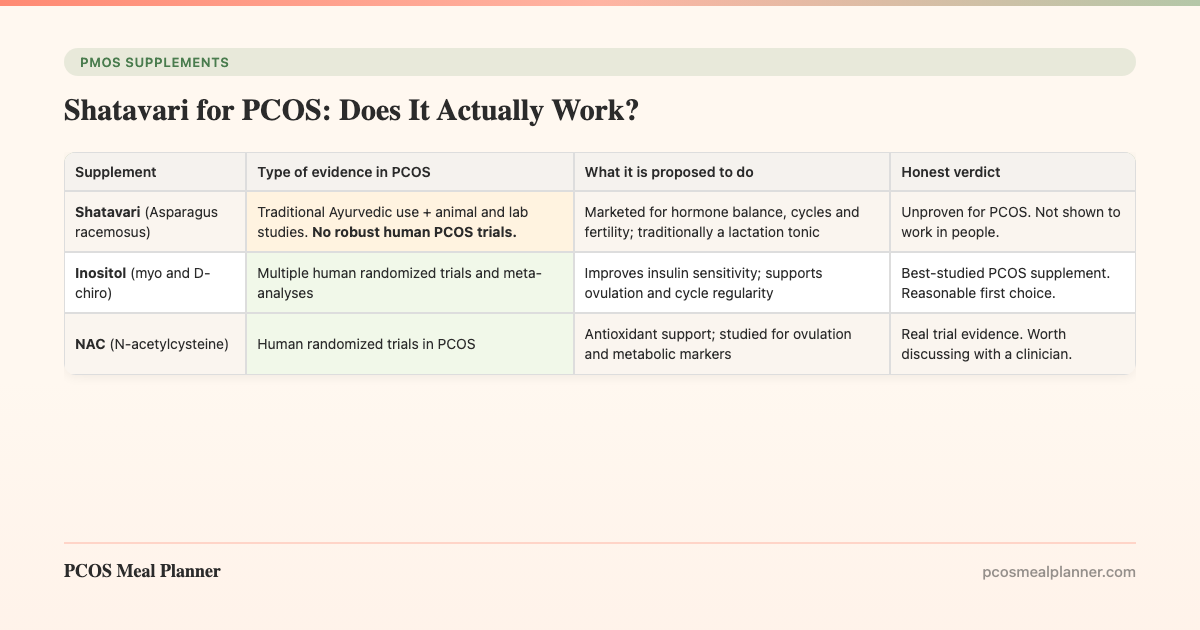
The clearest way to see the gap is to line shatavari up against two supplements that do have human PCOS trials behind them. Inositol, a vitamin-like compound that improves how cells respond to insulin, is the most studied supplement in PCOS. NAC, or N-acetylcysteine, is an antioxidant precursor with randomized trial evidence for ovulation and some metabolic markers.
| Supplement | Type of evidence in PCOS | What it is proposed to do | Honest verdict |
|---|---|---|---|
| Shatavari (Asparagus racemosus) | Traditional Ayurvedic use + animal and lab studies. No robust human PCOS trials. | Marketed for hormone balance, cycles and fertility; traditionally a lactation tonic | Unproven for PCOS. Not shown to work in people. |
| Inositol (myo and D-chiro) | Multiple human randomized trials and meta-analyses | Improves insulin sensitivity; supports ovulation and cycle regularity | Best-studied PCOS supplement. Reasonable first choice. |
| NAC (N-acetylcysteine) | Human randomized trials in PCOS | Antioxidant support; studied for ovulation and metabolic markers | Real trial evidence. Worth discussing with a doctor. |
The point is not that shatavari is harmful or fake. The point is that if you are spending money and hope on a PCOS supplement, the ones with human trials should come first. For the full breakdown of the evidence-graded options, see our guide to the best supplements for PMOS, ranked by clinical evidence, and the head-to-head on inositol versus berberine for PCOS.
What the traditional and preclinical evidence does and does not tell you
Traditional and preclinical evidence is not worthless. It is where good research questions come from. But it has clear limits, and knowing them protects you from marketing.
Traditional use tells you a plant has been used, often for a very long time, and usually without obvious harm at typical doses. It does not tell you the herb causes the outcome people hoped for. Ayurvedic tradition uses shatavari mainly as a lactation and reproductive tonic, not as a treatment for a modern, lab-defined syndrome like PCOS.
Preclinical evidence means animal and laboratory studies. These can show a compound has antioxidant activity or affects hormone-related pathways in cells or rodents. That is useful for understanding mechanism, but effects in a mouse or a dish routinely fail to show up in human trials. Dose, absorption, and human biology all differ. A phytoestrogen-like signal in a lab is a hypothesis, not a result you can promise a woman with PCOS.
So when a label leans on "traditionally used to balance female hormones" or "studies show antioxidant effects," read it precisely. Those statements can be technically true while telling you nothing about whether shatavari improves PCOS.
The claims versus the reality
It helps to separate the specific marketing claims from what the evidence supports.
- Claim: shatavari balances hormones. Reality: "hormone balance" is not a measured outcome, and no robust human PCOS trial shows shatavari changes testosterone, LH, or insulin.
- Claim: shatavari regulates your cycle. Reality: cycle regularity in PCOS is driven mostly by insulin and androgen levels. There is no human trial showing shatavari restores ovulation in PCOS.
- Claim: shatavari boosts fertility. Reality: it is a traditional reproductive tonic, but no reliable human data show it improves PCOS fertility. Do not delay proven fertility care for it.
- Claim: it is natural, so it is safe and worth trying. Reality: natural does not mean risk-free or effective, and unproven means you may be paying for hope.
If shatavari genuinely did any of these things at the level claimed, it would be straightforward to prove in a trial. The honest position is that this proof does not exist yet.
Is shatavari safe?
Safety notes worth reading before you buy.
- Asparagus family. Shatavari is Asparagus racemosus. If you are allergic to asparagus, avoid it.
- Pregnancy and breastfeeding. Safety data are limited. It has traditionally been used to support lactation, but you should discuss it with a doctor before using it while pregnant or breastfeeding rather than assuming tradition equals safety.
- Medication interactions. It may interact with medicines, including diuretics (it has a traditional diuretic reputation), and with blood-sugar or lithium medications. Check with your doctor or pharmacist if you take anything regularly.
- Quality and purity vary. Herbal supplements are lightly regulated. Actual dose, root quality, and contamination risk differ widely between brands. If you do try it, choose a brand with third-party testing.
None of this means shatavari is dangerous for most people. It means "generally well tolerated in tradition" is not the same as "proven safe in rigorous trials," and a few groups should be careful. When evidence is thin, the safety conversation matters more, not less.
Why food-first and evidence-backed supplements come first
The strongest lever in PCOS is not a herb. It is the pattern of insulin resistance that drives most PCOS symptoms. Insulin resistance means your cells respond poorly to insulin, so your body makes more of it, and that excess insulin pushes the ovaries to make more androgens. Diamanti-Kandarakis and Dunaif set this mechanism out clearly in their 2012 review, and it is why food is the foundation of every credible PCOS plan.
An insulin-friendly plate, protein first, plenty of fibre, a Mediterranean fat profile, and fewer refined-carb spikes, works on that upstream driver directly. No supplement, evidence-backed or not, outperforms getting the plate right. Supplements are a layer on top, not a replacement.
Once the food is in place, adding a supplement that actually has human trials behind it is a rational next step. Adding an unproven herb because it trended is not. The order matters: food first, then evidence-backed support, then, only if you want to and a doctor agrees, experimental extras.
What to prioritise instead of shatavari
If your goal is real change in PCOS symptoms, here is the practical order of operations.
- Get the plate right. Insulin-friendly, protein-forward meals are the highest-leverage change and cost nothing extra. This is the foundation everything else sits on.
- Consider inositol. It is the most studied PCOS supplement, with human trials for insulin sensitivity and ovulation. Start here if you want a supplement.
- Discuss NAC with a doctor. It has randomized trial evidence for ovulation and metabolic markers and is generally well tolerated.
- Match supplements to your symptoms. There is no universal PCOS stack. Read the evidence-graded supplement guide to match choices to your phenotype.
- Treat shatavari as optional and experimental. If you still want to try it, do it with eyes open, after the steps above, not instead of them, and after checking the safety notes with a doctor.
How the PCOS Meal Planner helps
This is where a system beats chasing trending herbs. The PCOS Meal Planner builds insulin-friendly meals around the exact upstream pattern that actually drives PCOS symptoms, so you spend your energy on the change with the strongest evidence: what is on your plate. You get real recipes, the right protein-to-carb ratio, and a plan you can actually follow, instead of a cupboard of hopeful supplements. Build the food foundation first, then layer in an evidence-backed supplement if you choose. Build your food-first PCOS plan now.
Often asked questions
Does shatavari help PCOS?
There is no robust human evidence that shatavari helps PCOS (now also called PMOS). No well-designed randomized trials have tested it for PCOS symptoms, insulin resistance, or ovulation. Support is traditional use plus animal and lab studies, which cannot confirm a benefit in people. It is not proven to balance hormones or treat PCOS.
What is shatavari and what is it traditionally used for?
Shatavari is the root of Asparagus racemosus, a climbing plant in the asparagus family used for centuries in Ayurveda as a female reproductive tonic. Its most consistent traditional use is as a galactagogue, a herb to support breast-milk production. It contains steroidal saponins called shatavarins, which is part of why it is marketed as hormone-related.
Why is shatavari marketed for PCOS and hormone balance?
Because it has a long history as a female reproductive tonic, it contains plant compounds with hormone-like activity in the lab, and hormone balance is a phrase that sells supplements. Rising interest in Ayurvedic and adaptogenic herbs pushed it into the PCOS market. None of that is the same as proof of benefit.
Is shatavari safe to take?
It is generally considered well tolerated in traditional use, but rigorous human safety data are limited. Avoid it if you are allergic to asparagus. Discuss it with a doctor before use in pregnancy or breastfeeding. It may interact with diuretics and blood-sugar or lithium medicines, and herbal quality and purity vary between brands.
Is shatavari better than inositol or NAC for PCOS?
No. Inositol and NAC both have real human randomized trials in PCOS; shatavari has none of that quality. Inositol is the most studied supplement for PCOS insulin resistance and ovulation, and NAC has trial evidence too. The better-studied options come first. Shatavari is not a proven substitute for either.
Can shatavari help with PCOS fertility?
There is no reliable human evidence that shatavari improves fertility in PCOS. It is a traditional reproductive tonic, and some animal studies report reproductive effects, but that does not translate to proven benefit in women with PCOS. Do not delay evidence-based fertility care to trial an unproven herb.
Sources and further reading
PCOS pathophysiology and the insulin-resistance mechanism
Clinical guidelines and patient-facing summaries
- International Evidence-Based Guideline for PCOS (Monash, 2023)
- NHS: Polycystic ovary syndrome (PCOS)
- Mayo Clinic: PCOS
Note on shatavari sources: we have deliberately not cited a human PCOS efficacy trial for shatavari, because at the time of writing no robust randomized controlled trial of Asparagus racemosus for PCOS exists. Claims about shatavari for PCOS rest on traditional Ayurvedic use and preclinical animal or laboratory studies, which we describe as unproven rather than dressing them up as clinical evidence.
How this article was made
This article deliberately takes the honest position that no robust human randomized trials of shatavari (Asparagus racemosus) for PCOS exist. We describe its support as traditional Ayurvedic use plus preclinical animal and laboratory studies, and we do not present those as clinical proof. The insulin-resistance mechanism that makes food-first care the priority draws on Diamanti-Kandarakis and Dunaif 2012. Care priorities are aligned with the 2023 International Evidence-Based Guideline for PCOS and patient-facing summaries from the NHS and Mayo Clinic.
Comparisons with inositol and NAC reflect that both have human randomized trials in PCOS while shatavari does not. PMOS is the new name for PCOS as of 12 May 2026; the underlying biology is unchanged. This article is educational and is not medical advice; talk to your doctor or pharmacist before starting or stopping any supplement.
Community Comments
Add a comment