Last updated: July 27, 2026 · PMOS is the new name for PCOS as of 12 May 2026. Compared against current meta-analytic evidence for both supplements.
Quick answer
- Inositol is usually the first-line choice. It has the strongest, broadest, pregnancy-safe evidence of any PMOS (the new name for PCOS) supplement, improves insulin sensitivity, and restores ovulation in roughly 50 to 70 percent of women who are not ovulating.
- NAC is a well-tolerated antioxidant add-on. N-acetylcysteine lowers oxidative stress and also improves insulin sensitivity. The evidence is promising but smaller and more mixed than inositol.
- For insulin resistance, both help; inositol has the larger evidence base. Both work on the same upstream driver of PMOS, so either is a reasonable metabolic support.
- For fertility markers, NAC looks promising. A 2025 meta-analysis of 22 trials (2,515 women) found NAC raised progesterone (SMD 0.95) and endometrial thickness (SMD 0.58), in some outcomes comparable to metformin.
- You can take both, and there is no head-to-head trial. They use different mechanisms, so they combine well. Food comes first either way.
Supplements work best on top of the right plate. Build an insulin-friendly PMOS meal plan to give either one something to build on.
What is inositol and how does it work for PCOS?
Inositol is a sugar-like compound your body makes and gets from food, and it acts as a second messenger inside the insulin signalling pathway. The form used for PMOS is mostly myo-inositol, usually combined with a small amount of D-chiro-inositol at a 40 to 1 ratio, which mirrors the ratio found in healthy ovaries. By helping insulin work better, inositol lowers the high insulin that drives androgen excess in PMOS.
The clinical picture is consistent. Fruzzetti and colleagues, in a 2017 randomised trial, compared myo-inositol directly with metformin and found that myo-inositol improved insulin sensitivity, normalised the menstrual cycle in about half of women after six months, and produced results comparable to metformin, with far fewer side effects. Across the wider literature, inositol restores ovulation in roughly 50 to 70 percent of women who are not ovulating and can improve egg quality. It is considered safe to continue in pregnancy, which is one reason it is often first-line.
The dose most trials use is 4 grams of myo-inositol a day, usually split into 2 grams in the morning and 2 grams in the evening, often paired with 100 milligrams of D-chiro-inositol to hold the 40 to 1 ratio. It is not an instant fix. Most women need eight to twelve weeks of daily use before cycle changes show up, and it works best taken consistently rather than only in the second half of the cycle. Our deeper explainer covers doses and timing in the full guide to inositol for PMOS.
What is NAC and how does it work for PCOS?
NAC stands for N-acetylcysteine, a derivative of the amino acid cysteine and a precursor to glutathione, the body's main internal antioxidant. It works on PMOS through two levers. First, it lowers oxidative stress, which runs high in many women with PMOS. Second, it improves insulin sensitivity, and in some studies its metabolic effects looked similar to metformin.
The most complete recent evidence comes from Vina and colleagues, whose 2025 meta-analysis pooled 22 studies covering 2,515 women with PCOS. NAC significantly raised progesterone, with a standardised mean difference of 0.95, and increased endometrial thickness, with a standardised mean difference of 0.58. It also raised luteinising hormone compared with metformin, with a standardised mean difference of 0.67. It did not significantly change estradiol, sex-hormone-binding globulin, or follicle-stimulating hormone. These are useful reproductive signals, but the evidence base is smaller and more mixed than inositol's.
The doses used in PCOS trials usually fall between 1.2 and 1.8 grams a day, commonly given as 600 milligrams two or three times daily with food, which reduces the stomach upset some people notice. Like inositol, NAC is not a quick fix, and most studies ran for eight to sixteen weeks. Because it is water-soluble and cleared quickly, splitting the dose through the day keeps levels steadier than a single large dose. For the full write-up see our guide to NAC for PCOS.
NAC vs inositol: side-by-side comparison
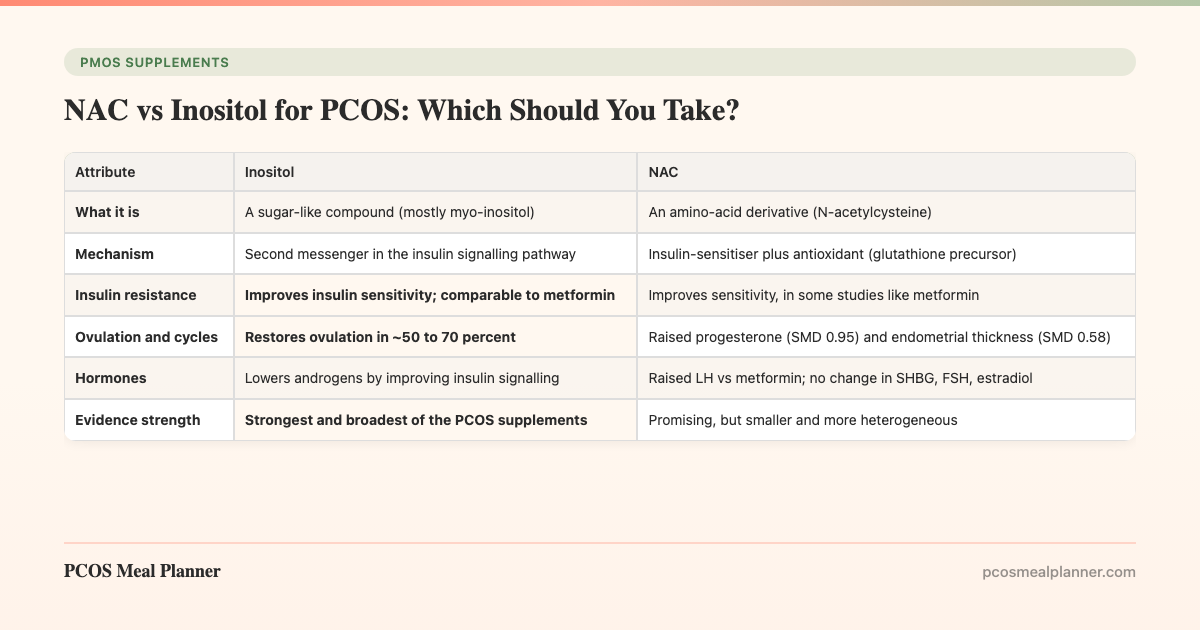
Here is how the two supplements line up across the attributes that matter most when you are choosing. Remember there is no trial that pits them directly against each other, so each column reflects the evidence for that supplement on its own.
| Attribute | Inositol | NAC |
|---|---|---|
| What it is | A sugar-like compound (mostly myo-inositol) | An amino-acid derivative (N-acetylcysteine) |
| Mechanism | Second messenger in the insulin signalling pathway | Insulin-sensitiser plus antioxidant (glutathione precursor) |
| Insulin resistance | Improves insulin sensitivity; comparable to metformin | Improves sensitivity, in some studies like metformin |
| Ovulation and cycles | Restores ovulation in ~50 to 70 percent | Raised progesterone (SMD 0.95) and endometrial thickness (SMD 0.58) |
| Hormones | Lowers androgens by improving insulin signalling | Raised LH vs metformin; no change in SHBG, FSH, estradiol |
| Evidence strength | Strongest and broadest of the PCOS supplements | Promising, but smaller and more heterogeneous |
| Pregnancy safety | Considered safe, often used in pregnancy | Discuss with a doctor first |
| Side effects | Mild, mostly digestive at high doses | Generally well tolerated, occasional nausea |
| Typical cost | Low | Low |
| Best for whom | First-line, insulin resistance, cycle regularity | Add-on, antioxidant support, some fertility markers |
Which is better for insulin resistance?
Both help, and inositol has the larger evidence base. Insulin resistance is the upstream driver of most PMOS symptoms, the mechanism laid out by Diamanti-Kandarakis and Dunaif in their landmark 2012 review. High insulin pushes the ovaries to make more androgens, which is what produces the acne, unwanted hair, and irregular cycles. Anything that lowers insulin tends to ease those symptoms downstream.
Inositol acts directly inside the insulin signalling pathway, and its metabolic effects have been measured in many trials, including the head-to-head comparison with metformin that Fruzzetti reported. NAC improves insulin sensitivity too, partly by lowering the oxidative stress that interferes with insulin signalling, and some studies found its metabolic effects comparable to metformin. If insulin resistance is your single biggest concern, inositol is the more established first choice, with NAC a sensible add-on when you also want antioxidant support. Both sit inside the wider picture in our round-up of the best supplements for PMOS in 2026.
Which is better for ovulation, cycles and fertility?
Inositol has the broader fertility evidence. Myo-inositol restores ovulation in roughly 50 to 70 percent of women who are not ovulating, normalised the menstrual cycle in about half of women within six months in Fruzzetti's trial, and can improve egg quality. Because it is considered safe in pregnancy, it is the supplement most often continued by women who are trying to conceive.
NAC has promising fertility markers of its own. The 2025 meta-analysis found it raised progesterone and endometrial thickness, both of which support the luteal phase and implantation. It also raised luteinising hormone compared with metformin, which is worth noting because LH is often already high in PMOS, so that particular change is not automatically a benefit. There is no direct head-to-head trial for fertility outcomes, so inositol remains the usual first-line option, with NAC most often discussed as a complement around ovulation support.
Which has the stronger evidence base?
Inositol, clearly. It has the strongest and broadest evidence of any PMOS supplement, spanning many randomised trials, several meta-analyses, and a mention in international guidance. That depth is why doctors reach for it first. Its effects on insulin, cycles, and ovulation have been reproduced across different populations and doses.
NAC's evidence is growing and now genuinely substantial, with the 2025 meta-analysis pooling 22 trials. But the studies vary widely in dose, duration, and what they compared NAC against, which makes the overall picture more heterogeneous and harder to generalise. It is a promising supplement with real signals, not a settled first-line therapy. If you are also weighing other options, our comparison of inositol versus berberine for PCOS covers the other supplement most people ask about.
Can you take NAC and inositol together?
Yes, and it is a common pairing. The two work through different mechanisms, so they do not overlap or cancel out. Inositol works inside the insulin signalling pathway, while NAC works as an antioxidant and a glutathione precursor. There is no known dangerous interaction between them.
A reasonable approach is to use inositol as the base, since it has the deeper evidence, and add NAC on top if you want extra antioxidant support or you are targeting luteal-phase markers. Start one supplement at a time, give it several weeks, and note what changes before adding the second. That way you can tell which one is doing what.
A practical stack looks like 4 grams of myo-inositol split morning and evening, with 600 milligrams of NAC once or twice a day added after four to six weeks if you want the antioxidant layer. Take them with meals to blunt any nausea. There is no need to megadose either one, and more is not better past the amounts used in trials. Always check with your doctor before stacking supplements, especially if you take other medications or you are pregnant or planning pregnancy.
Who should choose which?
The right pick depends on your main goal. Here is a simple way to decide.
- Just starting out, with irregular cycles or insulin resistance: inositol first. It is the most evidence-backed starting point.
- Trying to conceive: inositol first-line because it is pregnancy-safe and fertility-tested, then discuss NAC with your doctor as a possible add-on.
- Focused on antioxidant support or high oxidative stress: NAC is the more targeted choice here.
- Already on metformin: either can complement it, since both improve insulin sensitivity by different routes. Ask your doctor which fits your plan.
- Pregnant or planning pregnancy soon: inositol is the better-established safe option; discuss NAC before using it.
Are NAC and inositol safe? Side effects and pregnancy
Both are generally well tolerated, which is one of their main advantages over stronger interventions. Inositol's side effects are mild and mostly digestive, such as nausea or gas, and tend to appear only at high doses above roughly 12 grams a day. It is considered safe to continue in pregnancy, which sets it apart from most other supplements.
NAC is also generally well tolerated, with occasional nausea or stomach upset and a mild sulphur smell being the most common complaints. The pregnancy safety data are thinner than for inositol, so it should be discussed with a doctor before you try to conceive or during pregnancy. NAC can also interact with a few medications, so a quick check with your doctor or pharmacist is worth it. Neither supplement replaces medical care. This article is educational and not medical advice, and the underlying biology is unchanged by the renaming covered in our explainer on why PCOS is now called PMOS.
Food first: supplements sit on top of an insulin-friendly PMOS plate
Neither supplement is a substitute for the plate. The upstream driver both target is insulin resistance, and the way you eat moves it more than any capsule can. A moderate-carb, higher-protein, higher-fibre pattern with a Mediterranean fat profile and protein-first meals does the heavy lifting, and the supplement fine-tunes on top of that.
In practice that means a plate built around protein and vegetables with the starch kept moderate and unrefined. A breakfast of Greek yogurt with berries and chia does more for your morning insulin than a capsule taken alongside a bowl of sugary cereal. Eating protein and vegetables before the carb part of a meal lowers the after-meal glucose rise, which is exactly the load your supplement is trying to help with. Get the plate right first, and inositol or NAC has something real to build on.
This is where the PCOS Meal Planner earns its place. It builds insulin-friendly meals around your specific PMOS pattern, so whichever supplement you choose has an insulin-lowering foundation to work with. That is the real answer to NAC vs inositol for PCOS: pick the supplement that fits your goal, but build it on an insulin-friendly plate first. Build your plan now.
Often asked questions
Should I take NAC or inositol for PCOS?
For most people with PMOS (the new name for PCOS since 12 May 2026), inositol is the better first choice. It has the strongest, broadest, pregnancy-safe evidence, improves insulin sensitivity, and restores ovulation in roughly 50 to 70 percent of women who are not ovulating. NAC is a well-tolerated antioxidant add-on with promising but smaller evidence. There is no head-to-head trial, so the choice comes down to your main goal.
Can you take NAC and inositol together for PCOS?
Yes. They work through different mechanisms, so they combine well. Inositol acts inside the insulin signalling pathway, while NAC works as an antioxidant and a glutathione precursor. There is no known dangerous interaction. Use inositol as the base and add NAC on top, one at a time, and check with your doctor first if you take other medications or are pregnant.
Which is better for insulin resistance, NAC or inositol?
Both improve insulin sensitivity, which is the upstream driver of most PMOS symptoms. Inositol has more and larger trials and acts directly in the insulin signalling pathway. NAC improves sensitivity partly by lowering oxidative stress, and in some studies its metabolic effects were comparable to metformin. If insulin resistance is your main target, inositol is the more established first choice.
Is inositol or NAC better for fertility and ovulation with PCOS?
Inositol has the broader fertility evidence. It restores ovulation in roughly 50 to 70 percent of women who are not ovulating and can improve egg quality, and it is pregnancy-safe. NAC shows promising markers: a 2025 meta-analysis of 22 studies found it raised progesterone and endometrial thickness. There is no direct head-to-head trial, so inositol is usually first-line with NAC as a complement.
Is NAC or inositol safe in pregnancy?
Inositol is the better-established option in pregnancy and is often continued through it, though you should still confirm with your doctor. NAC is generally well tolerated, but the pregnancy safety data are thinner, so discuss it with your doctor before trying to conceive or during pregnancy. Both are educational supplements, not a replacement for medical care.
Do NAC and inositol have side effects?
Both are generally well tolerated. Inositol can cause mild digestive upset such as nausea or gas at high doses, usually above about 12 grams a day. NAC can occasionally cause nausea or stomach upset and has a mild sulphur smell. Neither has serious side effects at typical doses, but NAC can interact with some medications, so check with your doctor.
Sources and further reading
Inositol evidence
NAC evidence
PCOS / PMOS mechanism
Clinical guidelines and patient-facing summaries
- International Evidence-Based Guideline for PCOS (Monash, 2023)
- NHS: Polycystic ovary syndrome (PCOS)
- Mayo Clinic: PCOS
How this article was made
The inositol findings draw on Fruzzetti et al. 2017, a randomised trial comparing metformin and myo-inositol that reported improved insulin sensitivity and menstrual-cycle normalisation with myo-inositol comparable to metformin, with fewer side effects. The NAC findings draw on the Vina et al.
2025 meta-analysis of 22 studies (2,515 women), which reported raised progesterone (SMD 0.95), endometrial thickness (SMD 0.58), and LH versus metformin (SMD 0.67), with no significant change in estradiol, SHBG, or FSH. Shared mechanism draws on Diamanti-Kandarakis and Dunaif 2012. There is no large trial comparing NAC and inositol directly, so they are compared on their individual evidence, aligned with the 2023 International Evidence-Based Guideline for PCOS. Both supplements are generally well tolerated, but check with a doctor before starting either, especially during pregnancy or alongside medications. PMOS is the new name for PCOS as of 12 May 2026; the underlying biology is unchanged. This article is informational and not medical advice.
Community Comments
Add a comment