Last updated: July 19, 2026 · PMOS is the new name for PCOS as of 12 May 2026. Reviewed against the 2026 meta-analysis on vitamin D and insulin resistance.
Quick answer
- Lower vitamin D tracks with higher insulin resistance in PCOS. A 2026 meta-analysis of 14 studies and 1,856 women found serum 25(OH)D and insulin resistance moved in opposite directions (pooled r = -0.32, 95% CI -0.40 to -0.23, p<0.001).
- This is a correlation, not proof. The study shows the two are linked. It does not prove that taking vitamin D reverses insulin resistance. Be honest about that gap before you reach for a bottle.
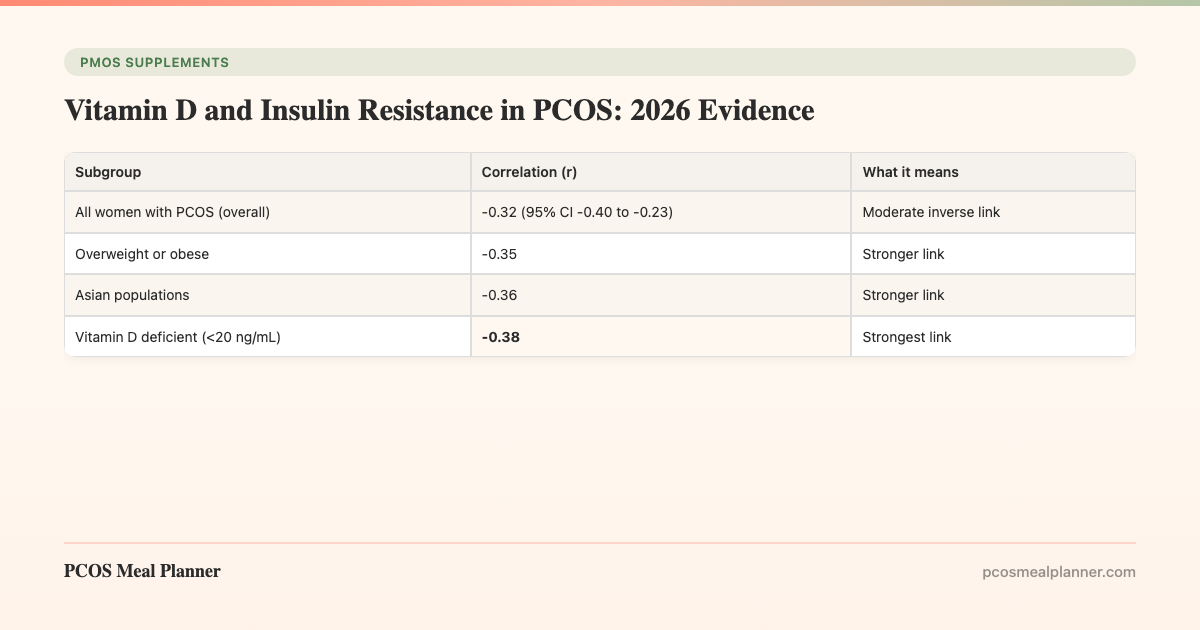
- The link was strongest where it matters most. It was stronger in overweight or obese women (r = -0.35), in Asian populations (r = -0.36), and strongest of all in women who were already vitamin D deficient, under 20 ng/mL (r = -0.38).
- Test before you treat. Ask for a 25(OH)D blood test, then correct a real deficiency with food, sensible sun, and doctor-guided supplements. Do not mega-dose blindly; very high doses can be harmful.
- Vitamin D is one input, not the whole picture. The bigger lever for PCOS insulin resistance is still the overall insulin-friendly way you eat every day.
Want an insulin-friendly plan built around vitamin-D-rich foods? Generate a personalised PMOS plan.
What the 2026 vitamin D and insulin resistance in PCOS study found
Lower vitamin D was linked to higher insulin resistance. Guo and colleagues published a systematic review and meta-analysis in the Journal of Obstetrics and Gynaecology Research in 2026. They pooled 14 studies covering 1,856 women with PCOS and looked at the relationship between serum 25(OH)D, the standard blood marker of vitamin D status, and insulin resistance.
The pooled result was a significant inverse correlation: r = -0.32 (95% CI -0.40 to -0.23, p<0.001). In plain English, as vitamin D went down, insulin resistance went up, and the pattern was consistent enough across studies to be statistically solid. The authors concluded that lower vitamin D is linked to greater insulin resistance in women with PCOS, and that vitamin D status is worth checking as part of a metabolic evaluation.
A correlation of -0.32 is a moderate one. It is strong enough to take seriously and far from a one-to-one lockstep, which is what you would expect for a single nutrient sitting inside a condition with many moving parts. The fact that the confidence interval sits entirely below zero, from -0.40 to -0.23, is the important detail: the direction of the link is consistent, not a fluke of one or two outlier studies.
That is a useful, specific finding. It is also easy to over-read, so the next section draws the line clearly.
Correlation or causation? The honest read
This is an association, not proof. A correlation of -0.32 tells you the two measures move together. It does not tell you that low vitamin D causes insulin resistance, and it does not tell you that swallowing vitamin D will reverse it.
There are good reasons to stay careful. Body fat stores vitamin D, so people carrying more weight often show lower blood levels, and excess weight also drives insulin resistance. That means a third factor, body fat, can push both numbers at once and create a link that is not cause and effect. Time spent outdoors, overall diet quality, and general health can pull the same way.
Supplement trials that have tested whether adding vitamin D lowers insulin resistance have been mixed rather than decisive. The only thing that would settle the question is large, well-run randomised trials that give vitamin D or a placebo and measure insulin resistance over time, and the current answer from that kind of evidence is not a clean yes.
It is also worth knowing that vitamin D deficiency is common in women with PCOS, so a low reading is not rare or alarming on its own. So the fair summary is this: vitamin D is a meaningful marker, correcting a genuine deficiency is sensible for many reasons, but a pill is not an established fix for insulin resistance on its own. Treat the association as a reason to test, not a reason to assume.
Why vitamin D and insulin resistance may be linked
Vitamin D touches the same machinery that handles insulin. Vitamin D receptors sit on the insulin-producing beta cells of the pancreas and on muscle and fat cells, the tissues that respond to insulin. Vitamin D appears to support both insulin secretion and insulin sensitivity, and it helps regulate inflammation and calcium signalling, which both affect how well insulin works.
Insulin resistance is the core metabolic driver behind many PMOS symptoms, from irregular cycles to stubborn weight and raised androgens (Diamanti-Kandarakis and Dunaif, 2012). Anything that plausibly touches insulin signalling is so relevant, and that biological plausibility is part of why researchers take the vitamin D link seriously rather than dismissing it as coincidence.
Vitamin D also has a hand in inflammation, which tends to run higher in PMOS and makes cells less responsive to insulin. So there are at least two plausible routes for the connection: a direct effect on the insulin-handling tissues, and an indirect effect through lower background inflammation. Plausible is not the same as proven, but it does raise the odds that the association is picking up something real rather than pure noise.
Vitamin D is one lever among several. Two other well-studied ones for PMOS are covered in our guides to inositol for PMOS and magnesium for PCOS, both of which also act on insulin sensitivity.
Who is most affected by low vitamin D in PCOS
The link was strongest in the women who had the most to gain. The meta-analysis broke the data down by subgroup, and the inverse correlation was not the same size for everyone.
| Subgroup | Correlation (r) | What it means |
|---|---|---|
| All women with PCOS (overall) | -0.32 (95% CI -0.40 to -0.23) | Moderate inverse link |
| Overweight or obese | -0.35 | Stronger link |
| Asian populations | -0.36 | Stronger link |
| Vitamin D deficient (<20 ng/mL) | -0.38 | Strongest link |
The practical read is straightforward. If you are overweight, from a higher-risk population, or already known to be low on vitamin D, the relationship between your vitamin D and your insulin resistance is likely to be tighter, so checking your level has more value. Someone whose vitamin D is already comfortably in range has less to gain from chasing the number higher.
How to test your vitamin D
Ask for a 25(OH)D blood test. The marker is called 25-hydroxyvitamin D, written 25(OH)D, and it reflects your stored vitamin D status better than any symptom or guess. It is a simple blood draw that most doctors can order alongside the usual PMOS metabolic panel.
Thresholds and units vary by country, so use the reference range your lab and doctor give you. Commonly used cut-offs look like this:
- Deficient: under 20 ng/mL (50 nmol/L)
- Insufficient: 20 to 30 ng/mL (50 to 75 nmol/L)
- Enough: 30 ng/mL and above (75 nmol/L and above)
If your results come back in nmol/L rather than ng/mL, you can roughly convert by multiplying ng/mL by 2.5. Testing first means you treat a real number, not a hunch, and it gives you a baseline to re-check later so you can see whether a change actually moved anything.
Symptoms are a poor guide here. Low vitamin D can be silent, or it can show up as vague tiredness, low mood, or aches that are easy to blame on everything else, so the only reliable way to know is the blood test. If you do start correcting a low level, most doctors re-check after about three months, which is roughly how long it takes for a steady dose to settle your stored level into a new range.
Vitamin D from food, and why sun still does the heavy lifting
Most of your vitamin D comes from sunlight, and food provides a smaller, reliable top-up. No single food is a magic fix, but a few are genuinely rich sources, and oily fish leads the list while also delivering omega-3, which is useful for PMOS in its own right.
| Food | Vitamin D (approx) | Notes for your PMOS plan |
|---|---|---|
| Wild salmon (3 oz / 85 g, cooked) | ~400 to 600 IU | Top whole-food source; also omega-3 |
| Canned sardines or salmon (with bones) | ~250 to 450 IU per serving | Shelf-stable, and the bones add calcium |
| Mackerel or trout (cooked) | ~few hundred IU | Oily fish; aim for two servings a week |
| Egg yolks (2 large) | ~80 IU | Eat the whole egg; protein-first breakfast |
| UV-exposed mushrooms | ~up to several hundred IU | Main plant source (vitamin D2) |
| Fortified milk, plant milk, yogurt, cereal | ~100 IU per serving | Check the label; easy daily top-up |
| Cod liver oil (1 tsp) | ~450 to 1,000 IU | Concentrated; also high in vitamin A, so do not overdo it |
Figures are approximate and vary by product, season, and how the food was raised or prepared. The honest limitation: food alone rarely corrects a true deficiency, which is exactly why testing and, where needed, supplements come into the picture.
Sensible sun, not sunburn
Your skin makes vitamin D from UVB sunlight, so short, regular exposure helps. A few minutes of midday sun on your arms and legs on a clear day can trigger meaningful vitamin D production, though the exact amount depends on your skin tone, the season, and your latitude.
Two honest caveats. First, in winter or at higher latitudes the sun sits too low for your skin to make much vitamin D at all, which is when diet and supplements matter more. Second, people with darker skin need longer exposure to make the same amount, so a one-size rule does not work. The goal is brief, regular light exposure, never burning, because sunburn raises skin-cancer risk and does nothing extra for your vitamin D.
Should you supplement? Test first, do not mega-dose
Correct a real deficiency; do not blind-dose on assumption. If your 25(OH)D test comes back low, a supplement is a reasonable way to bring it up, ideally alongside more oily fish and sensible sun. The dose should be set by a doctor based on your measured level, because the right amount to correct a deficiency is different from a small maintenance dose.
A couple of practical points if a doctor does recommend a supplement. Vitamin D3 (cholecalciferol) is generally the preferred form for raising and holding blood levels, and because vitamin D is fat-soluble it is best taken with a meal that contains some fat. Magnesium is a cofactor your body uses to process vitamin D, which is one reason the two are often discussed together for PMOS.
Here is the safety point that gets skipped. Vitamin D is fat-soluble, which means it is stored in the body rather than flushed out like vitamin C. Very high doses over time can cause vitamin D toxicity, raising blood calcium and leading to nausea, weakness, kidney stones, and kidney damage. More is not better, and a bottle labelled with a very high dose is not a shortcut. This is one reason our guide to the best supplements for PMOS puts testing and doctor guidance ahead of stacking pills.
How vitamin D fits your PMOS plan
Vitamin D is a supporting player, not the star. The 2026 meta-analysis is a good reason to check your level and correct a deficiency, but the biggest lever on insulin resistance is still the overall way you eat: an insulin-friendly pattern that is moderate in carb, higher in protein and fibre, and built on whole foods. Fold vitamin D into that rather than treating it as a separate project.
The neat part is that the food which raises vitamin D also fits an insulin-friendly plate. Two servings of oily fish a week, whole eggs at breakfast, and fortified options where they help all do double duty. The PCOS Meal Planner builds insulin-friendly weekly meals and can weave in vitamin-D-rich foods by default, so you cover the link between vitamin D and insulin resistance in PCOS through your normal meals instead of another thing to remember. Generate your plan now, and if you want the background on the name change, see our explainer on why PCOS is now called PMOS.
Often asked questions
Does low vitamin D cause insulin resistance in PCOS?
Not proven. A 2026 meta-analysis of 14 studies and 1,856 women found lower vitamin D was linked to higher insulin resistance (pooled r = -0.32, p<0.001), but a correlation is not causation. Obesity lowers vitamin D and raises insulin resistance, so a third factor can drive both. Correcting a real deficiency is sensible; treating vitamin D as a proven cure is not.
What did the 2026 vitamin D and PCOS meta-analysis find?
Across 14 studies and 1,856 women with PCOS, serum 25(OH)D and insulin resistance moved in opposite directions (pooled r = -0.32, 95% CI -0.40 to -0.23, p<0.001). The link was stronger in overweight or obese women (r = -0.35), in Asian populations (r = -0.36), and strongest in women who were vitamin D deficient under 20 ng/mL (r = -0.38).
Should I take vitamin D for PCOS insulin resistance?
Test first, then decide with a doctor. The evidence is an association, not proof that supplements reverse insulin resistance, so get a 25(OH)D blood test and correct a genuine deficiency rather than supplement on assumption. Do not mega-dose blindly; vitamin D is fat-soluble, accumulates, and very high doses can be harmful.
What vitamin D level should I aim for with PCOS?
Use your doctor and lab reference range, since thresholds and units vary. Common cut-offs are deficient under 20 ng/mL (50 nmol/L), insufficient 20 to 30 ng/mL, and enough 30 ng/mL and above. The 2026 link with insulin resistance was strongest below 20 ng/mL, so the priority is fixing a true deficiency, not pushing a normal level higher.
What foods are highest in vitamin D for PCOS?
Oily fish leads: wild salmon, mackerel, sardines, and trout. Egg yolks, UV-exposed mushrooms (the main plant source, as D2), and fortified milks, yogurts, and cereals add a reliable top-up. Cod liver oil is concentrated. Sunlight still does most of the work, so food alone rarely corrects a real deficiency, especially in winter.
Can too much vitamin D be harmful?
Yes. Vitamin D is fat-soluble and stored in the body, so excess does not simply wash out. Very high doses over time can cause toxicity, raising blood calcium and leading to nausea, weakness, kidney stones, and kidney damage. That is why blind mega-dosing is unwise and why a doctor should set the dose from your measured 25(OH)D level.
Sources and further reading
The 2026 vitamin D and insulin resistance meta-analysis
Insulin resistance in PCOS / PMOS
Clinical guidelines and patient-facing summaries
- International Evidence-Based Guideline for PCOS (Monash, 2023)
- NHS: Polycystic ovary syndrome (PCOS)
- Mayo Clinic: PCOS
How this article was made
The central finding is from Guo et al. 2026 in the Journal of Obstetrics and Gynaecology Research, a systematic review and meta-analysis of 14 studies and 1,856 women with PCOS reporting a pooled inverse correlation of r = -0.32 (95% CI -0.40 to -0.23, p<0.001) between serum 25(OH)D and insulin resistance, strongest in deficient (r = -0.38), overweight or obese (r = -0.35), and Asian (r = -0.36) subgroups. That result is a correlation, so we present it as an association rather than proof of cause.
Mechanism and the central role of insulin resistance draw on Diamanti-Kandarakis and Dunaif 2012. Framing is aligned with the 2023 International Evidence-Based Guideline for PCOS, plus NHS and Mayo Clinic patient summaries. PMOS is the new name for PCOS as of 12 May 2026; the biology is unchanged. This article is educational and is not medical advice. Get your vitamin D level tested and let a doctor guide any supplementation; very high doses can be harmful.
Related reading
- The best supplements for PMOS: what the evidence supports
- Inositol for PMOS and insulin sensitivity
- Magnesium for PCOS: a complete guide
- PCOS is now PMOS: the full renaming explainer
Community Comments
Add a comment