How CoQ10 may help PCOS
A flow diagram. At the top, a box for CoQ10 (coenzyme Q10), made in the mitochondria. Two arrows lead to two mechanism boxes: mitochondrial energy (helping cells burn glucose to make ATP) on the left, and antioxidant defence (lowering oxidative stress) on the right. Both mechanisms feed into a pooled-outcomes box summarising a meta-analysis of 9 randomized trials in 1,021 women: lower HOMA-IR, lower fasting insulin, lower fasting glucose, lower testosterone, higher FSH, lower triglycerides, lower total cholesterol and LDL, and higher HDL. A note at the bottom states that supplements support an insulin-friendly plate rather than replace it.
How CoQ10 May Help PCOS
One supplement, two mechanisms, measurable metabolic outcomes
CoQ10 (Coenzyme Q10)
made in your mitochondria
What is CoQ10 (coenzyme Q10)?
CoQ10, or coenzyme Q10, is a fat-soluble compound your body makes and stores inside the mitochondria of nearly every cell. It has two jobs. It shuttles electrons along the chain that produces ATP, the energy currency your cells run on. It also works as a fat-soluble antioxidant, protecting cell membranes from oxidative damage.
Levels are highest in the organs that use the most energy, such as the heart, liver and kidneys. Your body makes less CoQ10 as you age, and certain medications lower it too. CoQ10 comes in two forms: ubiquinone (the oxidized form) and ubiquinol (the reduced form). Both are sold as supplements, and your body converts between them.
How does CoQ10 work in PCOS?
Two of CoQ10's roles line up directly with the biology of PCOS: mitochondrial energy production and antioxidant defence. Research links PCOS with mitochondrial strain and higher oxidative stress in muscle, fat and the ovary. When mitochondria work less efficiently, cells handle glucose less well, which feeds insulin resistance.
By supporting the electron transport chain, CoQ10 helps cells generate energy from glucose more efficiently. By mopping up free radicals, it lowers the oxidative stress that is tied to poor insulin signalling. Insulin resistance sits at the centre of PCOS. Diamanti-Kandarakis and Dunaif (Endocrine Reviews, 2012) describe it as a core driver that pushes the ovary to make more androgens. Anything that eases insulin resistance can so ripple outward to androgens and cycles, which is why a mitochondrial-antioxidant supplement is a plausible fit rather than a random one.
Put simply, PCOS is a condition where cells struggle to use energy cleanly, and CoQ10 works on exactly that machinery. That is the theory. The value of the meta-analysis below is that it tests whether the theory holds up in real women, not just in cells under a microscope.
What does the evidence show for CoQ10 and PCOS?
The strongest single source is a systematic review and meta-analysis by Zhang and colleagues, published in Reproductive Sciences in 2023. It pooled 9 randomized controlled trials involving 1,021 women with PCOS and looked at metabolic, hormonal and lipid outcomes. Across those trials, CoQ10 supplementation improved insulin resistance, shifted two key reproductive hormones, and improved the blood lipid profile.
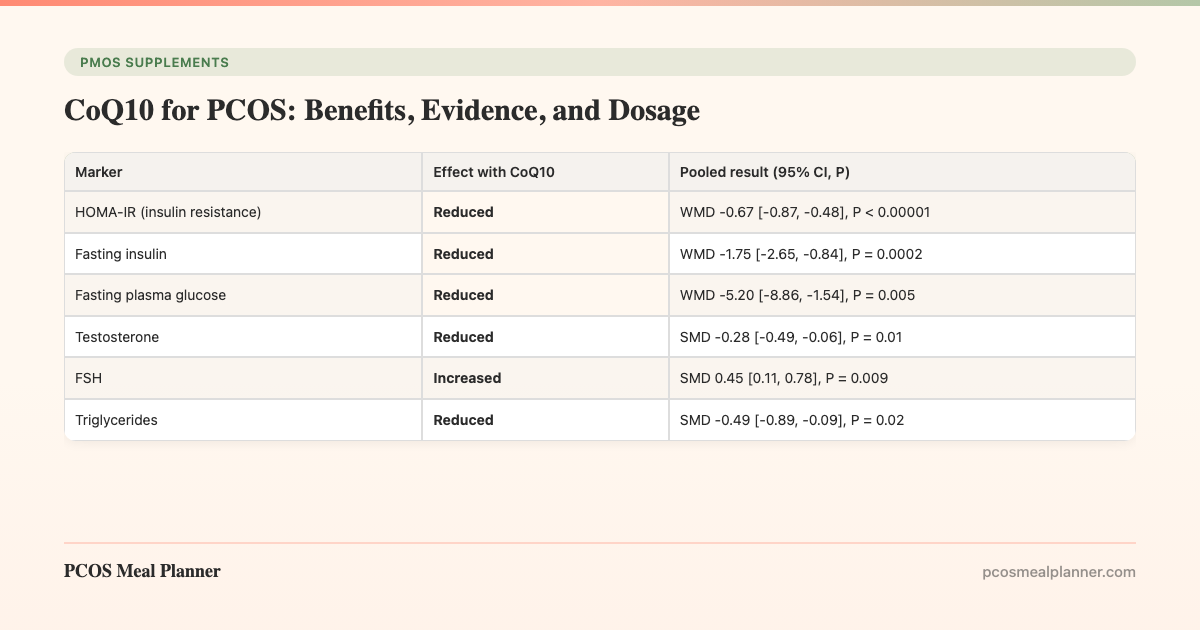
Here are the pooled results as the meta-analysis reported them. WMD is the weighted mean difference and SMD is the standardised mean difference; a negative value means CoQ10 lowered the marker, a positive value means it raised it.
Marker
Effect with CoQ10
Pooled result (95% CI, P)
HOMA-IR (insulin resistance)
Reduced WMD -0.67 [-0.87, -0.48], P < 0.00001
Fasting insulin
Reduced WMD -1.75 [-2.65, -0.84], P = 0.0002
Fasting plasma glucose
Reduced WMD -5.20 [-8.86, -1.54], P = 0.005
Testosterone
Reduced SMD -0.28 [-0.49, -0.06], P = 0.01
FSH
Increased SMD 0.45 [0.11, 0.78], P = 0.009
Triglycerides
Reduced SMD -0.49 [-0.89, -0.09], P = 0.02
Total cholesterol
Reduced SMD -0.35 [-0.56, -0.14], P = 0.001
LDL cholesterol
Reduced SMD -0.22 [-0.43, -0.01], P = 0.04
HDL cholesterol
Increased SMD 0.22 [0.01, 0.43], P = 0.04
The pattern is consistent: CoQ10 nudged the metabolic and lipid markers of PCOS in the direction you want, and moved testosterone and FSH toward a healthier reproductive balance. These are pooled averages across trials, not guarantees for any one person, but they are real human results rather than test-tube promise.
A few caveats keep this honest. The 9 trials were mostly small, ran for weeks rather than years, and varied in dose and design, which is why the meta-analysis authors describe the evidence as promising rather than settled. The reproductive-hormone effects were graded with the standardised mean difference, a statistical measure that pools trials using different lab units, so they show direction and size of effect rather than a plain milligram change. Bigger and longer trials would firm up the numbers. Even so, the consistency across separate studies is what makes CoQ10 stand out from supplements that rest on a single trial or none at all.
CoQ10 and insulin resistance
The clearest win in the data is insulin resistance. HOMA-IR, the standard index that combines fasting glucose and fasting insulin, fell by 0.67 points, a result the meta-analysis reported as highly statistically robust (P less than 0.00001). Fasting insulin and fasting glucose both dropped alongside it.
This matters because insulin resistance is the engine room of PCOS. When cells resist insulin, the pancreas pumps out more of it, and high insulin tells the ovaries to make more testosterone and lowers SHBG, the protein that keeps testosterone in check. Bring insulin down and you take pressure off that whole cascade. That is why an insulin-focused supplement, layered on top of an insulin-friendly diet, can do more than its narrow label suggests. For a broader look at your options, see our guide to the best supplements for PMOS .
CoQ10, testosterone and fertility
CoQ10 also touched the reproductive hormones. In the pooled data, testosterone fell (SMD -0.28) and FSH rose (SMD 0.45). Lower testosterone can ease the androgen-driven symptoms of PCOS such as acne and unwanted hair growth, and FSH is the hormone that helps a follicle mature toward ovulation.
Because CoQ10 fuels the mitochondria, and the egg is one of the most mitochondria-dense cells in the body, it has been studied as a support alongside standard ovulation-induction treatment. The evidence here is still early, so this section is background rather than a fertility plan. If you are trying to conceive, that decision belongs with your doctor or fertility specialist, who can weigh CoQ10 against your full picture rather than leaving you to self-prescribe.
CoQ10 and cholesterol: the lipid picture
The meta-analysis also tracked blood lipids, and CoQ10 improved every one it measured. Total cholesterol fell (SMD -0.35), LDL cholesterol, the type linked to heart risk, fell (SMD -0.22), triglycerides fell (SMD -0.49), and HDL cholesterol, the protective type, rose (SMD 0.22). Each result cleared the threshold for statistical significance.
This matters more for PCOS than lipid numbers do for the average person. Women with PCOS carry a higher long-term risk of heart disease and type 2 diabetes, and the lipid profile is one of the levers behind that risk. A supplement that trims LDL and triglycerides while lifting HDL, on top of a heart-friendly diet, is working on a real problem rather than a cosmetic one. The effect sizes are modest averages, so CoQ10 complements the dietary and lifestyle changes that move lipids most, rather than standing in for them.
What dose of CoQ10 was used in PCOS trials?
Across the trials that fed the meta-analysis, CoQ10 doses generally fell in the range of about 100 to 200 mg per day, taken for roughly 8 to 12 weeks, sometimes split into two smaller doses. Because CoQ10 is fat-soluble, absorption improves when it is taken with a meal that contains some fat, which is one reason it pairs naturally with a Mediterranean-style plate.
An important note on dosing. There is no single official CoQ10 dose for PCOS, and this article does not prescribe one. The ranges above describe what researchers studied, not what you should take. Supplement strength, form (ubiquinone versus ubiquinol) and quality vary widely between brands. Your doctor or pharmacist can help you choose a dose and product that fit you and check it against anything else you take.
Ubiquinone or ubiquinol: does the form matter?
CoQ10 supplements come in two forms. Ubiquinone is the oxidized form and the one used in most of the older research, including many of the PCOS trials. Ubiquinol is the reduced form, marketed as better absorbed, especially in older adults. Your body converts between the two, so both raise your CoQ10 levels.
For most people the practical difference is small, and the trials that produced the PCOS results largely used ubiquinone. Ubiquinol usually costs more. Whichever form you consider, absorption improves when it is taken with dietary fat, and product quality varies widely between brands. A pharmacist's steer on a reputable product is worth more than the claims printed on the label.
CoQ10 food sources: what to eat
You can get CoQ10 from food, though in smaller amounts than the trial doses. The richest sources are, in rough order:
Organ meats. Heart, liver and kidney are the most concentrated food sources by a wide margin.Oily fish. Sardines, mackerel, herring and salmon, which also deliver the omega-3 fats that help PCOS on their own.Nuts and seeds. Pistachios, peanuts and sesame seeds carry useful amounts, plus fibre, magnesium and healthy fat.Some vegetables. Spinach, broccoli and cauliflower contribute smaller amounts.
Food will not match a 100 to 200 mg capsule, so think of it as a foundation rather than a substitute if a supplement is recommended. Practically, working oily fish into your week two or three times covers CoQ10, omega-3 and protein in one move. That kind of overlap, where one food earns its place several ways, is exactly what an insulin-friendly plate is built to capture.
Who might consider CoQ10 for PCOS?
CoQ10 is not something everyone with PCOS needs. The women most likely to see a benefit, based on the evidence, are those with measured insulin resistance or a metabolic focus: raised HOMA-IR or fasting insulin, higher triglycerides, or a family history of type 2 diabetes. The pooled results were strongest for exactly those markers.
It is worth comparing against the other insulin-focused options rather than stacking blindly. Our comparison of inositol versus berberine for PCOS covers the two most-used metabolic supplements, and NAC for PCOS covers another antioxidant with its own trial evidence. Whichever you consider, the sensible order is diet and activity first, then a single well-chosen supplement discussed with your doctor, then re-testing to see if it actually moved your numbers.
Is CoQ10 safe? Side effects and interactions
CoQ10 is generally well tolerated. In the 2023 meta-analysis, only one trial formally tracked adverse events, and it reported none. In wider use, the most common complaints are mild and usually gut-related, such as nausea or stomach upset, and often ease when the supplement is taken with food.
The interaction to know about is with blood thinners. CoQ10 has a structure similar to vitamin K and may reduce the effect of anticoagulants such as warfarin, so anyone on those medications should check with a doctor before starting. There is not enough safety data to recommend CoQ10 during pregnancy or breastfeeding. CoQ10 is a supplement, not a substitute for medical care. If you are pregnant, planning pregnancy, or taking any medication, confirm with your doctor or pharmacist before you begin.
How CoQ10 fits an insulin-friendly PMOS plate
Here is the honest framing. CoQ10 is a genuinely evidence-backed option, but it is a layer on top of the plate, not the plate itself. The pooled effects came in women who were also, in most trials, eating and living in ways that support insulin sensitivity. A supplement works best when the foundation underneath it is already doing its job.
That foundation is an antioxidant-rich, insulin-friendly way of eating: protein-first meals, plenty of fibre and colourful vegetables, a Mediterranean fat profile, oily fish for both CoQ10 and omega-3, and fewer refined-carb spikes. That is precisely what the PCOS Meal Planner builds for you, around your specific symptoms, so the food is already carrying most of the metabolic load before any capsule is added. If you are weighing CoQ10 for PCOS, start by getting the plate right, and treat the supplement as the optional layer it is.
Often asked questions
Is CoQ10 good for PCOS?
CoQ10 has more pooled human evidence than most PCOS supplements. A 2023 meta-analysis of 9 trials and 1,021 women found it improved insulin resistance, lowered fasting glucose and testosterone, raised FSH, and improved lipids. It does not replace an insulin-friendly diet, and you should check with your doctor before starting.
Share this answer
Does CoQ10 help with PCOS insulin resistance?
Yes, in pooled data. CoQ10 lowered HOMA-IR by 0.67 points (95% CI -0.87 to -0.48), cut fasting insulin by about 1.75 units, and reduced fasting glucose by about 5.2 mg/dL. It likely works upstream, on the mitochondria and by lowering oxidative stress. Insulin resistance drives most PCOS symptoms.
Share this answer
Can CoQ10 improve fertility or ovulation with PCOS?
The signals point in a helpful direction, but the evidence is early. CoQ10 raised FSH and lowered testosterone in pooled trials, two hormones central to ovulation, and it fuels the mitochondria-dense egg. This is background, not a fertility plan. If you are trying to conceive, work with your doctor rather than self-prescribing.
Share this answer
What is the best CoQ10 dosage for PCOS?
Trials used roughly 100 to 200 mg per day for about 8 to 12 weeks, sometimes in two doses, taken with a fat-containing meal for absorption. There is no single official PCOS dose, and this is not a prescription. Your doctor or pharmacist can advise a dose and product that fit you.
Share this answer
What foods are high in CoQ10?
Organ meats (heart, liver) are richest, then oily fish (sardines, mackerel, salmon), then nuts and seeds (pistachios, peanuts, sesame). Spinach, broccoli and cauliflower add smaller amounts. Food amounts are modest next to trial doses, so treat food as a foundation, not a replacement.
Share this answer
Is CoQ10 safe to take with PCOS?
It is generally well tolerated, and the one trial that tracked adverse events reported none. Mild stomach upset is possible. The main caution is that CoQ10 can reduce the effect of blood thinners like warfarin, so check first if you take anticoagulants. There is not enough data for pregnancy or breastfeeding. It is not a substitute for medical care.
Share this answer
Sources and further reading
CoQ10 and PCOS
Insulin resistance in PCOS
Clinical guidelines and patient-facing summaries
An antioxidant-rich, insulin-friendly PMOS plate is the foundation. CoQ10 is a layer on top, not the base. Our
AI PCOS Meal Planner builds the antioxidant-rich, insulin-friendly plate around your symptoms, with oily fish, fibre and protein-first meals doing the metabolic heavy lifting.
Build your personalised plan now .
How this article was made
The pooled results come from Zhang et al. 2023 in Reproductive Sciences, a systematic review and meta-analysis of 9 randomized controlled trials in 1,021 women with PCOS (HOMA-IR, fasting insulin and glucose, testosterone, FSH, and lipids reported exactly as stated in that paper). The insulin-resistance mechanism draws on Diamanti-Kandarakis and Dunaif 2012 in Endocrine Reviews. Guidance is aligned with the 2023 International Evidence-Based Guideline for PCOS and patient-facing summaries from the NHS and Mayo Clinic.
PMOS is the new name for PCOS as of 12 May 2026; the underlying biology is unchanged. This article is informational and not medical advice. CoQ10 is generally well tolerated but is not a substitute for medical care, can interact with blood thinners, and should be discussed with a doctor, especially if you are pregnant or on medication.
Related reading
Community Comments
Add a comment