The PMOS sugar-craving cycle and where to break it
A four-stage loop drawn clockwise. Stage one: you eat sugar or refined carbs. Stage two: blood sugar spikes and, in PMOS, insulin surges even higher. Stage three: blood sugar crashes below where it started. Stage four: the brain triggers hunger and an urgent sugar craving, which sends you back to stage one. A break-points strip at the bottom lists four ways to interrupt the loop: eat protein and fibre before carbs, do not skip meals, protect your sleep, and manage stress.
The PMOS Sugar-Craving Cycle
It is physiology, not willpower
1. You eat sugar or refined carbs
Fast fuel, little protein or fibre
2. Blood sugar spikes
In PMOS, insulin surges even higher
to move the sugar out of the blood
3. Blood sugar crashes
The insulin overshoots and drops
blood sugar below where it started
4. Brain triggers a craving
A low crash reads as an emergency,
so it asks for fast sugar again
Why do I crave sugar with PCOS?
You crave sugar with PMOS because your blood sugar is unstable and your insulin runs high, not because you lack discipline. The pattern is simple: a fast carb spikes blood sugar, a surge of insulin drives it back down, and it overshoots so blood sugar crashes below where it started. Your brain treats that crash as a fuel emergency and asks for the quickest fix it knows, which is sugar. Then the loop repeats.
In PMOS this loop is sharper. Insulin resistance means your cells respond less well to insulin, so your body makes more of it to do the same job (Diamanti-Kandarakis and Dunaif, 2012). Higher insulin means a bigger overshoot, a lower crash, and a stronger craving a couple of hours later. That is why the same slice of toast can leave someone with PMOS hungry and reaching for chocolate at 3pm while someone else feels fine. The craving is a symptom of the blood-sugar swing, so the fix is to flatten the swing.
The insulin and blood-sugar mechanism
Insulin is the hormone that moves sugar out of your blood and into your cells. In insulin resistance, the core feature of PMOS, cells are slow to respond, so the pancreas compensates by pumping out more insulin. This state of chronically high insulin is called hyperinsulinemia, and it sits upstream of most PMOS symptoms (Diamanti-Kandarakis and Dunaif, 2012).
For cravings, hyperinsulinemia matters because of what happens after a meal. Too much insulin clears blood sugar too aggressively, so blood sugar can drop below your starting level within a couple of hours. That reactive dip is a physical trigger for hunger and sugar-seeking, on top of any emotional pull. Both the NHS and Mayo Clinic list insulin resistance as central to PCOS, which is why food that spikes insulin the least tends to leave you steadiest and least prone to cravings.
It is not just insulin: serotonin, mood, sleep, stress and your cycle
Blood sugar is the biggest lever, but four other factors turn cravings up, and they often stack on the same day.
Serotonin and mood
Carb raises serotonin, the calm-and-content brain chemical, which is one reason a low mood can send you toward something sweet. The relief is real but brief, and the sugar crash that follows can leave your mood lower than before. Naming this pattern helps you catch it: the craving may be about feeling flat, not about hunger.
Sleep
Short sleep changes appetite hormones and lowers insulin sensitivity the next day, so one bad night can mean a day of stronger cravings. If you are exhausted, expect the urge to be louder and plan protein-forward meals rather than relying on resolve.
Stress
Stress raises cortisol, which pushes blood sugar up and then down and nudges you toward comfort food. High, ongoing stress works against steady blood sugar directly, so managing it is part of managing cravings, not a separate project.
Your cycle
In the luteal phase, the week or so before your period, hormonal shifts lower serotonin and raise appetite, so sugar and carb cravings climb for many people with PMOS. This is a predictable, normal pattern. Planning meals ahead for that week takes the pressure off willpower at the exact time it is weakest.
Craving triggers and what to do about each
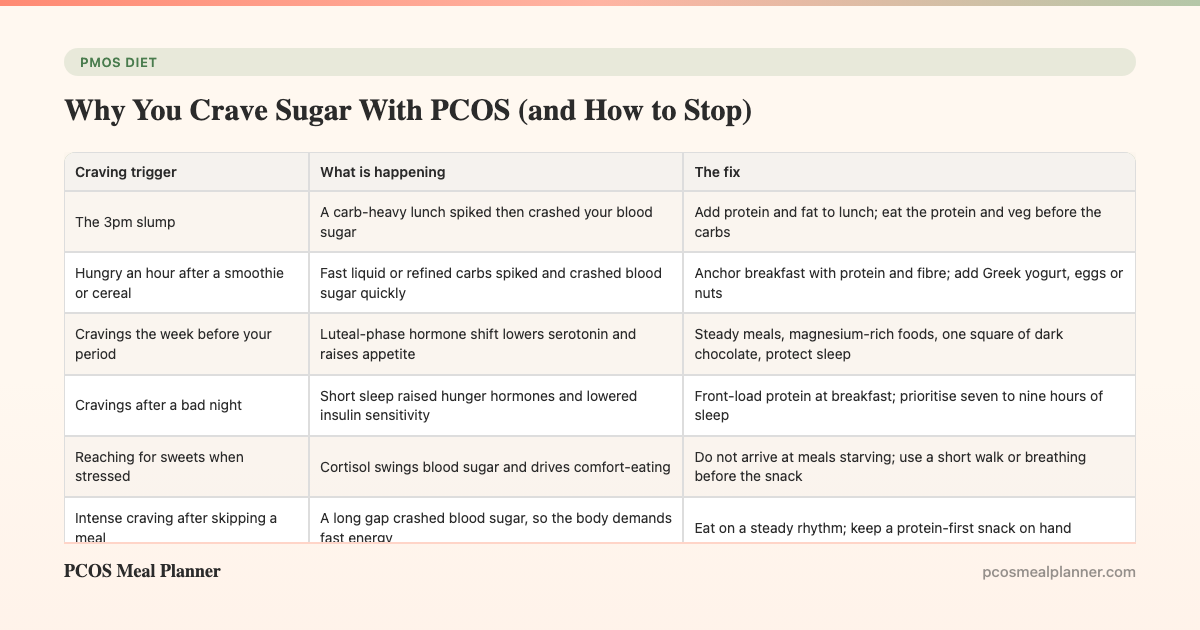
Most cravings map to a specific trigger. Once you can name what is happening in the moment, the fix becomes obvious. Use this table to match the trigger to the action.
Craving trigger
What is happening
The fix
The 3pm slump
A carb-heavy lunch spiked then crashed your blood sugar
Add protein and fat to lunch; eat the protein and veg before the carbs
Hungry an hour after a smoothie or cereal
Fast liquid or refined carbs spiked and crashed blood sugar quickly
Anchor breakfast with protein and fibre; add Greek yogurt, eggs or nuts
Cravings the week before your period
Luteal-phase hormone shift lowers serotonin and raises appetite
Steady meals, magnesium-rich foods, one square of dark chocolate, protect sleep
Cravings after a bad night
Short sleep raised hunger hormones and lowered insulin sensitivity
Front-load protein at breakfast; prioritise seven to nine hours of sleep
Reaching for sweets when stressed
Cortisol swings blood sugar and drives comfort-eating
Do not arrive at meals starving; use a short walk or breathing before the snack
Intense craving after skipping a meal
A long gap crashed blood sugar, so the body demands fast energy
Eat on a steady rhythm; keep a protein-first snack on hand
Why dieting and restriction make PCOS cravings worse
Trying to cut sugar hard usually makes the craving stronger, which is the opposite of what most advice assumes. When you restrict tightly or skip meals, blood sugar drops, hunger hormones rise, and your body pushes back with a louder demand for exactly the food you are avoiding. That is biology, not weakness, and it is why "just have more willpower" fails so reliably.
Restriction also sets up an all-or-nothing loop. You white-knuckle through the day, blood sugar crashes by evening, and you overeat the very thing you banned, then feel guilty and restrict harder the next day. Breaking that loop starts with eating enough, regularly, with protein at every meal. If sweet foods feel forbidden, that scarcity often intensifies the pull, so a planned square of dark chocolate can defuse a craving better than a rule that bans it. The food-noise this creates has its own guide: see how to quiet PMOS food noise .
Protein-first meals, fibre and regular eating: the core fix
The single easiest change is to eat your protein and vegetables before the carb part of a meal. The order you eat in genuinely changes your blood-sugar response. Shukla and colleagues (2015) gave people the same meal in different orders and found that eating protein and vegetables first cut the post-meal glucose response by 29 percent and the insulin response by 37 percent, compared with eating the carb first.
Flatter blood sugar after a meal means a smaller crash two hours later, and a smaller crash means a weaker craving. Practically: eat the chicken and salad before the rice, the eggs before the toast, the fish and greens before the potatoes. You are not removing the carb, only moving it to the second half of the plate. It costs nothing, needs no special food, and works at every meal. Aim for a palm-sized portion of protein at breakfast, lunch and dinner so the effect compounds across the day.
Fibre makes protein-first eating stick. Fibre slows how fast sugar enters your blood, so it blunts the spike and the crash that follows. Vegetables, beans, lentils, oats, chia and whole fruit all add fibre to a meal, and they pair naturally with protein. A bowl that combines protein and fibre is far steadier than the same calories from a refined carb alone.
Regular meals matter just as much. Skipping breakfast or leaving long gaps crashes blood sugar directly, then you arrive at the next meal ravenous and reach for the fastest carb in sight. Eating on a steady rhythm, roughly every four to five hours, keeps blood sugar from bottoming out. If eating windows suit your routine, the timing question is covered in time-restricted eating for PCOS , but the rule that beats all others is do not skip meals to try to control cravings. It backfires.
Crave this, eat this instead
When a specific craving hits, you do not have to just resist it. Reach for a version that satisfies the same want while landing gently on your blood sugar. Each swap below pairs the sweet pull with protein, fat or fibre so the sugar arrives slower.
When you crave
Reach for
Why it works
A chocolate bar
One or two squares of 85% dark chocolate with a few almonds Fat and fibre slow the sugar; a small amount satisfies the craving
Sweets or candy
Berries with plain Greek yogurt
Protein and fibre blunt the spike, with natural sweetness
Biscuits with your tea
Apple slices with peanut butter
Fibre, protein and fat together steady blood sugar
A fizzy drink
Sparkling water with lime, or cinnamon tea
No sugar hit, so no spike and no rebound crash
Ice cream
Frozen banana blended with Greek yogurt
Protein-rich and whole-food sweet, without the sugar load
A cereal or pastry breakfast
Eggs with avocado, or oats with protein and nuts Protein-first breakfast prevents the mid-morning crash
Craving-buster snacks that actually work
The snacks that shut a craving down all share the same shape: protein plus fibre or fat, with little or no fast sugar. Keep two or three of these easy to grab so the steady option is the convenient one.
Plain Greek yogurt with berries and a spoon of chia. High protein, real sweetness, slow sugar.A hard-boiled egg with a handful of cherry tomatoes. Protein and volume for almost no blood-sugar impact.Apple or pear slices with a tablespoon of nut butter. Fibre and fat wrap the fruit sugar.A small handful of nuts with one or two squares of 85% dark chocolate. Satisfies a sweet craving with magnesium and healthy fat.Hummus with pepper strips or cucumber. Fibre and protein, crunchy and filling.Cottage cheese with cinnamon and a few berries. Slow protein that holds you between meals.
Notice that none of these ban sweetness. They deliver it alongside protein and fibre so the sugar lands slowly and the crash never comes.
When PCOS sugar cravings are a sign to get help
Cravings themselves are normal physiology and nothing to be ashamed of. But sometimes they point to something that deserves care rather than another diet rule. If food feels out of control, if cravings come with low mood or with bingeing, or if you swing between strict restriction and overeating in a way that distresses you, that can relate to disordered eating.
This is common in people managing a metabolic condition, and it is not a failure of willpower. If any of this sounds familiar, it is worth talking to your doctor, and in the UK you can contact Beat, the eating disorder charity, for confidential support. Reaching out early makes it easier to turn around. Steadying blood sugar helps the physical side of cravings, but if your relationship with food feels distressing, that deserves proper support on its own terms.
How to stop PCOS sugar cravings for good
Lasting change comes from a steady system, not a burst of willpower. A plan that keeps protein at every meal, fibre high, meals regular, and sweet foods included in small planned amounts stops the spike-and-crash loop before it starts. That is the difference between fighting cravings all day and simply having fewer of them. If you want the food chosen for you, the PCOS Meal Planner builds insulin-friendly meals in exactly this shape, matched to your symptoms. For the bigger picture on which eating pattern has the best evidence, see the best diet for PCOS in 2026 . Steady the blood sugar, and PCOS sugar cravings fade on their own.
Often asked questions
Why do I crave sugar so much with PCOS?
Because of insulin resistance and blood-sugar swings, not weak willpower. In PMOS your cells respond less well to insulin, so you make more of it. A fast carb spikes blood sugar, the extra insulin overshoots, and blood sugar crashes below where it started. Your brain reads the crash as an emergency and asks for sugar. Low serotonin, poor sleep, stress and the luteal phase make it stronger.
Share this answer
How do I stop sugar cravings with PCOS?
Steady your blood sugar so it stops spiking and crashing. Eat protein and vegetables before the carbs, keep fibre high, eat regular meals, do not skip breakfast, and protect your sleep. Shukla and colleagues (2015) found eating protein and veg first cut the glucose response by 29 percent and the insulin response by 37 percent. Pair any sweet food with protein, fat or fibre.
Share this answer
Are sugar cravings worse before my period with PCOS?
Yes, for many people. In the luteal phase, the week or so before your period, hormone shifts lower serotonin and raise appetite, so sugar and carb cravings climb. This is a normal pattern, not lost control. Use the same tools more deliberately: protein at every meal, steady eating, magnesium-rich foods, a square of dark chocolate, and protected sleep.
Share this answer
Does eating protein before carbs really reduce cravings?
Yes. The order you eat in changes how much blood sugar and insulin rise. Shukla and colleagues (2015) had people eat the same meal in different orders and found protein and vegetables first cut the glucose response by 29 percent and the insulin response by 37 percent. Flatter blood sugar means a smaller crash later, which means a weaker craving. It costs nothing.
Share this answer
Why do I still crave sugar even when I am eating enough?
Often it is the type and timing of food, not the amount. A mostly-carb meal can still spike and crash even with adequate calories, and skipping meals crashes blood sugar directly. Restriction is a common hidden cause: cutting sugar too hard makes your body push back with stronger cravings. Poor sleep and high stress raise the urge on their own.
Share this answer
When are PCOS sugar cravings a sign of something more serious?
Cravings themselves are normal. But if food feels out of control, if cravings come with low mood or bingeing, or if you swing between restricting and overeating and it distresses you, that can relate to disordered eating and is worth support. Talk to your doctor, and in the UK you can contact Beat, the eating disorder charity, for confidential help.
Share this answer
Sources and further reading
Insulin resistance and PCOS physiology
Food order, blood sugar and insulin
Clinical guidelines and patient-facing summaries
Steady your blood sugar and the cravings fade. Our
AI PCOS Meal Planner builds an insulin-friendly PMOS plan that keeps protein at every meal, fibre high and meals regular, so blood sugar stops spiking and crashing. That is the difference between fighting cravings and simply having fewer of them.
Build your plan now .
How this article was made
The blood-sugar and insulin-resistance mechanism draws on Diamanti-Kandarakis and Dunaif 2012 in Endocrine Reviews on insulin resistance and hyperinsulinemia in PCOS. The protein-first finding, a 29 percent lower glucose response and a 37 percent lower insulin response when protein and vegetables are eaten before carbs, is from Shukla et al. 2015 in Diabetes Care. Clinical framing follows the International Evidence-Based Guideline for PCOS (Monash), the NHS, and Mayo Clinic.
The serotonin, sleep, stress and cycle-phase contributors are described as general physiology, not from a single trial. PMOS is the new name for PCOS as of 12 May 2026; the underlying biology is unchanged. This article is informational and not medical advice; if cravings come with low mood or food feels out of control, please speak to your doctor.
Related reading
Community Comments
Add a comment