Last updated: July 14, 2026 · PMOS is the new name for PCOS as of 12 May 2026. Reviewed against current research on lifestyle-change adherence.
Quick answer
- Most PCOS lifestyle changes fail for a predictable reason, and it is not a lack of willpower. In a 2026 PLoS One trial, 61% of women with PCOS quit a structured lifestyle program within a year.
- What predicted who quit was not bloodwork, mood scores, or starting diet. None of those differed between the women who stayed and the women who left. The one baseline factor that predicted dropout was low everyday physical activity (Xie 2026).
- Sticking is a friction-and-expectations problem, not a willpower problem. Plans collapse under too many daily decisions, all-or-nothing rules, and unrealistic timelines.
- What works: start smaller than feels worth it, cut the number of food decisions, make protein the default, build movement into the day you already have, and judge progress over three to six months.
- The most reliable fix is to stop relying on daily motivation and let a system carry the plan.
Tired of starting over every few weeks? Let the system build and carry the plan for you.
How common is it to quit a PCOS lifestyle plan?
More than half of women quit, and faster than most expect. A 2026 randomized controlled trial in PLoS One followed overweight women with PMOS through a structured lifestyle program that also included cyclic progestin and metformin. Within one year, 61% of them (69 women) had dropped out (Xie 2026). The trial counted someone as a dropout if she proactively withdrew, missed two consecutive visits, or lost contact for more than six months.
That number is worth sitting with. These were women who had signed up for a supervised program, motivated enough to enroll and show up on day one. If most of them still stopped, the honest conclusion is that the problem is structural, not personal. Standard lifestyle plans ask for more daily effort than most real lives can sustain. Once you accept that, you can stop blaming yourself and start designing around it.
What actually predicts who sticks and who quits
The most useful finding in the 2026 trial was what did not predict dropout. The researchers compared the women who finished with the women who quit across baseline demographic, clinical, biochemical, psychological, and dietary characteristics. None of those differed significantly between the two groups (Xie 2026). Starting weight, hormone labs, mood scores, and even baseline diet did not separate the stayers from the quitters.
One factor did. Baseline physical activity level, measured objectively with an accelerometer, was the strongest predictor of dropout. Each 0.3-unit increase in physical activity level was linked to a 29.6% lower chance of quitting (Xie 2026). In plain terms: the women who were already moving more in daily life were far more likely to stay the course. Everyday activity, not motivation on paper, tracked with who stuck.
This reframes the whole question. If your bloodwork and your mindset do not predict whether you will stick, then the answer is not hidden inside your body chemistry or your character. It sits in your daily behavior and the amount of friction between you and the plan.
2026 research update: what keeps women with PCOS going
Two 2026 studies add to the dropout picture. The first interviewed 20 patients, 13 doctors and 4 nurses at hospitals in Hunan Province, China (Shen et al., Journal of Nutrition Education and Behavior, 2026). It found three stages of habit change: intention, adoption and keeping it up. Women could also drop out at any point. Good feedback, outside help and self-control pushed women forward. Personal limits, their surroundings and the condition itself held them back. Interviews show reasons, not results.
The second study, in Lahore, Pakistan, gave 50 women aged 18 to 30 one-to-one food counselling at the start and at 3 months (Fayyaz et al., Nutrition, 2026). By 6 months, their diet variety score rose from 2.94 to 5.10. Their visceral fat score fell from 12.74 to 11.74. There was no control group, so some of that change might have come anyway.
Both point the same way as the trial above. Feedback and support, not willpower, keep a plan going.
Why willpower is the wrong frame
Willpower is the wrong way to think about this, and the trial data support that. The women who quit did not start with worse psychological scores than the women who stayed (Xie 2026). They were not weaker or less motivated at baseline. So try harder is not a real fix, because effort was never the variable that separated the two groups.
A better frame is friction plus expectations. Friction is every small point of resistance between you and the healthy choice: the decision about what to cook, the missing ingredient, the recipe you have to look up, the willpower tax of a fridge with nothing ready. Expectations are the timeline you set in your head. Most people expect fast, visible results, then quit when the scale does not move in two weeks.
Insulin resistance, the core metabolic driver of PMOS, shifts slowly (the condition was renamed from PCOS to PMOS in May 2026, but the biology is unchanged, per Diamanti-Kandarakis and Dunaif 2012). A plan judged on a one-week timeline will almost always feel like a failure, even when it is quietly working. Lower the friction and lengthen the timeline, and the same person who kept quitting can suddenly stick.
The friction that drives dropout, and the fix
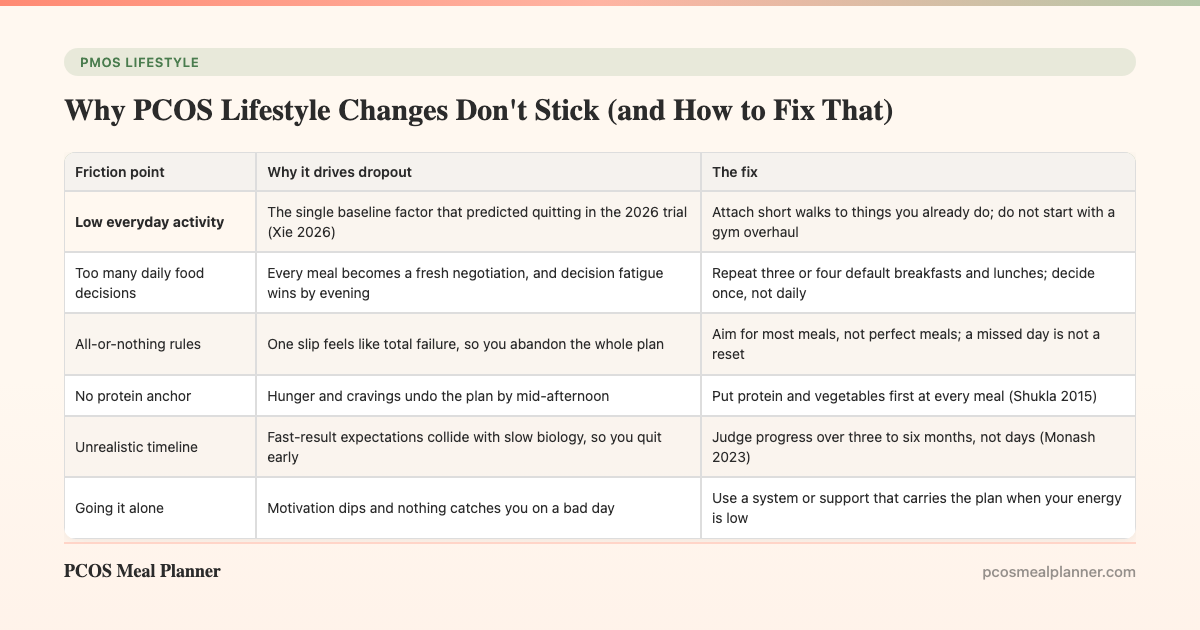
Here is the practical map. The first row is the factor the 2026 trial actually proved predicts dropout. The rest are the common friction points that make any plan fragile, matched to the fix that removes them.
| Friction point | Why it drives dropout | The fix |
|---|---|---|
| Low everyday activity | The single baseline factor that predicted quitting in the 2026 trial (Xie 2026) | Attach short walks to things you already do; do not start with a gym overhaul |
| Too many daily food decisions | Every meal becomes a fresh negotiation, and decision fatigue wins by evening | Repeat three or four default breakfasts and lunches; decide once, not daily |
| All-or-nothing rules | One slip feels like total failure, so you abandon the whole plan | Aim for most meals, not perfect meals; a missed day is not a reset |
| No protein anchor | Hunger and cravings undo the plan by mid-afternoon | Put protein and vegetables first at every meal (Shukla 2015) |
| Unrealistic timeline | Fast-result expectations collide with slow biology, so you quit early | Judge progress over three to six months, not days (Monash 2023) |
| Going it alone | Motivation dips and nothing catches you on a bad day | Use a system or support that carries the plan when your energy is low |
Only the first row is proven by the trial. The others are the friction points that show up again and again in real life, and every fix works the same way: it removes a decision or lowers the effort, so the plan does not depend on a good day.
Stickiness tactic 1: start smaller than feels worth it
The most common mistake is starting too big. A full diet overhaul on a Monday feels virtuous and collapses by Thursday. The better move is the opposite: pick a change so small it feels almost pointless, then let it compound.
Concrete examples for PMOS: add one palm of protein to the breakfast you already eat. Or drink a glass of water and eat protein before the carb at dinner. Or take a ten-minute walk after your largest meal. Each one is small enough to survive a bad day, and small changes that survive beat big changes that do not. Once the tiny habit is automatic, stack the next one on top of it.
Stickiness tactic 2: cut the number of daily food decisions
Every food decision is a chance to fall off the plan. Decision fatigue is real, and by evening most people are running on empty. The fix is to remove the decisions, not to make better ones under pressure.
Pick three or four breakfasts and three or four lunches and rotate them. Boring is a feature, not a bug, when the goal is adherence. Keep a short default shopping list so the fridge is always stocked for those meals. When the healthy choice is the easy, already-decided choice, you are not spending willpower on it at all. This is where a done-for-you plan earns its keep: it makes the decision once, for the whole week, so you never negotiate with yourself at 6pm.
Stickiness tactic 3: make protein the default
Protein is the single most useful default for PMOS meals, for two reasons. It keeps you full, which removes the afternoon crash that derails most plans. And the order you eat it in matters. Eating protein and vegetables before the carb portion of a meal significantly lowers the post-meal glucose and insulin response (Shukla 2015).
Make it a rule you never have to think about: every meal starts with a protein anchor of roughly 25 to 30 grams, and the carb comes last on the plate. Eggs or Greek yogurt at breakfast, a palm of fish or chicken or tofu at lunch and dinner. Because insulin resistance sits upstream of most PMOS symptoms (Diamanti-Kandarakis and Dunaif 2012), a protein-first default quietly works on the root driver at every meal, without any extra effort from you.
Stickiness tactic 4: build movement into the day you already have
This is the tactic the 2026 trial points to most directly. Low baseline activity predicted dropout, so raising your everyday movement is not just good for your metabolism, it is one of the strongest levers for staying on the plan at all (Xie 2026).
The key is to attach movement to your existing day rather than adding a separate project. A ten-minute walk after each main meal doubles as blood-sugar management and daily activity. Take stairs, park further away, walk while you take calls. Two or three short strength sessions a week add to it. Exercise also improves the cardiometabolic and hormonal profile in PCOS, so the movement makes the rest of the plan work better (Patten 2021). If you are not sure where to begin, the guide to which workouts help PMOS and which ones backfire is a useful map. You are not training for anything. You are lowering the odds you quit.
2026 research update: how much movement the trials point to
A 2026 network meta-analysis pooled 43 randomized trials with 2433 women with PCOS (Zhang et al., Human Reproduction Update, 2026). It compared diet and exercise programs on waist size, blood sugar, blood fats and blood pressure. Mind-body exercise ranked best for insulin resistance. Aerobic exercise ranked best for waist-to-hip ratio and blood pressure, and HIIT ranked best for HDL cholesterol.
The widest spread of benefits came at about 480 to 1012 MET-minutes of exercise a week. For blood fats, the best results came from 60-minute sessions, 3 times a week, kept up for 13 to 17 weeks.
The limit: the authors rated most results low or very low certainty. Still, the message fits this tactic. You do not need an extreme plan. A steady weekly dose of movement you can keep is what the trials reward.
Stickiness tactic 5: set a realistic timeline and track one thing
Expectations quietly decide whether you stay. The 2023 international PCOS guideline treats lifestyle change as a sustained, months-long approach, with modest weight loss of around 5 to 10% improving symptoms for many women (Monash 2023). That is the timeline to hold in your head, not a two-week transformation.
Set your review window at three to six months and track process, not just the scale. Pick one simple thing to log: meals that hit the protein anchor, days you walked after dinner, or how many mornings you woke up rested. Light self-monitoring keeps the plan visible without turning it into another full-time job. Some women also cut down the number of eating decisions further by pairing this with time-restricted eating for PMOS. And if your baseline activity is low, the trial's own conclusion is that you should get extra, personalized support rather than white-knuckling it alone (Xie 2026).
How a done-for-you PMOS system removes the daily friction
Every tactic above has one thing in common: it works by removing decisions and lowering friction, not by demanding more willpower. That is exactly what a system does better than a plan. A plan is a document you have to execute. A system decides for you, so there is nothing to negotiate.
The PCOS Meal Planner builds an insulin-friendly, protein-first week around your specific PMOS profile, so the meals, the order, and the shopping list are already decided. It removes the exact friction that the 2026 trial data point to: the daily decisions, the blank-fridge moments, the willpower tax of starting from scratch. You are not relying on motivation on your worst day, because the plan is already made. Build your plan now and see how much lighter sticking to a PCOS lifestyle change becomes when you are not carrying it on willpower alone.
Often asked questions
Why don't PCOS lifestyle changes stick?
Because of friction and unrealistic expectations, not a lack of willpower. In a 2026 PLoS One trial, 61% of women with PCOS quit a structured lifestyle program within a year, and the women who quit did not have worse bloodwork, mood, or starting diet than those who stayed (Xie 2026). Lower the friction and the plan sticks.
How many women quit PCOS lifestyle programs?
In a 2026 randomized controlled trial in PLoS One, 61.06% of overweight women with PCOS (69 women) dropped out of a structured lifestyle intervention within one year (Xie 2026). If more than half of motivated trial people quit, the problem is structural, not personal weakness.
Is it a lack of willpower if my PCOS diet keeps failing?
No. The 2026 trial found no difference in baseline psychological characteristics between the women who finished and those who quit (Xie 2026). They were not less motivated at the start. Adherence is a friction problem: lower the resistance so the plan survives your worst days, not just your best.
What is the best way to make PCOS diet changes stick?
Reduce what depends on daily motivation: start smaller than feels worth it, cut daily food decisions by repeating a few default meals, make protein the anchor of every meal (Shukla 2015), build movement into your existing day (Xie 2026), and judge progress over three to six months. Best of all, let a system decide the plan for you.
How long before PCOS lifestyle changes show results?
Longer than most plans promise, which is why people quit early. The 2023 international PCOS guideline frames change as a months-long approach, with around 5 to 10% weight loss improving symptoms for many women (Monash 2023). Set the review window at three to six months and track process, not the daily scale.
Does exercise help PCOS lifestyle changes stick?
Yes. Low baseline physical activity was the strongest predictor of dropout in the 2026 trial, and each 0.3-unit rise in activity was linked to a 29.6% lower chance of quitting (Xie 2026). Exercise also improves the cardiometabolic profile in PCOS (Patten 2021). Attach movement to what you already do, like a walk after meals.
Sources and further reading
The dropout evidence
- Xie M et al. Determinants of dropout from lifestyle interventions for overweight polycystic ovary syndrome: an exploratory analysis of a randomized controlled trial. PLoS One. 2026
- Shen et al. Revealing the Complexity of Health Behavior Change Among Women with Polycystic Ovary Syndrome: A Qualitative Grounded Theory Study. J Nutr Educ Behav. 2026
- Fayyaz et al. Targeted nutritional counseling improves dietary diversity and body composition in females with polycystic ovarian syndrome (PCOS): A quasi-experimental study. Nutrition. 2026
Exercise, food order and insulin resistance in PCOS
- Patten RK et al. Exercise interventions in polycystic ovary syndrome: a systematic review and meta-analysis. Front Physiol. 2021
- Zhang et al. Lifestyle interventions for cardiometabolic health in women with polycystic ovary syndrome: a systematic review and network meta-analysis. Hum Reprod Update. 2026
- Shukla AP et al. Food order has a significant impact on postprandial glucose and insulin levels. Diabetes Care. 2015
- Diamanti-Kandarakis E, Dunaif A. Insulin resistance and the polycystic ovary syndrome revisited. Endocr Rev. 2012
Clinical guidelines and patient-facing summaries
- International Evidence-Based Guideline for the Assessment and Management of PCOS (Monash, 2023)
- NHS: Polycystic ovary syndrome (PCOS)
- Mayo Clinic: Polycystic ovary syndrome (PCOS)
How this article was made
The dropout statistics and baseline predictors come directly from Xie et al. 2026, an exploratory analysis of a randomized controlled trial in PLoS One, which found that 61.06% of overweight women with PCOS left a structured lifestyle program within a year and that low baseline physical activity was the strongest predictor of dropout (each 0.3-unit increase in physical activity level was linked to a 29.6% lower chance of quitting). The protein-first guidance draws on Shukla et al.
2015 on food order and postprandial glucose. The role of insulin resistance as the upstream driver of PMOS draws on Diamanti-Kandarakis and Dunaif 2012. Exercise benefits draw on Patten et al. 2021. Timeline and weight-change framing follow the 2023 International Evidence-Based Guideline for PCOS. PMOS is the new name for PCOS as of 12 May 2026; the underlying biology is unchanged. This article is educational and is not medical advice. Talk to your doctor before changing medication, diet or exercise.
Community Comments
Add a comment