Why most PCOS diets work: they share the same principles
A converging diagram. Across the top sit six diet labels studied in the 2026 review: low-glycemic-index, Mediterranean, calorie-controlled, ketogenic, intermittent fasting and DASH. Six arrows point down from these diets into one shared box that lists the principles they have in common: lower glycemic load, adequate protein, more fibre and whole foods. An arrow leads down to a box for steadier blood sugar and better insulin sensitivity, which in turn leads to three outcome boxes: lower weight, BMI and waist; more balanced hormones; and more regular cycles. A note at the bottom states that findings on cholesterol, inflammation and oxidative stress were less consistent.
Why Most PCOS Diets Work
Different names, the same underlying principles
Low-GI / low-GL
Mediterranean
Calorie-
controlled
Ketogenic
Intermittent
fasting
DASH
What did the 2026 review of 38 studies actually find?
The review (Akbas and colleagues, European Journal of Nutrition, 2026) gathered 38 studies of nutrition interventions in women with PCOS. The diets examined included calorie-restricted eating, low-glycemic-index and low-glycemic-load diets, ketogenic diets, intermittent fasting, DASH (dietary approaches to stop hypertension), Mediterranean-style eating and others. The headline result was consistent. Most of these dietary interventions improved body weight, BMI and waist circumference, and improved insulin sensitivity, reproductive hormone regulation and menstrual regularity.
The picture was not uniformly positive on every marker. Findings on blood lipids, inflammation and oxidative stress were inconsistent across studies, so no diet reliably wins on cholesterol or inflammatory markers. The authors concluded that diet is crucial for managing the metabolic, body-composition, hormonal and clinical outcomes of PCOS, but that the studies were heterogeneous, so we still need long-term randomised controlled trials before ranking any pattern first. In plain terms: diet clearly matters, and there is no single winner.
That heterogeneity is worth sitting with for a second, because it explains the confusion online. The 38 studies used different diets, ran for different lengths, and enrolled women with different starting weights and PMOS subtypes. When you pool all of that, a real signal survives (most diets improve the core outcomes) but the fine-grained ranking of one diet over another washes out. Anyone selling you a single definitive PCOS diet is claiming more certainty than the pooled evidence supports.
Why do so many different PCOS diets work?
The most useful insight is not which diet won, it is why so many of them helped at all. The diets that improved PMOS mostly do the same job through different routes. They lower the glycemic load of your meals and steady insulin. Insulin resistance is a central driver of PMOS, so androgen excess, irregular cycles and stubborn central weight all trace back to chronically high insulin (Diamanti-Kandarakis and Dunaif, Endocrine Reviews, 2012).
A low-GI diet lowers glycemic load directly by swapping fast carbs for slow ones. The Mediterranean pattern does it with fibre, olive oil and legumes. Keto does it by removing most carb. Calorie control and intermittent fasting do it by shrinking the total glucose and insulin burden across the day. Different labels, same target. Even the order you eat your food in matters: eating protein and vegetables before carb lowers the post-meal glucose and insulin spike (Shukla and colleagues, Diabetes Care, 2015). Once you see the shared mechanism, the diet wars get a lot quieter.
The seven approaches at a glance
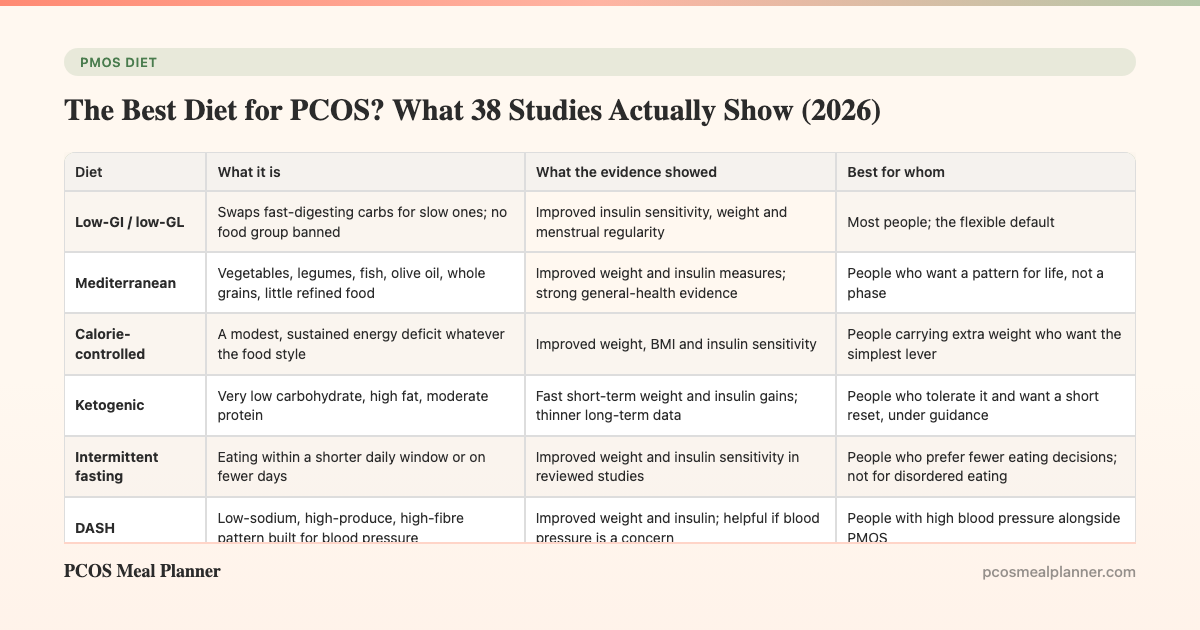
Here is how the main dietary patterns from the review compare on what they are, what the evidence showed, and who they tend to suit. Every row that helped did so mainly by steadying insulin.
Diet
What it is
What the evidence showed
Best for whom
Low-GI / low-GL Swaps fast-digesting carbs for slow ones; no food group banned
Improved insulin sensitivity, weight and menstrual regularity
Most people; the flexible default
Mediterranean Vegetables, legumes, fish, olive oil, whole grains, little refined food
Improved weight and insulin measures; strong general-health evidence
People who want a pattern for life, not a phase
Calorie-controlled A modest, sustained energy deficit whatever the food style
Improved weight, BMI and insulin sensitivity
People carrying extra weight who want the simplest lever
Ketogenic Very low carb, high fat, moderate protein
Fast short-term weight and insulin gains; thinner long-term data
People who tolerate it and want a short reset, under guidance
Intermittent fasting Eating within a shorter daily window or on fewer days
Improved weight and insulin sensitivity in reviewed studies
People who prefer fewer eating decisions; not for disordered eating
DASH Low-sodium, high-produce, high-fibre pattern built for blood pressure
Improved weight and insulin; helpful if blood pressure is a concern
People with high blood pressure alongside PMOS
Low-glycemic-index and low-glycemic-load diets
A low-GI diet keeps the food groups you already eat and changes the version. Steel-cut oats instead of instant, lentils and chickpeas instead of white rice, whole fruit instead of juice. Glycemic load accounts for both the quality and the amount of carb, which is why it predicts the real-world blood sugar response better than GI alone. In the review, low-GI and low-GL patterns improved insulin sensitivity and menstrual regularity, and they do it without banning any food group.
This is the most forgiving place to start because it fails gently. One higher-GI meal does not break it. That flexibility is exactly why low-GI eating tends to stick, and why it maps closely to what an insulin-friendly PMOS plan looks like day to day. A simple plate rule keeps most meals in a low-glycemic-load zone without any counting: fill half the plate with non-starchy vegetables, a quarter with protein, and a quarter with a slow carb.
The Mediterranean diet
The Mediterranean pattern leans on vegetables, legumes, fish, extra-virgin olive oil, nuts and whole grains, with very little refined carb or processed meat. It lowers glycemic load through fibre and fat rather than restriction, and it carries the deepest general-health evidence of any pattern here, for heart health and beyond. In the PCOS studies reviewed, it improved weight and insulin measures.
Its real advantage is longevity. People can eat this way for decades, which matters more than a fast start when PMOS is a lifelong condition. For most readers, a Mediterranean-flavoured, lower-GI plate is the sensible default.
Calorie-controlled diets
A modest, sustained calorie deficit improved weight, BMI and insulin sensitivity in the review, regardless of the exact food style layered on top. For someone carrying extra weight, even a 5 to 10 percent reduction can restart ovulation and improve androgens. The catch is that raw calorie counting is hard to keep up and can tip into an unhealthy relationship with food.
The more durable version is to control calories through the composition of the plate rather than a tracking app: more protein and fibre for fullness, fewer refined carbs and liquid calories. That way the deficit happens with less willpower and less hunger.
Ketogenic diets
A ketogenic diet cuts carb low enough to shift the body toward burning fat for fuel. Because it removes most of the glucose load, it can produce fast improvements in weight and insulin, and it appeared in the review among the patterns that helped. The trade-offs are real. It is socially and practically demanding, the long-term PMOS data are limited, and cutting whole grains, legumes and fruit removes fibre sources that support the gut and cholesterol.
Keto can suit some people as a short, supervised reset or a longer pattern if they genuinely tolerate it. It is not a required step for PMOS, and it is not the automatic winner despite its popularity online. Some women notice changes in energy, sleep or cycle timing on very low carb, so it is worth tracking closely rather than assuming faster is always better. If a keto plan is not something you can picture eating a year from now, a lower-GI plate will usually get you most of the same insulin benefit with far less friction.
Intermittent fasting and time-restricted eating
Intermittent fasting shortens when you eat, not only what you eat. Time-restricted eating, for example an eight to ten hour daily window, lowers the total glucose and insulin load across the day, and in the review it improved weight and insulin sensitivity alongside the other patterns. The important caveat is that it is not for everyone, and anyone with a history of disordered eating should avoid it. The window has to still contain enough protein, fibre and vegetables, or it just becomes skipped meals. We cover the practical setup in the guide to time-restricted eating for PCOS .
The DASH diet
DASH was designed to lower blood pressure, with an emphasis on vegetables, fruit, low-fat dairy, whole grains and low sodium. That structure also lowers glycemic load and raises fibre, so it improved weight and insulin measures in the reviewed studies. It earns its place in a PMOS conversation mainly for women who also have raised blood pressure or a strong family history of hypertension, since it targets both problems with one plate.
The overlap with the other winning patterns is almost total, which is the recurring theme of this whole review. If you already like a produce-heavy plate, DASH needs no special products and no tracking, just a shift toward vegetables, beans and whole grains and away from processed, salty food. The one thing it adds is a deliberate cap on sodium, and that is worth knowing because women with PMOS carry a higher long-term risk of high blood pressure and heart disease.
Where the evidence was inconsistent
Being honest about the limits is part of using this well. The 2026 review found that effects on blood lipids, inflammation and oxidative stress were inconsistent from study to study. That does not mean diet cannot help those markers, it means no single pattern reliably won on them across the evidence. Study designs, durations and populations varied a lot, which is exactly why the authors called for long-term randomised controlled trials.
Two takeaways follow. First, be sceptical of any diet marketed as the definitive anti-inflammatory fix for PMOS, because the pooled data do not support that ranking. Second, some levers beyond the headline diet, such as the gut microbiome, are still being mapped; our explainer on synbiotics for PCOS covers where that evidence currently stands.
Sustainability is the real deciding factor
If most of the diets work through the same mechanism, then the tie-breaker is not the mechanism, it is adherence. The best diet for PCOS is the one you can keep doing on a Tuesday when you are tired, on a budget, cooking for a family, and eating out on the weekend. A diet that drops your insulin 20 percent for three weeks and then collapses loses to a slightly less aggressive plan you follow for three years.
This is where a plan built for your real life beats a plan copied from an influencer. The winning pattern respects your food culture, your cooking time and your budget, because those are the things that decide whether you are still eating this way in six months. Diet also works better paired with movement, especially resistance training, which independently improves insulin sensitivity (Patten and colleagues, 2021).
How to build the best PCOS diet for you
You do not need to pick a brand. You need to hit the shared principles that every winning diet in the review had in common, in a form you will actually keep. Here is the practical order.
Anchor every meal with protein. Aim for a palm or two of protein first, which blunts the glucose response and keeps you full.Lower the glycemic load, do not fear all carbs. Choose slow carbs (oats, legumes, whole fruit, intact grains) over refined ones, and keep portions sensible.Add fibre and healthy fat. Vegetables, legumes, nuts and olive oil steady blood sugar and support the gut.Pick the wrapper you will keep. Mediterranean-flavoured for most, DASH if blood pressure is an issue, a shorter eating window if that suits you, keto only if you tolerate it and have guidance.Move, and re-check. Add two or three strength sessions a week, and track how your cycle, energy and any labs trend over months, not days.
This is exactly what the PCOS Meal Planner automates. Instead of choosing a named diet and hoping, it builds an insulin-friendly plan around the principles all the winning diets share, then matches it to your symptoms, tastes and budget so it is one you can actually sustain. For readers weighing medication alongside food, our guide to GLP-1 medications for PMOS explains how diet and drugs fit together. The bottom line from 38 studies is simple: the best diet for PCOS is not a brand, it is the insulin-friendly pattern you will keep eating, and building that is the whole point of what we do. Start your plan now .
Often asked questions
What is the best diet for PCOS?
There is no single best diet. A 2026 review of 38 studies found low-GI, Mediterranean, calorie-controlled, ketogenic, intermittent fasting and DASH patterns all improved weight, insulin sensitivity, hormones and cycles. No one diet clearly won, so the best is the insulin-friendly pattern you can sustain.
Share this answer
Is keto better than the Mediterranean diet for PCOS?
The 2026 review crowns no winner. Both improved weight, insulin and hormonal measures. Keto can move things faster short-term but is harder to sustain with thinner long-term data. The Mediterranean pattern is easier to keep up for years, so it is the safer default for most people.
Share this answer
Does the type of diet matter for PCOS, or just weight loss?
Both matter, but the mechanism matters most. Much of the benefit tracks with better insulin sensitivity, not the diet label. Even without big weight loss, lowering meal glycemic load and eating enough protein and fibre can improve insulin and hormones.
Share this answer
What do all the diets that help PCOS have in common?
They lower the glycemic load of meals and steady insulin. Low-GI, Mediterranean, keto, DASH, calorie-controlled and intermittent fasting versions that helped all cut refined-carb spikes, included protein, added fibre and leaned on whole foods. Insulin resistance is the shared target.
Share this answer
Does intermittent fasting work for PCOS?
It can. In the 2026 review, intermittent fasting and time-restricted eating improved weight and insulin sensitivity alongside the other diets. A shorter eating window lowers the daily glucose and insulin load. It is not for anyone with a history of disordered eating, and the window still needs enough protein and fibre.
Share this answer
Is there one PCOS diet with the most evidence?
No single diet stands out as the clear leader. The review concluded diet is crucial for PCOS outcomes, but the studies were heterogeneous and long-term trials are still needed. Low-GI and Mediterranean eating have the most consistent support and the best sustainability, which is why guidelines favour flexible, insulin-friendly eating.
Share this answer
Sources and further reading
The 2026 systematic review of PCOS diets
Mechanism: insulin resistance and food order
Exercise alongside diet
Clinical guidelines and patient-facing summaries
Get an insulin-friendly PMOS plan built on the principles all the winning diets share. The 2026 review is clear that no single diet wins, so instead of picking a brand, our
AI PCOS Meal Planner builds a lower-glycemic-load, higher-protein, higher-fibre plan matched to your symptoms, tastes and budget, so it is one you can actually keep eating.
Build your plan now .
How this article was made
The evidence base is the 2026 systematic review by Akbas and colleagues in the European Journal of Nutrition, which pooled 38 studies of nutrition interventions in women with PCOS and reported that most diets improved weight, BMI, waist circumference, insulin sensitivity, reproductive hormones and menstrual regularity, with inconsistent effects on lipids, inflammation and oxidative stress. The insulin-resistance mechanism draws on Diamanti-Kandarakis and Dunaif 2012, food-order effects on Shukla et al.
2015, and the exercise point on Patten et al. 2021. Positioning follows the 2023 International Evidence-Based Guideline for PCOS toward flexible, sustainable eating. PMOS is the new name for PCOS as of 12 May 2026; the underlying biology is unchanged. There is no single best diet for PCOS, individual needs vary, and a doctor or registered dietitian can personalise any plan to your health. This article is informational and not medical advice.
Related reading
Community Comments
Add a comment