Last updated: July 13, 2026 · PMOS is the new name for PCOS as of 12 May 2026. Reviewed against the 2026 time-restricted eating trials.
Quick answer
- Time-restricted eating (TRE) means eating within a set daily window, commonly 8 to 10 hours, and fasting the rest of the day. It is the timing-focused form of intermittent fasting, with no calorie counting.
- In a 2026 RCT of 75 women with PCOS, a 10-hour window improved fasting insulin, HOMA-IR, body weight and waist circumference in just 6 weeks versus eating with no window (Aminian 2026, European Journal of Nutrition).
- An earlier window (8am to 6pm) edged ahead of a mid-day window (11am to 9pm) on some markers, which fits the higher insulin sensitivity earlier in the day.
- The metabolic wins are clear; the hormone wins are not. A 2026 review found no proven effect on testosterone or LH in randomised studies, so do not expect TRE alone to fix androgens.
- Timing is a container, not magic. The window only works if the food inside it is protein-first and insulin-friendly, and some women should avoid restriction entirely.
Want an insulin-friendly plan built around your eating window? Generate a personalised PMOS plan.
What is time-restricted eating, and how is it different from intermittent fasting?
Time-restricted eating is the timing-focused branch of intermittent fasting. You eat within a fixed daily window and take in only water, black coffee or plain tea outside it. There is no calorie counting and no fasting days. A 10-hour window, for example, might run from 9am to 7pm.
Other forms of intermittent fasting work differently. The 5:2 approach cuts calories hard on two separate days a week. Alternate-day fasting swaps between fasting and normal days. TRE keeps every day the same and simply narrows when you eat. That daily consistency is part of why it is easier to sustain and why researchers have tested it specifically in PCOS.
The practical takeaway: when a study says "time-restricted eating," it means a daily eating window, not a starvation protocol. For most women with PMOS, an 8-to-10-hour window is the version worth knowing about.
What did the 2026 PCOS trial find?
The clearest evidence to date comes from a 2026 randomised controlled trial published in the European Journal of Nutrition (Aminian and colleagues). Researchers randomised 75 women with PCOS into three groups for 6 weeks: early TRE (eating 8am to 6pm), mid-day TRE (eating 11am to 9pm), or an ad libitum control group that ate with no window. Fasting insulin was the primary outcome.
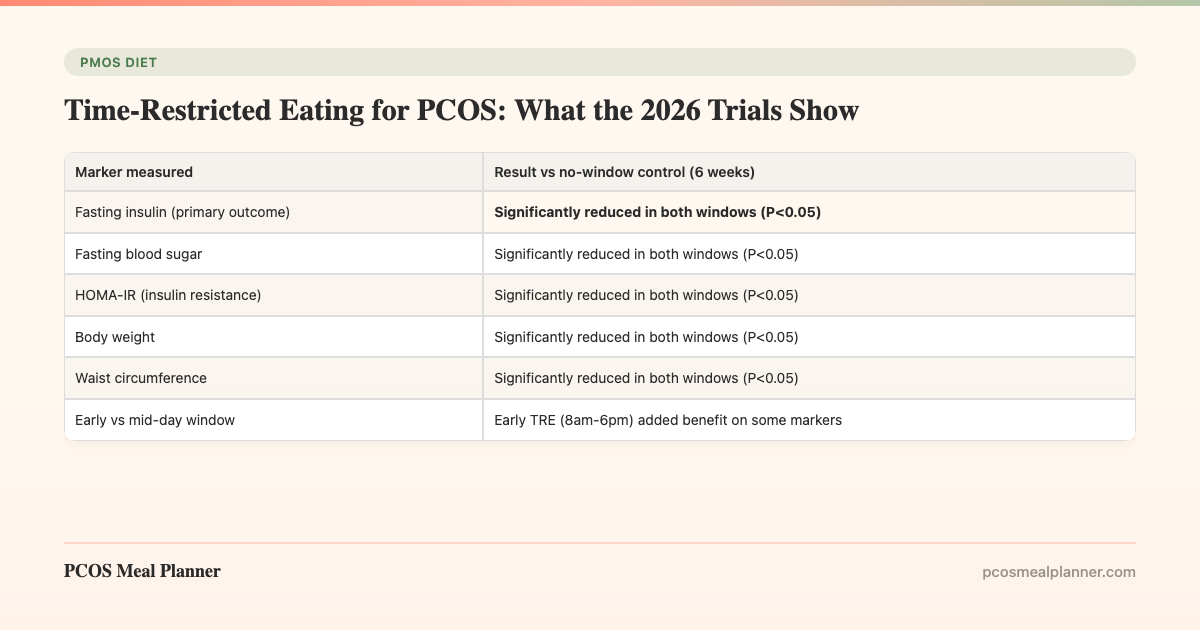
Both TRE groups beat the control group. Early and mid-day windows each produced significant reductions in fasting blood sugar, fasting insulin, HOMA-IR, body weight and waist circumference compared with eating freely (P less than 0.05). Early TRE showed additional benefit on some of those markers. In plain terms: narrowing the eating window to 10 hours, without any instruction to cut calories, moved the exact metabolic numbers that matter most in PCOS.
| Marker measured | Result vs no-window control (6 weeks) |
|---|---|
| Fasting insulin (primary outcome) | Significantly reduced in both windows (P<0.05) |
| Fasting blood sugar | Significantly reduced in both windows (P<0.05) |
| HOMA-IR (insulin resistance) | Significantly reduced in both windows (P<0.05) |
| Body weight | Significantly reduced in both windows (P<0.05) |
| Waist circumference | Significantly reduced in both windows (P<0.05) |
| Early vs mid-day window | Early TRE (8am-6pm) added benefit on some markers |
Two honest caveats keep this in proportion. The trial was 6 weeks, so it tells us about short-term change, not year-out results. And it studied 75 women, which is a solid but not enormous sample. Even so, it is a randomised trial pointing in a consistent direction, which is stronger evidence than the observational data that came before it.
Early window vs mid-day window: does the timing matter?
Both windows worked, and the early one had a small edge. In the 2026 trial, early TRE (8am to 6pm) outperformed mid-day TRE (11am to 9pm) on some metabolic markers, even though both windows were the same 10-hour length.
This lines up with circadian biology. Your body handles glucose better earlier in the day, when insulin sensitivity is naturally higher. The same meal eaten at 8am often produces a smaller glucose and insulin rise than at 9pm. Front-loading food toward the morning, and closing the kitchen a few hours before bed, works with that rhythm instead of against it.
Do not over-read the difference, though. The gap between the two windows was modest, and a mid-day window still delivered real benefit. The best window is the 8-to-10-hour one you can actually keep most days. A consistent 11am-to-9pm window beats an ambitious 8am-to-4pm window you abandon by Wednesday.
Why does time-restricted eating help PMOS?
Insulin resistance sits upstream of most PCOS symptoms. When cells respond poorly to insulin, the pancreas pumps out more of it, and chronically high insulin drives the ovaries to make more androgens and lowers SHBG (Diamanti-Kandarakis and Dunaif, 2012). Anything that lowers the insulin load has leverage over the whole cascade, which is mapped out in the PMOS hormone cascade explainer.
Time-restricted eating lowers that insulin load in two ways. First, a shorter eating window usually means fewer eating occasions and a natural, unforced drop in intake, which reduces total insulin exposure across the day. Second, closing the window earlier removes late-night meals, the point when glucose tolerance is at its worst. The trial results, lower fasting insulin and HOMA-IR, are exactly what you would predict if the mechanism is reduced insulin exposure aligned to the body clock.
There is a rest-and-recovery angle too. A long daily eating window keeps the metabolic machinery working almost continuously, while a defined fasting period gives it a break. It is worth being disciplined about the evidence here: the measurable win in the 2026 trial was insulin, not a long list of downstream effects. So anchor on that one clear mechanism, less insulin, more of the time, working with the body clock rather than against it.
The honest hormone picture (what TRE does not clearly do)
Here is where careful sources part ways with the hype. The metabolic case is solid, but the reproductive-hormone case is not, and a 2026 systematic review makes that plain. Jirapak and colleagues (Nutrition and Health) reviewed 6 studies of time-restricted eating and androgen markers in adult women.
In women with general obesity, randomised trials found no significant change in testosterone, oestrogen, progesterone, LH, cortisol, DHEA or SHBG. In women with PCOS specifically, some non-randomised studies did report lower testosterone and LH, but the review flagged that those changes may be driven by weight loss rather than the meal timing itself. The reviewers concluded that TRE appears hormonally safe as a weight-loss strategy, that a PCOS-specific hormone benefit is inconclusive, and that more long-term randomised trials are needed.
The honest read: use time-restricted eating for its metabolic effects (insulin, HOMA-IR, weight, waist), which are backed by randomised data. Do not expect it, on its own, to reliably lower testosterone or regulate LH. If your androgens improve, it is most likely riding along with weight and insulin change, not the clock alone.
How to combine time-restricted eating with a PMOS-friendly diet
The window is a container. What you put in it decides most of the outcome. A 10-hour window packed with refined carbs will not reproduce the trial results, because the insulin spikes happen inside the window regardless of how long it is.
Keep the PMOS fundamentals inside your eating window:
- Build every meal protein-first. Aim for 25 to 40g of protein per meal. Eating protein and vegetables before starch measurably lowers the post-meal glucose and insulin response (Shukla and colleagues, Diabetes Care 2015).
- Anchor with fibre. Vegetables, legumes and lower-glycaemic carbs slow glucose absorption and feed the gut. Gut health and insulin sensitivity are linked, which is why synbiotics for PCOS can complement a timing approach.
- Use a Mediterranean fat profile. Olive oil, nuts, seeds and oily fish over refined and fried fats.
- Break your fast with protein, not sugar. A protein-forward first meal sets the tone for glucose stability across the whole window.
Put simply: the same insulin-friendly plate that helps PMOS on its own is what makes the eating window earn its keep. The timing amplifies good food; it does not rescue poor food.
A simple 10-hour window to start
You do not need to jump straight to a tight window. Ease in and let it become a habit.
- Start at 12 hours. For the first week, eat within a 12-hour window, for example 8am to 8pm. This alone removes late-night snacking for most people.
- Shrink to 10 hours. Move to a 10-hour window you can keep 5 or 6 days a week, such as 9am to 7pm or the trial's 8am to 6pm.
- Break the fast with protein. Eggs, Greek yogurt, cottage cheese or a protein shake, paired with fibre.
- Hydrate during the fast. Water, black coffee and plain tea are fine and help with hunger.
- Protect sleep and consistency. Keep the window roughly the same each day. An irregular window loses the circadian advantage.
For a step-by-step protocol with meal timing and troubleshooting, see the companion guide on how to do time-restricted eating with PCOS.
What results can you realistically expect, and when?
Set expectations to the evidence, not the marketing. The 2026 trial ran for 6 weeks, so it shows short-term change in fasting insulin, HOMA-IR, weight and waist. That is the honest timeframe to hold in mind: think in terms of the first month or two of consistent practice, not an overnight fix.
Response also varies from woman to woman. Some see fasting glucose settle and clothes fit differently within a few weeks. Others need longer, and a few find a strict window hard to sustain and get more from simply eating protein-first at every meal. None of those outcomes is a failure. The number that matters most in PCOS is the trend in fasting insulin and HOMA-IR across months, which is worth tracking with your doctor rather than chasing the scale each morning.
One reframe helps a lot: do not judge time-restricted eating by weight alone. In the trial, the insulin and waist changes are the headline, and those can improve even while the scale moves slowly. If your energy steadies, cravings ease and the post-meal slump fades, the eating window is doing its real job on the biology that drives PMOS.
Who should be cautious with time-restricted eating
Time-restricted eating is a tool, not a rule, and it is not right for everyone. A narrowed eating window can do harm in the wrong situation.
Speak to a doctor before trying an eating-window restriction if any of these apply:
- A history of disordered eating. Rules around when you can and cannot eat can reactivate restrictive or binge patterns. For many people in recovery, TRE is the wrong tool.
- Functional hypothalamic amenorrhea or missing periods from under-eating. If your period has stopped because of low energy availability, further restriction can make it worse, not better.
- Pregnancy or breastfeeding. Energy and nutrient needs are higher, and fasting windows are not appropriate.
- Glucose-lowering medication. If you take insulin or a sulfonylurea, longer fasts can cause hypoglycaemia. Your prescriber may need to adjust doses before you change your eating window.
Whatever your situation, the eating window should never push your total intake too low. If you feel dizzy, exhausted or preoccupied with food, widen the window.
How the PCOS Meal Planner builds a plan around your window
Knowing the window is the easy part. Filling it with the right food, every day, is where most plans fall apart. The PCOS Meal Planner builds insulin-friendly meals designed to fit your chosen eating window, so your first meal is protein-forward, your carbs are lower-glycaemic, and the macros match what the 2026 trial rewarded. You set the window; the system fills it with meals that make the timing count. Build your insulin-friendly PMOS plan now.
Often asked questions
Does time-restricted eating help PCOS?
Yes, for metabolic markers. A 2026 RCT of 75 women with PCOS found a 10-hour eating window significantly reduced fasting blood sugar, fasting insulin, HOMA-IR, body weight and waist circumference over 6 weeks versus no window (Aminian, European Journal of Nutrition). The reproductive-hormone benefit is still uncertain.
What is the best eating window for PCOS?
The window tested in the 2026 trial was 10 hours, eaten consistently every day. Both an early window (8am to 6pm) and a mid-day window (11am to 9pm) worked. The best window is the 8-to-10-hour one you can keep most days without disrupting sleep or medication timing.
Is early or mid-day time-restricted eating better for PCOS?
Both helped, and the early window (8am to 6pm) edged ahead of the mid-day window (11am to 9pm) on some markers. That fits the higher insulin sensitivity earlier in the day. The difference was modest, so a consistent mid-day window is still worthwhile if an early one is not realistic.
Does time-restricted eating lower testosterone or other PCOS hormones?
Not clearly. A 2026 review (Jirapak, Nutrition and Health) found no significant change in testosterone, oestrogen, progesterone, LH, cortisol, DHEA or SHBG in randomised studies. Some PCOS studies reported lower testosterone and LH, but likely from weight loss, not the timing itself. TRE appears hormonally safe, but the hormone benefit is unproven.
Who should not try time-restricted eating with PCOS?
Seek guidance first if you have a history of disordered eating, functional hypothalamic amenorrhea or a missing period from under-eating, or are pregnant or breastfeeding. If you take insulin or a sulfonylurea, longer fasts can cause low blood sugar, so speak to your prescriber before changing your eating window.
How do I combine time-restricted eating with a PCOS diet?
The window is a container; the food inside decides most of the result. Keep meals protein-first, add fibre-rich vegetables and legumes, choose lower-glycaemic carbs, and use a Mediterranean fat profile. Eating protein and vegetables before starch lowers the glucose response (Shukla 2015). A window full of refined carbs will not deliver the trial results.
Sources and further reading
Time-restricted eating in PCOS (2026 evidence)
- Aminian M et al. Effect of two types of time-restricted eating on glycemic, lipid indices, and weight in women with polycystic ovary syndrome: a randomized controlled trial. Eur J Nutr. 2026
- Jirapak A et al. Impact of time-restricted eating on reproductive hormones and androgen markers in adult females: a systematic review. Nutr Health. 2026
Insulin resistance and PCOS pathophysiology
Food order and post-meal glucose
Clinical guidelines and patient-facing summaries
- International Evidence-Based Guideline for PCOS (Monash, 2023)
- NHS: Polycystic ovary syndrome (PCOS)
- Mayo Clinic: PCOS
How this article was made
The core evidence is the 2026 randomised controlled trial by Aminian et al. in the European Journal of Nutrition (75 women with PCOS, 6 weeks, early vs mid-day 10-hour windows vs ad libitum control) and the 2026 systematic review by Jirapak et al. in Nutrition and Health on time-restricted eating and reproductive hormones. The insulin-resistance mechanism draws on Diamanti-Kandarakis and Dunaif 2012, and the protein-first food-order effect on Shukla et al.
2015. Aligned with the 2023 International Evidence-Based Guideline for PCOS, the NHS and Mayo Clinic patient summaries. We deliberately keep the honest nuance that metabolic benefits are better supported than hormone benefits. PMOS is the new name for PCOS as of 12 May 2026; the underlying biology is unchanged. This article is informational and is not medical advice; talk to your own doctor before changing how or when you eat, especially if you take medication.
Community Comments
Add a comment