First-party disclosure. PCOS Meal Planner is a competing product to MyFitnessPal in the meal-planning space. We have written this guide to be useful to women who currently use MyFitnessPal and want to make it work for PCOS. Where we believe a different tool serves PCOS better, we say so explicitly. The "Honest side-by-side" section near the end is the only place we make a direct product recommendation.
Why MyFitnessPal can work for PCOS, with the right settings
MyFitnessPal is the most-used food and macro tracking app in the world (220M+ accounts). For women with PCOS who already use it, the question is rarely "should I switch tools?" It is "can I configure this to actually support insulin sensitivity, cycle regulation, and the macro pattern PCOS actually responds to?" The honest answer: yes, but only on Premium+, and only after you change the default macro split that the app sets for you. Out of the box, MyFitnessPal's defaults are calibrated for general weight control, not for the insulin-resistant PCOS phenotype that 70 percent of PCOS women fall into.
This guide covers the exact settings that make MyFitnessPal PCOS-aware, what to log carefully, and the four things MyFitnessPal structurally cannot do for PCOS no matter how you configure it.
The macro split that actually works for PCOS
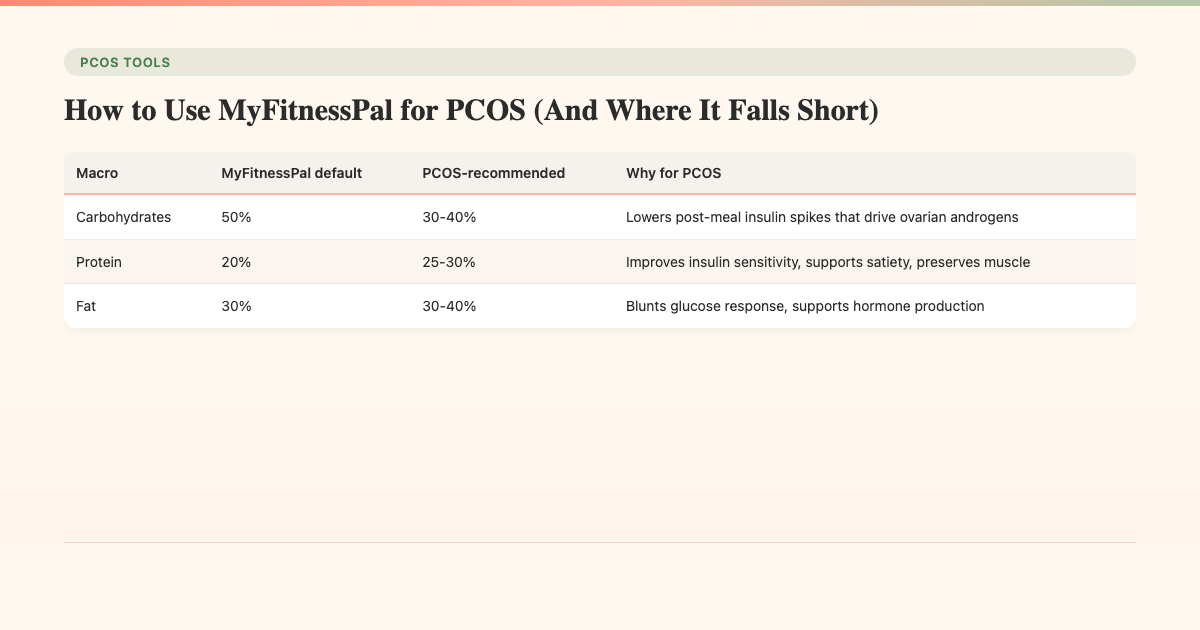
The single most important configuration change is the macro split. MyFitnessPal's default is about 50 percent carbs, 20 percent protein, 30 percent fat. The 2023 International Evidence-based Guideline for the Assessment and Management of PCOS supports a much higher protein and lower carb pattern for most insulin-resistant PCOS phenotypes:
| Macro | MyFitnessPal default | PCOS-recommended | Why for PCOS |
|---|---|---|---|
| Carbs | 50% | 30-40% | Lowers post-meal insulin spikes that drive ovarian androgens |
| Protein | 20% | 25-30% | Improves insulin sensitivity, supports satiety, preserves muscle |
| Fat | 30% | 30-40% | Blunts glucose response, supports hormone production |
Step-by-step: setting your macros for PCOS in MyFitnessPal Premium+
- Open MyFitnessPal Premium+ on web (the mobile app's settings UI is more limited).
- Go to My Home → Goals → Calorie, Carbs, Protein and Fat Goals.
- Switch from "Percentage" to "Gram" goals if you want hard limits, or stay on percentage. Most PCOS users do better with percentage targets.
- Set Carbs to 35%, Protein to 30%, Fat to 35% as a starting point. Adjust over 4-6 weeks based on energy, cravings, and cycle response.
- Optional: enable fiber tracking and set the goal to 28g/day minimum.
- If you have access to net carbs tracking on Premium+, enable it. Net carbs (total carbs minus fiber) is more useful than total carbs for PCOS insulin response.
What about lean PCOS or post-pill PCOS?
Lean PCOS and post-pill PCOS phenotypes often have less aggressive insulin resistance and may need a slightly higher carb tolerance (35-45 percent), with more attention to adequate calorie intake (cortisol-driven phenotypes are made worse by aggressive deficits). Start at 40 percent carbs, 25 percent protein, 35 percent fat and adjust based on cycle and energy response.
Foods to log carefully (the deceptive ones)
MyFitnessPal's database is crowdsourced and contains thousands of duplicate or inaccurate entries. For PCOS specifically, log these categories with extra care:
- Yogurts. Many "Greek yogurt" entries are actually conventional yogurt with added sugar. Verify the protein per 100g matches what is on the actual label (true Greek yogurt has 8-10g protein per 100g; flavored versions are often 4-6g and have 12-15g added sugar).
- Protein bars and "low-carb" snacks. Sugar alcohols, fiber from non-traditional sources, and rounded macros can underrepresent the actual glycemic load. Cross-check the label.
- Restaurant meals. Crowdsourced restaurant entries are often optimistic by 100-300 calories and 20-40g of carbs. When possible, use the restaurant's own published nutrition data.
- Smoothies and bowls. Even "healthy" smoothies often clock 50-80g of carbs from concentrated fruit. The post-meal insulin response of a smoothie is often much higher than the same calories from whole foods.
- Granola, bars, and cereals. "Healthy" labeling does not protect against high added-sugar content. PCOS-aware logging means looking at sugar grams, not just total carbs.
- Sauces, dressings, and condiments. Easy to forget. A serving of barbecue sauce or sweet salad dressing can add 10-15g of sugar.
What MyFitnessPal cannot do for PCOS, no matter how you configure it
These are structural gaps in the product, not user error.
1. No insulin-response weighting
MyFitnessPal treats 30g of carbs as 30g of carbs whether they came from sweet potato + protein + olive oil (low glycemic load, blunted insulin response) or from a glass of orange juice (high glycemic load, sharp insulin response). The two have very different impacts on PCOS symptoms even at identical macro counts. PCOS-aware nutrition apps weight food combinations and glycemic load; MyFitnessPal does not.
2. No cycle, symptom, or ovulation tracking
MyFitnessPal has no native menstrual cycle, ovulation, or PCOS symptom tracking. You cannot log cycle phase, symptom severity (acne, hirsutism, mood, energy), or ovulation indicators. For PCOS, the most useful insight is "which meal patterns correlate with symptom improvement over a cycle" — and you need both data streams to see that pattern.
3. No PCOS-specific recipe library
MyFitnessPal's meal-planning library (Premium+ feature) supports general diets (low-carb, keto, Mediterranean, paleo, etc.) but does not have a PCOS-specific recipe library. The recipes that approximate PCOS-friendly are scattered across the keto and Mediterranean libraries, with no curation by phenotype.
4. No PCOS-trained AI coach
MyFitnessPal's AI coach (Premium+) is trained on general nutrition and weight control. It does not understand the androgen-insulin loop, lean PCOS specifics, or the diet changes that move PCOS markers specifically. Asking it "what should I eat with PCOS" returns generic healthy-eating advice rather than phenotype-specific guidance.
When to switch tools, and what to switch to
Three signals that MyFitnessPal has hit its ceiling for your PCOS journey:
- You're hitting your macro and calorie targets but cycle, skin, or energy aren't moving after 8-12 weeks of consistent logging.
- You want to track cycle and symptom alongside food without copying data between apps.
- You want recipe suggestions that are weighted for PCOS specifically, not generic low-carb or Mediterranean.
If you do switch, the realistic options are PCOS Meal Planner (web app, $7.99/month, PCOS-native macros and recipes plus AI coach), Cysterhood (mobile app, $20/month, RD-founded, recipe library), or Allara Health (telehealth + meal guidance, $125-149/month, includes doctor access).
Honest side-by-side: MyFitnessPal vs PCOS Meal Planner
| Feature | MyFitnessPal Premium+ | PCOS Meal Planner |
|---|---|---|
| Cost | $99.99/year | $39.99/year ($7.99/month) |
| PCOS-aware macro defaults | No (must reconfigure) | Yes, by phenotype |
| Personalized weekly meal plan | Generic templates | Built around your phenotype + preferences |
| PCOS-specific recipe library | No | 500+ PCOS-tagged recipes |
| Cycle & symptom tracking | No | Yes, integrated with meal log |
| PCOS-trained AI coach | No | Yes |
| Food database breadth | Industry-leading (14M+ items) | Smaller, PCOS-curated |
| Barcode scanning | Yes | Limited |
| Best for | General macro tracking, broad food database needs | PCOS-specific meal planning + symptom-aware nutrition |
Honest recommendation: if you only need to track macros and you have already spent time configuring MyFitnessPal for PCOS, there is no urgent reason to switch. If you want PCOS-aware meal planning, recipe curation by phenotype, and integrated cycle and symptom tracking, MyFitnessPal cannot do those things and a PCOS-native tool will. Start a free 7-day trial of PCOS Meal Planner to compare in your own routine.
Frequently Asked Questions
Can MyFitnessPal track PCOS?
MyFitnessPal can track macros and calories, which are useful for PCOS, but it does not natively track menstrual cycle, ovulation, PCOS symptoms (acne, hirsutism, energy, mood), or PCOS-specific micronutrients (magnesium, inositol, chromium, zinc). For symptom-aware PCOS care, a dedicated PCOS app pairs better.
What macro split should I use in MyFitnessPal for PCOS?
Most evidence-based starting points for insulin-resistant PCOS phenotypes are 30 to 40 percent carbs, 25 to 30 percent protein, 30 to 40 percent fat. The default MyFitnessPal split (50 percent carbs) is too carb-heavy for most insulin-resistant phenotypes. Lean PCOS and post-pill PCOS often tolerate slightly higher carb percentages (35-45 percent) with more emphasis on adequate calorie intake.
Should I count calories with PCOS?
Mixed evidence. A modest calorie deficit drives weight loss across all phenotypes, but aggressive deficits worsen HPA-axis stress and can backfire with PCOS by raising cortisol, which raises insulin, which sustains androgen excess. For most women, focusing on macro balance, meal composition, and meal timing produces better results than strict calorie counting.
Is the free version of MyFitnessPal enough for PCOS?
The free version does not allow custom macro percentages, so you are stuck with the default 50/20/30 split that is too carb-heavy for most PCOS phenotypes. Premium+ ($99.99/year) is required to set PCOS-appropriate macros, which makes it functionally equivalent in cost to a dedicated PCOS app.
Can I use MyFitnessPal alongside a PCOS app?
Yes. Some women keep MyFitnessPal for its food database breadth and barcode scanning while using a PCOS-specific app for meal planning, recipes, and symptom tracking. The downside is double-logging and no automatic data sharing between the two.
Does MyFitnessPal have any PCOS-specific features?
No. MyFitnessPal does not offer PCOS-specific macro defaults, recipe libraries, symptom tracking, or coaching. The platform is built for general nutrition and weight control. PCOS support comes entirely from the user's own configuration choices.
Sources
- Teede HJ, Tay CT, Laven JJE, et al. Recommendations from the 2023 International Evidence-based Guideline for the Assessment and Management of Polycystic Ovary Syndrome. Fertility and Sterility. 2023;120(4):767-793. PubMed: 37580056
- Moran LJ, Ko H, Misso M, et al. Dietary composition in the treatment of polycystic ovary syndrome. Journal of the Academy of Nutrition and Dietetics. 2013;113(4):520-545. PubMed: 23420000
- Sorensen LB, Soe M, Halkier KH, Stigsby B, Astrup A. Effects of increased dietary protein-to-carb ratios in women with polycystic ovary syndrome. American Journal of Clinical Nutrition. 2012;95(1):39-48. PubMed: 22158730
- Lim SS, Hutchison SK, Van Ryswyk E, et al. Lifestyle changes in women with polycystic ovary syndrome. Cochrane Database of Systematic Reviews. 2019;3(3):CD007506. PubMed: 30921478
- National Institutes of Health, Office of Dietary Supplements. Magnesium, Zinc, Chromium, Vitamin D fact sheets. NIH ODS
Related reading on PCOS Meal Planner
- PCOS 101: Complete Dietitian-Reviewed Guide
- The PCOS Grocery List
- Insulin Resistance Meal Plan for PCOS
- Why Calorie Restriction Backfires in PCOS
- PCOS Protein Calculator
How this article was researched
This guide was built from a hands-on review of MyFitnessPal Premium+ (April 2026), the published macro recommendations in the 2023 International Evidence-based Guideline for the Assessment and Management of PCOS, the 2019 Cochrane systematic review on lifestyle changes for PCOS, and primary nutrition research on protein-to-carb ratios in PCOS. The first-party perspective is disclosed at the top of the article. This article is being prioritized for medical review by our contracted Registered Dietitian Nutritionist as part of our retroactive review program. See our editorial standards.
Community Comments
Add a comment