Last updated: June 15, 2026 · PMOS is the new name for PCOS as of 12 May 2026. Educational content reviewed against fertility-organisation guidance. Not medical advice.
Quick answer
- No, PMOS (PCOS) does not directly affect male fertility. PMOS (Polyendocrine Metabolic Ovarian Syndrome) is defined by ovarian function, so it is a female condition. It acts on her cycle and ovulation, not on a man's sperm.
- The right question for a male partner is his OWN metabolic health. A man's fertility depends on his own sperm quality, hormones and lifestyle, none of which his partner's PMOS changes.
- Where the link does show up is metabolic. Fertility organisations (ASRM, Mayo Clinic, NHS) report that obesity, insulin resistance and metabolic syndrome are linked to poorer sperm parameters. That same metabolic pattern is the core of PMOS.
- A man from a PMOS family may carry the metabolic phenotype. The shared genetics affect insulin signalling and androgen handling (Cannarella 2018), so screening his own metabolic health is reasonable.
- What to do: a male partner can look after his own metabolic and reproductive health with insulin-friendly eating, activity and a doctor's review. This is education, not a promise about conception.
Cooking for a household where someone has PMOS? Build one insulin-friendly plan everyone eats.
The question that does matter for a male partner is your own metabolic health, because the same insulin-resistance pattern that sits at the centre of PMOS is also linked, by fertility organisations, to poorer sperm parameters. This guide explains what PMOS does and does not do to a couple's fertility, where the male side actually fits, and what a male partner can usefully do. It is education, not a promise about conception.
Does PMOS (PCOS) affect male fertility?
No, not directly. PMOS stands for Polyendocrine Metabolic Ovarian Syndrome, and the diagnosis depends on ovarian features: irregular ovulation, polycystic ovaries on ultrasound, and androgen excess in a female endocrine system. A man does not have ovaries, so PMOS cannot occur in him and cannot act on his reproductive system from the outside.
Your partner's PMOS does not change your sperm, your hormones or your fertility. Those depend on your own body. The only place PMOS becomes relevant to a man is the metabolic pattern underneath it, and even then the issue is his own metabolic health, not her diagnosis. So the useful question is not "does her PMOS affect me" but "is my own metabolic and reproductive health in good shape."
What PMOS does and does not do to a couple's fertility
It helps to separate the two sides of a couple's fertility picture. PMOS sits firmly on one side.
- What PMOS does: it can affect a woman's ovulation. Irregular or absent ovulation is one of the most common reasons couples with PMOS take longer to conceive. That is her side of the picture, and it is covered in the dedicated guide linked below.
- What PMOS does not do: it does not reach across to the man. It does not lower his sperm count, change his testosterone, or alter his fertility in any direct way.
This matters for how a couple approaches things. Her PMOS care addresses her ovulation. His fertility is a separate assessment about his own health. Both sides deserve attention, and one does not substitute for the other. For her side, see PMOS and trying to conceive: the male partner's guide.
The male side: how metabolic health relates to sperm quality
Here is where PMOS and male fertility share a thread, but only through metabolism. Fertility organisations report that a man's metabolic health is connected to his sperm quality.
The American Society for Reproductive Medicine (ASRM), the Mayo Clinic and the NHS all describe obesity and related metabolic problems as factors that can affect male fertility. According to these organisations, excess weight, insulin resistance and metabolic syndrome are linked to poorer sperm parameters, including lower sperm count, reduced motility and shifts in reproductive hormones. The mechanisms they point to include hormonal disruption, oxidative stress, and raised scrotal temperature from excess body fat.
That metabolic pattern, insulin resistance and metabolic syndrome, is the same pattern that sits at the centre of PMOS. Insulin resistance is a well-established driver of PMOS (Diamanti-Kandarakis and Dunaif, 2012). So the link between PMOS and male fertility is not direct; it runs through shared metabolic biology. A man who carries the same metabolic pattern may see it reflected in his sperm, regardless of his partner's diagnosis.
The genetics overlap: men from a PMOS family
There is one more reason a male partner might pay attention to his own metabolic health: he may be from a PMOS family himself. PMOS is polygenic and the genes that contribute most affect insulin signalling and androgen metabolism. Those genes are inherited by sons as well as daughters.
Cannarella and colleagues (2018) reviewed whether a male equivalent of the PCOS genotype exists and described a recognisable metabolic phenotype in male first-degree relatives, centred on insulin resistance and altered androgen handling. A man does not get PMOS from this, because he has no ovaries, but he can carry the metabolic tendency. Combined with the organisation guidance above, that gives a man from a PMOS family a sensible reason to look after his metabolic health and to mention the family history to his doctor. The hub guide covers this in full: is there a male equivalent of PMOS.
The shared metabolic thread, summarised
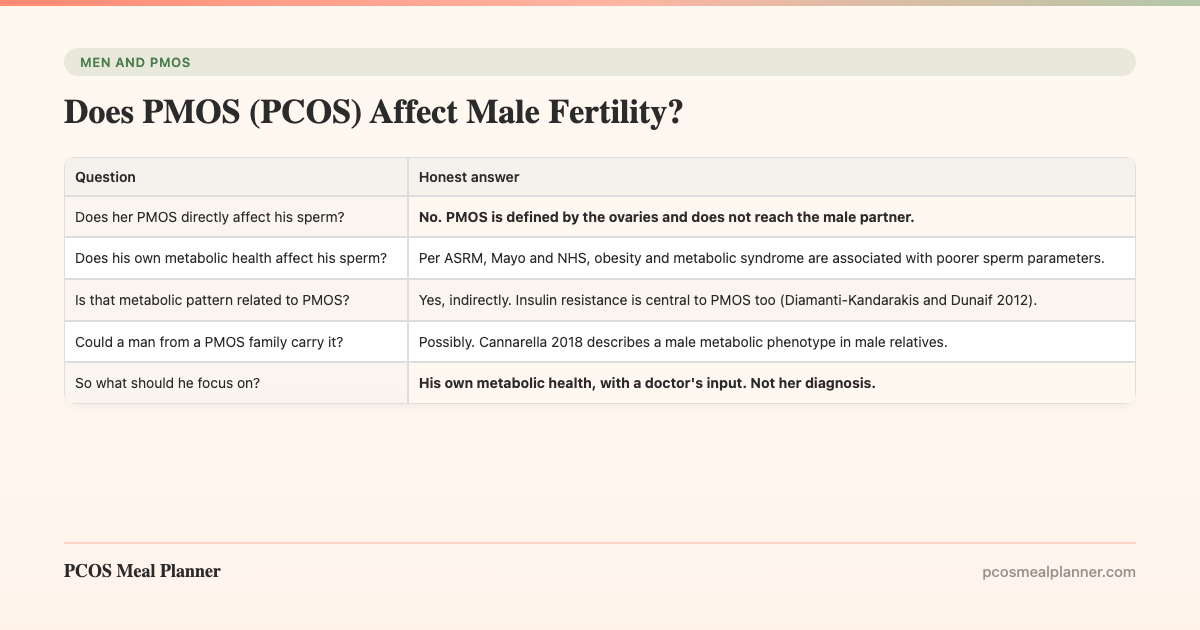
Because the link is easy to misread, here is the relationship laid out plainly.
| Question | Honest answer |
|---|---|
| Does her PMOS directly affect his sperm? | No. PMOS is defined by the ovaries and does not reach the male partner. |
| Does his own metabolic health affect his sperm? | Per ASRM, Mayo and NHS, obesity and metabolic syndrome are linked to poorer sperm parameters. |
| Is that metabolic pattern related to PMOS? | Yes, indirectly. Insulin resistance is central to PMOS too (Diamanti-Kandarakis and Dunaif 2012). |
| Could a man from a PMOS family carry it? | Possibly. Cannarella 2018 describes a male metabolic phenotype in male relatives. |
| So what should he focus on? | His own metabolic health, with a doctor's input. Not her diagnosis. |
What a male partner can do for his own metabolic and reproductive health
The genetics and the diagnosis are not in your hands. Your own metabolic health largely is. Fertility organisations give consistent, practical advice, and none of it is a guarantee about conception.
- Reach and keep a healthy weight. Carrying excess weight is the metabolic factor most often linked to sperm quality by ASRM, Mayo and the NHS. Even modest changes can move metabolic markers.
- Eat an insulin-friendly pattern. Moderate carb, higher protein, higher fibre, a Mediterranean fat profile, and fewer refined-carb spikes. This is the same way of eating that supports PMOS, because the upstream metabolic driver overlaps.
- Build muscle and stay active. Muscle is the largest insulin-sensitive tissue. Regular activity and a couple of strength sessions a week improve insulin sensitivity over weeks.
- Protect sleep and manage stress. Both influence insulin sensitivity and hormone balance.
- Limit smoking, heavy alcohol and prolonged scrotal heat. These are commonly listed by fertility organisations as factors that can affect sperm.
- Talk to a doctor. If you have been trying for a while, ask about a semen analysis and a metabolic review. A specialist should guide anything specific.
The full diet detail for men sits in the spoke on the insulin-resistance diet for men.
When to see a doctor or get a semen analysis
Fertility organisations generally suggest that a couple seek assessment if they have been trying to conceive for about a year without success, or sooner if there are known risk factors or the woman is older. When a couple is assessed, both partners are looked at, because male factors contribute to around half of cases overall.
The standard first test for the male partner is a semen analysis, which measures count, motility and shape. This is routine, not a reflection of anyone's diagnosis. If you are worried, or if you carry metabolic risk yourself, raise it early. Acting on metabolic health is most useful before, not after, problems set in. Always follow the guidance of your own doctor or a fertility specialist.
Where the household plan helps both of you
This is the one place her PMOS and his metabolic health genuinely overlap: the food. The insulin-friendly way of eating that supports PMOS is the same pattern fertility organisations point to for metabolic health, so a single household plan serves both partners. The PCOS Meal Planner builds insulin-friendly meals around that shared metabolic pattern, so a wife with PMOS and a husband looking after his own metabolic health eat from the same plan. You are not running two kitchens or cooking "diet food" for one person. You are cooking one set of meals that works for the household. Build a household plan now.
Often asked questions
Does PMOS (PCOS) affect male fertility?
No, not directly. PMOS (the new name for PCOS as of 12 May 2026) is defined by ovarian function, so it is a female condition that affects her ovulation, not his sperm. A male partner's fertility depends on his own sperm quality, hormones and lifestyle. The only relevance to a man is the shared metabolic pattern, which is about his own health.
Can a man catch or develop PMOS from his partner?
No. PMOS is not contagious and a man cannot develop it, because it is defined by the ovaries. Living with a partner who has PMOS causes no direct hormonal change in a man. What he can usefully focus on is his own metabolic health, which supports his own reproductive health.
How does a man's metabolic health affect his sperm?
Fertility organisations (ASRM, Mayo Clinic, NHS) report that obesity, insulin resistance and metabolic syndrome are linked to poorer sperm parameters, including lower count and reduced motility. The good news is that metabolic health is modifiable through diet, weight control and activity.
If my partner has PMOS, should I get my fertility checked too?
If a couple has been trying to conceive without success, fertility organisations recommend assessing both partners, because male factors contribute to roughly half of cases. A semen analysis is the standard first male test. This is good practice, not a reflection of her PMOS. Speak to a doctor about timing.
Does a man from a PMOS family have worse fertility?
Not necessarily, but he may carry the shared metabolic phenotype. Cannarella (2018) describes a male equivalent of the PCOS genotype in male relatives, centred on insulin resistance. Since that pattern is linked to sperm quality, looking after his own metabolic health and flagging the family history to a doctor is sensible.
What can a male partner do for his own fertility and metabolic health?
Fertility organisations advise keeping a healthy weight, eating an insulin-friendly diet, staying active, building muscle, sleeping enough, and limiting smoking and heavy alcohol. These support metabolic health and may help sperm quality. None are guarantees about conception, so let a doctor guide anything specific.
Sources and further reading
Male fertility and metabolic health (organisation guidance)
- American Society for Reproductive Medicine (ASRM): patient details on fertility
- Mayo Clinic: Male infertility, symptoms and causes
- NHS: Infertility overview
The male metabolic equivalent and shared genetics
- Cannarella R et al. Does a male polycystic ovarian syndrome equivalent exist? J Endocrinol Invest. 2018
- Diamanti-Kandarakis E, Dunaif A. Insulin resistance and the polycystic ovary syndrome revisited. Endocr Rev. 2012
PMOS / PCOS clinical guidance and patient summaries
- International Evidence-Based Guideline for PCOS (Monash, 2023)
- NHS: Polycystic ovary syndrome (PCOS)
How this article was made
This article is educational and not medical advice, and it makes no promises about conception. The core point, that PMOS is a female condition defined by the ovaries and does not directly affect a male partner's fertility, follows from the diagnostic definition of the condition and the 2023 International Evidence-Based Guideline for PCOS. Claims about how obesity, insulin resistance and metabolic syndrome relate to sperm parameters are attributed to fertility organisations: the American Society for Reproductive Medicine (ASRM), the Mayo Clinic and the NHS, rather than to any single study.
The shared metabolic biology between PMOS and the male phenotype draws on Cannarella et al. 2018 in the Journal of Endocrinological Investigation and on Diamanti-Kandarakis and Dunaif 2012 on insulin resistance. PMOS is the new name for PCOS as of 12 May 2026; the underlying biology is unchanged. Anything specific to your situation should be guided by your own doctor or a fertility specialist.
Community Comments
Add a comment