The male PMOS-family plate
A round plate divided into three sections. The largest section, about 30 to 40 percent, is protein with example foods of chicken, salmon, eggs, Greek yoghurt and lentils. A second section, about 30 percent, is non-starchy vegetables and fibre with example foods of leafy greens, broccoli, peppers and beans. The third section, about 30 percent, is smart carbohydrate and Mediterranean fats with example foods of oats, quinoa, olive oil, nuts and berries. A note at the bottom states that the same plate simply scales up in portion size from the household PMOS plan to suit a typical adult man.
The Male PMOS-Family Plate
Same insulin-friendly plate as PMOS, scaled up for a typical adult man
What is the insulin resistance diet for men?
The insulin resistance diet for men is a moderate-carb, higher-protein, higher-fibre way of eating with a Mediterranean fat profile. It is not a brand or a fad. It is a pattern designed to keep blood glucose steady so the pancreas does not have to pump out excess insulin meal after meal.
The key point for men in a PMOS family: this is the same pattern the women in the family follow. Insulin resistance is the shared driver, so the food that helps her PMOS helps his metabolic risk. That is the difference between a system and a stack of separate plans. You are not running two kitchens.
The macro framework
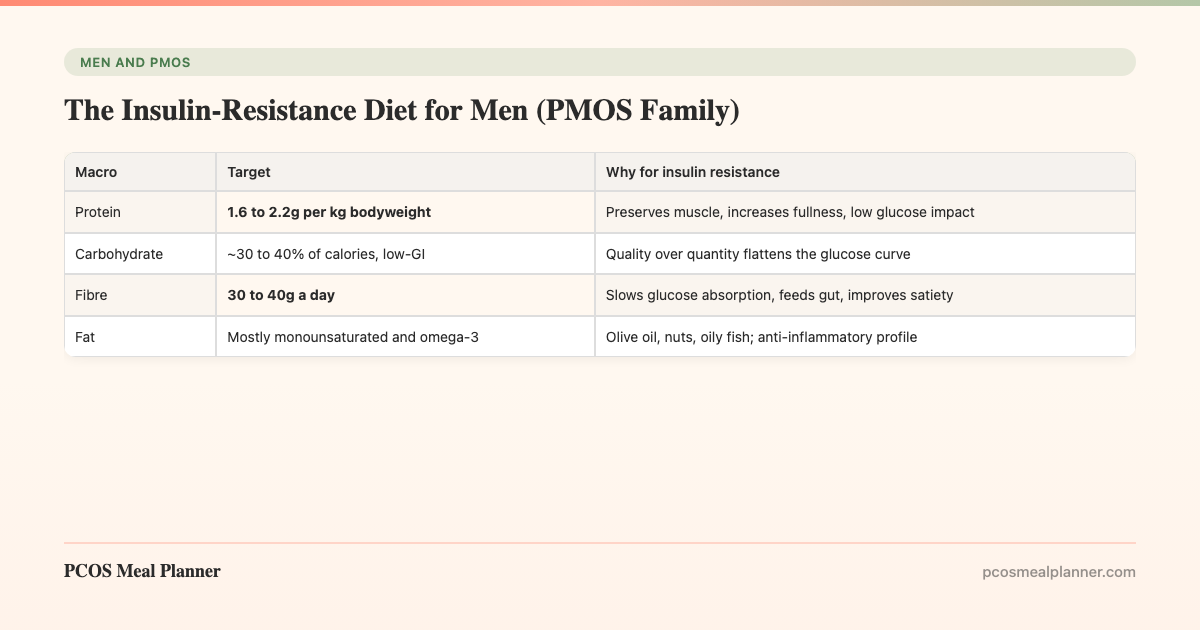
Start with proportions, not calorie counting. The plate splits into roughly three parts: protein, non-starchy vegetables and fibre, and smart carb plus fats. Here is the target split for a man working on insulin resistance.
Macro
Target
Why for insulin resistance
Protein
1.6 to 2.2g per kg bodyweight Preserves muscle, increases fullness, low glucose impact
Carb
~30 to 40% of calories, low-GI
Quality over quantity flattens the glucose curve
Fibre
30 to 40g a day Slows glucose absorption, feeds gut, improves satiety
Fat
Mostly monounsaturated and omega-3
Olive oil, nuts, oily fish; anti-inflammatory profile
For an 85kg man, that protein target is roughly 135 to 185g a day. The fastest way to hit it is to anchor every meal with a palm-to-two-palms of protein and let the carb fill the smaller remaining space.
Eat in the right order: protein and veg before carbs
Food order changes the glucose response without changing a single ingredient. Shukla and colleagues reported in Diabetes Care (2015) that eating protein and vegetables before the carb portion of a meal significantly lowered post-meal glucose and insulin compared with eating the carb first. Same plate, same calories, better numbers.
The practical rule: eat your meat or fish and your salad or vegetables first, then finish with the rice, bread or potato. It costs nothing, takes no extra time, and works at restaurants too. For a man with insulin resistance, this is one of the highest-leverage habits on the list.
Foods to build meals from
Stock the kitchen so the insulin-friendly choice is the easy one. These are the workhorse foods, with the specifics that matter.
Food
Serving
Why it earns a place
Eggs
3 large (~19g protein)
Cheap, complete protein, near-zero glucose impact
Plain Greek yoghurt (0 or 2%)
200g (~20g protein)
High protein, no added sugar, fast breakfast base
Salmon or other oily fish
150g (~30g protein)
Omega-3, anti-inflammatory, two to three times a week
Chicken breast or thigh
180g (~40g protein)
Lean, versatile, batch-cooks for the week
Lentils and beans
150g cooked (~9g protein, 8g fibre)
Protein plus fibre, low-GI carb in one
Oats (rolled or steel-cut)
60g dry (GI ~55)
Beta-glucan fibre, steady energy, cheap
Quinoa
80g dry (GI ~53)
Complete protein, low-GI rice swap
Leafy greens and cruciferous veg
2 large handfuls
Fibre, volume, micronutrients, almost no calories
Berries
150g
Low glycaemic load, polyphenols, the sweet hit
Extra virgin olive oil
1 to 2 tbsp
Monounsaturated fat, polyphenols, daily anti-inflammatory
Nuts (almonds, walnuts)
30g
Magnesium, healthy fat, portable protein snack
A full sample day with grams and timing
Here is a complete day for an active 85kg man aiming for roughly 2,400 calories and 170g of protein. Adjust portions up or down by appetite and activity, but keep the shape.
Meal and time
What to eat
Protein
Breakfast (7:30am)
3 eggs, 200g Greek yoghurt, 150g berries, 1 tbsp ground flaxseed
~40g
Lunch (12:30pm)
180g chicken, large salad with olive oil, then 80g (dry) quinoa
~48g
Snack (4:00pm)
30g almonds + 1 apple, or 150g cottage cheese
~8 to 18g
Dinner (7:00pm)
200g salmon, roasted broccoli and peppers, then 1 medium sweet potato
~40g
Optional evening
200g Greek yoghurt with cinnamon if hungry or training hard
~20g
Notice the shape repeats: protein anchors every meal, vegetables come before the carb, and the carb is always a low-GI side rather than the centre of the plate.
Portions: men need more food, not different food
A common mistake is for the man in a PMOS household to assume the meal plan is not for him because the portions look small. The food is right; the quantity just scales. A typical adult man needs more calories than a woman of the same activity level, often 400 to 700 more a day. The fix is simple: larger protein portions, a bigger carb side, an extra spoon of olive oil, a fourth meal if you train. Same ingredients, same plate shape, bigger servings.
This is exactly why one household plan works. The woman with PMOS and the man carrying the metabolic risk eat the same meals, he just eats more of them.
The part most men skip: strength training
Diet sets the ceiling, but training raises the floor. Muscle is the largest insulin-sensitive tissue in the body, so building and using it improves how you clear glucose. Patten and colleagues reviewed exercise interventions in the Journal of Clinical Medicine (2021) and found they improve insulin sensitivity, with resistance training a reliable lever.
Two to three strength sessions a week of compound lifts, squats, deadlifts, presses, rows, is enough to move the needle over weeks. Add a daily walk after your largest meal to blunt the glucose spike. You do not need to become an athlete; you need to be consistently active and to keep adding a little muscle.
Alcohol and the common mistakes
Alcohol works against insulin sensitivity. It is calorie-dense, it lowers your guard around food, and beer and sugary mixers stack a fast carb load on top. If you drink, keep it to one or two, choose dry wine or spirits with a zero-calorie mixer, and never drink on an empty stomach.
Skipping breakfast then overeating at night. Front-load protein instead of crashing into the evening starving.Liquid calories. Fruit juice, energy drinks and sugary coffees spike glucose with no fibre to slow it. Switch to water, black coffee or tea.Treating low-fat as a free pass. Low-fat often means more sugar. Read the carb line, not the front of the pack.Carb as the centre of the plate. Make protein and veg the base; carb is the side.Dieting without lifting. Losing weight without training loses muscle too, which lowers insulin sensitivity over time.
One plan for the whole household
This is where a system beats a stack of separate plans. The PCOS Meal Planner builds insulin-friendly meals around the upstream insulin pattern. That pattern is shared by PMOS and by the male metabolic phenotype, so one plan covers a woman with PMOS and the man carrying the metabolic risk. He simply eats larger portions of the same meals. You are not running two kitchens. You are running one, and it works on everyone at the table. Build a household plan now .
Often asked questions
What is the best diet for insulin resistance in men?
A moderate-carb, higher-protein, higher-fibre pattern with a Mediterranean fat profile. Aim for about 30 to 40 percent of calories from low-GI carb, 1.6 to 2.2g of protein per kg of bodyweight, 30 to 40g of fibre a day, and most fat from olive oil, nuts and oily fish. Eat protein and vegetables before carb (Shukla 2015). It is the same insulin-friendly pattern that helps PMOS.
Share this answer
Should a man eat low carb or just lower GI?
For most men, lower glycaemic index beats very low carb for sustainability. Carb quality matters more than a hard cut. Swap white bread, white rice and sugary drinks for oats, quinoa, lentils, sweet potato and whole fruit. Moderate carb of about 30 to 40 percent of calories from low-GI sources is practical and effective without an extreme restriction you cannot keep up.
Share this answer
How much protein does a man with insulin resistance need?
Aim for 1.6 to 2.2g per kg of bodyweight a day. For an 85kg man that is roughly 135 to 185g, spread across three or four meals of 35 to 50g each. Higher protein preserves muscle on a deficit, increases fullness, and has a low impact on blood glucose. Building meals protein-first is one of the highest-leverage changes a man can make.
Share this answer
Does the same diet that helps PMOS help the men in the family?
Yes. PMOS and the male metabolic phenotype share the same upstream driver, insulin resistance, so the same insulin-friendly way of eating helps both. The man does not need different food from the woman with PMOS, just larger portions. The food that targets her PMOS also targets his metabolic risk, so one household plan serves everyone.
Share this answer
How important is strength training for insulin resistance in men?
Very. Muscle is the largest insulin-sensitive tissue, so building it improves how the body clears glucose. Patten and colleagues (Journal of Clinical Medicine, 2021) found exercise interventions, including resistance training, improve insulin sensitivity. Two to three sessions a week of compound lifts is enough to see measurable change over weeks. Diet sets the ceiling, training raises the floor.
Share this answer
Can men with insulin resistance still drink alcohol?
In small amounts, occasionally, yes, but alcohol works against insulin sensitivity. It is calorie-dense, lowers your guard around food, and beer and sugary mixers add a fast carb load. If you drink, keep it to one or two, choose dry wine or spirits with a zero-calorie mixer over beer and cocktails, and never drink on an empty stomach. Reducing frequency beats chasing a perfect choice.
Share this answer
Sources and further reading
Meal order, protein and glucose
Exercise and insulin sensitivity
Insulin resistance mechanisms and the male equivalent
Clinical guidelines and patient-facing summaries
One insulin-friendly plan for the whole household. PMOS and the male metabolic phenotype share the same upstream driver, so the same food helps a woman with PMOS and the man carrying the metabolic risk. He just eats larger portions. Our
AI PCOS Meal Planner builds the plan once and feeds everyone at the table.
Build your household plan now .
How this article was made
The protein-first meal-order guidance is from Shukla et al. 2015 in Diabetes Care, which showed eating protein and vegetables before carb lowers post-meal glucose and insulin. The strength-training case draws on Patten et al. 2021 in the Journal of Clinical Medicine, which found exercise interventions improve insulin sensitivity. Insulin-resistance mechanisms and the shared male phenotype draw on Diamanti-Kandarakis and Dunaif 2012 (Endocrine Reviews) and Cannarella et al.
2018 (Journal of Endocrinological Investigation). The Mediterranean fat profile and overall eating pattern follow the 2023 International Evidence-Based Guideline for PCOS and the patient-facing summaries from the NHS, Mayo Clinic and Cleveland Clinic. PMOS is the new name for PCOS as of 12 May 2026; men cannot have PMOS, but male relatives can share the insulin-resistance driver. This article is informational and not medical advice.
Related reading
Community Comments
Add a comment