Can a man have it? A PMOS family checklist
A six-row answer table titled Can a man have this. Row one, a PMOS or PCOS diagnosis: No, marked with a coral cross. Row two, ovarian cysts: No, marked with a coral cross. Row three, inherited insulin resistance: Yes, marked with a green check. Row four, early male-pattern baldness: Yes, marked with a green check. Row five, higher type 2 diabetes risk: Yes, marked with a green check. Row six, elevated DHEA-S like his sisters: Often, marked with a green check. A footer note states that a man cannot get PMOS itself but can inherit the metabolic risk it shares.
Can a Man Have This?
A PMOS (PCOS) family checklist for brothers, sons and fathers
What men can and cannot share
Answer
A PMOS / PCOS diagnosis
Can men get PMOS or PCOS? No, and here is why
Men cannot get PMOS or PCOS. PMOS stands for Polyendocrine Metabolic Ovarian Syndrome. The diagnosis rests on ovarian features: irregular or absent ovulation, polycystic ovaries on ultrasound, and androgen excess expressed through a female endocrine system. A man has no ovaries, so he cannot meet a single one of the ovarian criteria. Any source that says a man "has PCOS" or "got PMOS" is using the term loosely or incorrectly.
This is not a technicality. It changes the right question. The useful question is not "can he get the same diagnosis" but "does he carry the same risk, and how would it show up in a male body." The rest of this article answers exactly that, trait by trait.
What men CAN and CANNOT share: the honest breakdown
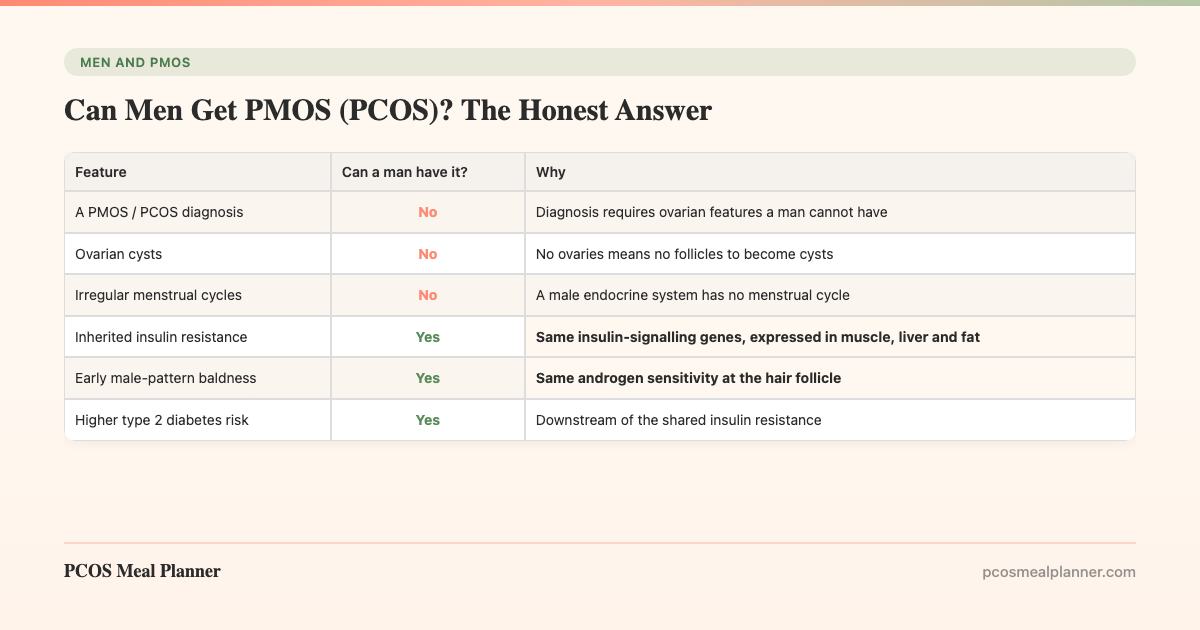
PMOS is polygenic and runs in families. The genes that matter most affect two systems: insulin signalling and androgen metabolism. Sons inherit them as readily as daughters. The table below is the direct answer to "can men get PCOS" split into its real parts.
Feature
Can a man have it?
Why
A PMOS / PCOS diagnosis
No Diagnosis requires ovarian features a man cannot have
Ovarian cysts
No No ovaries means no follicles to become cysts
Irregular menstrual cycles
No A male endocrine system has no menstrual cycle
Inherited insulin resistance
Yes Same insulin-signalling genes, expressed in muscle, liver and fat
Early male-pattern baldness
Yes Same androgen sensitivity at the hair follicle
Higher type 2 diabetes risk
Yes Downstream of the shared insulin resistance
High DHEA-S like his sisters
Often Documented in brothers (Legro 2002)
The pattern is clear. Everything that depends on the ovary is a No. Everything that depends on shared metabolism or androgen handling is a Yes. That is the male side of the family inheritance, and researchers call it the male equivalent. The full hub article on this is the male equivalent of PMOS .
Insulin resistance in men: yes, this is inherited
Insulin resistance is the trait men are most likely to share. It is the upstream driver of PMOS, and it does not need ovaries to operate. In a man who carries the family genes, muscle, liver and fat cells respond less well to insulin, so the pancreas compensates with higher output. Fasting insulin is usually the first lab value to drift, often years before fasting glucose moves.
Family studies back this up directly. Male first-degree relatives of women with PCOS tend toward the same insulin-resistance profile seen in their sisters, and the metabolic and androgen traits travel together through the family. The practical signal: a normal fasting glucose does not rule it out. A man with a PMOS family history should ask for fasting insulin or HOMA-IR, not just glucose alone.
Early male-pattern baldness: yes, and it is an early warning
Hair loss is the most visible thing a man can share, and it carries real details. Both PMOS-related hair thinning in women and male-pattern baldness in men are driven by sensitivity to androgens at the hair follicle. Matilainen and colleagues reported in The Lancet (2000) that early-onset male-pattern baldness is an independent marker of insulin resistance.
Sanke and colleagues (JAMA Dermatology, 2016) went further. They compared men with early androgenetic alopecia to women with PCOS and found the men shared a parallel hormonal and metabolic profile, in effect a phenotypic equivalent. So a man who started balding young, especially with PMOS in the family, has a reasonable case to get checked. The hair loss itself may not reverse, but the underlying metabolic risk is very modifiable. The dedicated spoke on early male-pattern baldness and insulin resistance covers the mechanism and the screening.
Higher metabolic and type 2 diabetes risk: yes
The shared insulin resistance has a downstream cost: a higher risk of metabolic syndrome and type 2 diabetes. Metabolic syndrome is the clustering of raised blood pressure, raised triglycerides, low HDL cholesterol, central weight gain, and high fasting glucose. Men who carry the PMOS family genes are more likely to develop that cluster, and central fat (around the abdomen) is the most metabolically active and highest-risk pattern.
Because most of this is silent for years, men in PMOS families often do not know they carry the risk until a routine blood test, or until the hair loss prompts a question. That silence is the argument for early, deliberate screening rather than waiting for symptoms.
Ovarian cysts and a PMOS diagnosis: no
This is worth stating plainly because the marketing around "male PCOS" muddies it. A man cannot have ovarian cysts, because he has no ovaries and no follicles to become cysts. He cannot have irregular cycles, because a male endocrine system has no menstrual cycle. And he cannot be diagnosed with PMOS or PCOS, because every diagnostic pathway requires ovarian features.
So when you read "men can get PCOS," translate it. What is true is that men can inherit the metabolic and androgen risk that PMOS shares. What is not true is that the condition itself crosses to men. Holding that line keeps the screening focused on what actually applies: insulin and metabolism, not ovaries.
Brothers and sons: what the research actually shows
Two of the cleanest lines of evidence come from studying the men in the family directly.
Brothers. Legro and colleagues reported in the Journal of Clinical Endocrinology and Metabolism (2002) that brothers of women with PCOS had significantly high DHEA-S, an adrenal androgen, compared with controls. That is a direct hormonal fingerprint of the shared inheritance, measurable in men who do not and cannot have PMOS themselves.
Sons. The risk appears early. Recabarren and colleagues (Journal of Clinical Endocrinology and Metabolism, 2008) studied sons of women with PCOS and found higher fasting insulin and adverse metabolic markers compared with sons of unaffected women, in some cases detectable by adolescence. This does not mean every son develops a problem. It means the inherited tendency is present early enough that early action has the most leverage. The dedicated spoke covers sons of mothers with PMOS and inherited metabolic risk in detail.
Cannarella and colleagues (Journal of Endocrinological Investigation, 2018) reviewed all of this and asked the direct question, does a male PCOS equivalent exist. Their answer aligns with this article: not the condition itself, but a recognisable male phenotype of shared metabolic and androgen risk.
What a man in a PMOS family should screen for and do
The genetics are fixed. The expression is not. Here is the practical order of operations for a man whose mother, sister or daughter has PMOS.
Get the right blood work. Ask a doctor for fasting glucose and fasting insulin (or HOMA-IR), HbA1c, a fasting lipid panel, blood pressure, and waist circumference. Fasting insulin is the one most often skipped and most often the first to move.Mention early baldness if it applies. Hair loss before age 35 with a PMOS family history is a reasonable thing to flag as a possible marker of insulin resistance.Eat the insulin-friendly pattern. Moderate carb, higher protein, higher fibre, a Mediterranean fat profile, and protein-first meals. This is the same upstream lever that helps PMOS, because the upstream driver, insulin resistance, is shared.Build muscle. Muscle is the largest insulin-sensitive tissue. Two to three strength sessions a week measurably improves insulin sensitivity over a few weeks.Protect sleep and manage stress. Both move insulin sensitivity directly, independent of diet.Re-test on a schedule. Track fasting insulin and HbA1c over time to read the trend, not a single snapshot.
The detailed eating plan for men sits in the spoke on male-pattern baldness and insulin resistance , and the broader family context is in PMOS for partners and family .
The household angle: one plan covers everyone
Here is the overlap worth naming. If your partner has PMOS and you carry the male metabolic risk, the same way of eating serves you both. Cooking from one insulin-friendly plan is not a compromise where one person eats "diet food." It is the same food working on the same biology in two people at the same table.
This is where a system beats a stack of separate plans. The PCOS Meal Planner builds insulin-friendly meals around the upstream insulin pattern that PMOS and the male equivalent share. One plan covers a wife or partner with PMOS and a husband or son carrying the metabolic risk. You run one kitchen, and it works on everyone. Build a household plan now .
Often asked questions
Can men get PMOS or PCOS?
No. PMOS (the new name for PCOS as of 12 May 2026) is defined by ovarian function, so only a person with ovaries can be diagnosed. A man cannot get PMOS or PCOS, and cannot have ovarian cysts or irregular cycles. He can inherit the metabolic and androgen genetics: insulin resistance, early baldness, and higher type 2 diabetes risk.
Share this answer
Do men get PCOS symptoms?
Men do not get the ovarian symptoms because they have no ovaries: no cysts, no irregular cycles, no diagnosis. They can share the metabolic side when they are first-degree relatives of a woman with PMOS: insulin resistance, early male-pattern baldness, lower SHBG, and raised metabolic and type 2 diabetes risk.
Share this answer
Is male-pattern baldness a sign of PCOS in men?
It is not a sign of PCOS, because men cannot have PCOS. It is a sign of the same biology. Matilainen (The Lancet, 2000) found early baldness is an independent marker of insulin resistance. Sanke (JAMA Dermatology, 2016) found men with early baldness had a profile mirroring PCOS in women.
Share this answer
Can a man inherit PCOS from his mother?
He cannot inherit PCOS itself, having no ovaries to express it, but he can inherit the genes. Recabarren (JCEM, 2008) found sons of women with PCOS had higher fasting insulin and adverse metabolic markers, in some cases by adolescence. The inherited part is the metabolic tendency, not the diagnosis.
Share this answer
What should a man in a PMOS family get checked for?
Fasting glucose and fasting insulin (or HOMA-IR), HbA1c, a fasting lipid panel, blood pressure, and waist circumference. These screen for insulin resistance and metabolic syndrome, the parts of PMOS men can share. Early baldness before 35 is worth mentioning as a possible marker.
Share this answer
Does the diet for PMOS also help men in the family?
Yes. The metabolic risk men inherit and PMOS share the same upstream driver, insulin resistance, so the same insulin-friendly pattern helps both: moderate carb, higher protein, higher fibre, Mediterranean fats, protein-first meals. One household plan covers everyone, with no separate diet food.
Share this answer
Sources and further reading
Brothers, sons and the male equivalent
Early male-pattern baldness and insulin resistance
Clinical guidelines and patient-facing summaries
One insulin-friendly plan for the whole household. Men cannot get PMOS, but they can inherit the metabolic risk it shares, and that risk responds to the same food. Our
AI PCOS Meal Planner builds the plan once and feeds a partner with PMOS and a husband or son carrying the risk from the same kitchen.
Build your household plan now .
How this article was made
The direct answer that men cannot be diagnosed with PMOS or PCOS follows the ovarian-based diagnostic criteria in the 2023 International Evidence-Based Guideline for PCOS and the patient summaries from the NHS, Mayo Clinic and Cleveland Clinic. The brother evidence (high DHEA-S) is from Legro et al. 2002 in JCEM. The son evidence (higher fasting insulin and adverse metabolic markers) is from Recabarren et al.
2008 in JCEM. The male-equivalent framing is from the Cannarella et al. 2018 review in the Journal of Endocrinological Investigation. The early-baldness link to insulin resistance is from Matilainen et al. 2000 in The Lancet, and the phenotypic-equivalent comparison from Sanke et al. 2016 in JAMA Dermatology. PMOS is the new name for PCOS as of 12 May 2026; the underlying biology is unchanged. This article is informational and not medical advice.
Related reading
Community Comments
Add a comment