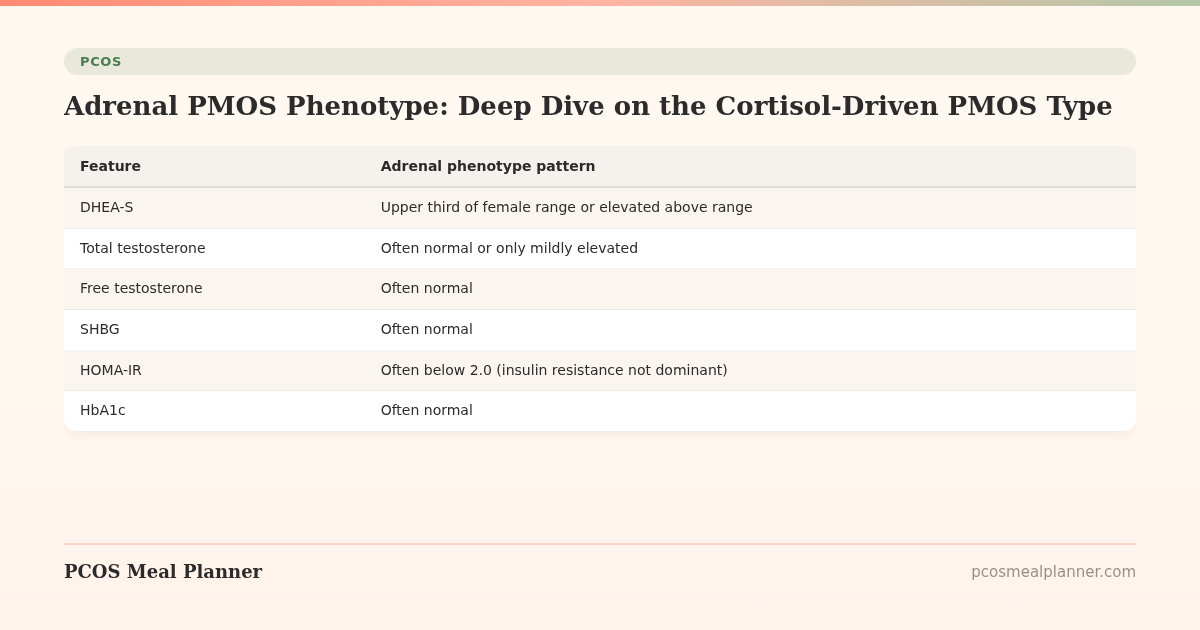
The adrenal PMOS phenotype accounts for around 15 percent of PMOS cases and is defined by high adrenal-source androgens (primarily DHEA-S) rather than ovarian-source androgens. Diagnostic markers: DHEA-S above the upper third of female range, often normal or only mildly high total/free testosterone, often normal fasting insulin and HbA1c, often normal BMI, anxiety prominent, sometimes flat or reversed cortisol pattern (high evening, low morning).
Treatment priorities differ significantly from insulin-resistant PMOS: stress and cortisol management as primary, adequate calories (not deficits), no 16:8+ fasting, magnesium evening, optional ashwagandha under doctor guidance, and gentler exercise (walking and lighter strength training, NOT HIIT). Standard PMOS interventions targeting insulin resistance often produce limited benefit because insulin is not the primary issue. This phenotype is commonly missed because labs may be unremarkable for typical PMOS markers. PMOS is the new name for PCOS as of 12 May 2026.
How to identify the adrenal phenotype
| Feature | Adrenal phenotype pattern |
|---|---|
| DHEA-S | Upper third of female range or high above range |
| Total testosterone | Often normal or only mildly high |
| Free testosterone | Often normal |
| SHBG | Often normal |
| HOMA-IR | Often below 2.0 (insulin resistance not dominant) |
| HbA1c | Often normal |
| BMI | Often normal |
| Cortisol | Sometimes flat or reversed pattern (high evening, low morning); morning cortisol may be normal but pattern dysregulated |
| Clinical pattern | Anxiety prominent, "wired but tired," difficulty falling asleep, salt and sugar evening cravings |
| Trigger history | Often onset or worsening after major stress event |
Why this phenotype is often missed
Standard PMOS labs (fasting insulin, HOMA-IR, HbA1c, total testosterone) are often unremarkable. The condition presents more like adrenal dysregulation than typical metabolic PMOS. Doctors who do not check DHEA-S or are not familiar with the adrenal subtype often miss it.
Important rule-out: non-classical congenital adrenal hyperplasia (NCCAH), which presents similarly with high DHEA-S. 17-hydroxyprogesterone test rules this out (above 200 ng/dL morning, follicular phase suggests NCCAH).
The adrenal PMOS treatment plan
Pillar 1: Stress and cortisol management as primary
- Sleep 7-9 hours, consistent bedtime, screen for OSA
- Magnesium glycinate 300-400mg evening
- Structured stress practice 10+ minutes daily (breathing, meditation, yoga, journaling, time outdoors)
- Limit caffeine to 1 cup/day or remove; never after noon
- Address chronic stressors where possible (work, relationships, caregiving load)
Pillar 2: Adequate calories - no deficits
Adrenal phenotype responds poorly to calorie restriction. Cortisol elevation from energy stress amplifies the underlying axis dysregulation. Eat at maintenance, with the 30/30/40 PMOS macro pattern. Avoid very low calorie diets, prolonged fasting, and aggressive deficits.
Pillar 3: NO 16:8+ fasting
Longer fasting raises cortisol significantly in adrenal phenotype. 12-14 hours overnight is the maximum. Earlier eating windows often work better (e.g., 7am-7pm rather than 12pm-8pm).
Pillar 4: Gentler exercise
- Walking 8,000-10,000 steps daily
- Strength training 2-3x/week at moderate intensity, focusing on form not max load
- Yoga 1-2x/week
- NO HIIT - raises cortisol and worsens the underlying axis
- NO long steady-state cardio (45+ min runs, spin classes)
- NO fasted training
Pillar 5: Supplements specific to this phenotype
- Magnesium glycinate 300-400mg evening - foundational
- B-complex daily - B vitamins support HPA axis function
- Vitamin C 500mg-1g/day - adrenal support, modest cortisol-lowering
- Ashwagandha (KSM-66 form) 600mg/day under doctor guidance. 8-week trials: ~25% cortisol reduction. Cycle off after 12 weeks. NOT in pregnancy.
- Rhodiola rosea 200-400mg if chronic fatigue pattern
- L-theanine 200mg as needed for acute stress
- Omega-3 2g/day - anti-inflammatory
- Inositol 4g/day can still be useful but is not the primary driver
Pillar 6: Medications less commonly needed
Adrenal phenotype often does not need metformin or GLP-1s (insulin is not the issue). Specific medical considerations:
- Low-dose corticosteroid (e.g., dexamethasone 0.25-0.5mg at bedtime) for very high DHEA-S under specialist care. Suppresses adrenal androgen production.
- SSRI/SNRI for the anxiety component if significant.
- Spironolactone for any androgenic symptoms despite the primarily adrenal source.
- COCs can help but the androgen-lowering effect is modest in adrenal phenotype.
Why standard PMOS interventions sometimes fail in adrenal phenotype
- Calorie restriction compounds cortisol problem
- 16:8+ fasting amplifies HPA dysregulation
- Intense exercise (HIIT, long cardio) raises cortisol
- Inositol alone targets insulin which is not the issue
- Metformin alone targets insulin resistance which is mild or absent
The right approach treats the HPA axis dysregulation first.
Expected response timeline
| Timeframe | What often changes |
|---|---|
| 1-2 weeks | Better sleep on magnesium and improved sleep hygiene; less morning anxiety |
| 4-8 weeks | Stress practice effects emerge; cortisol patterns start to normalise; energy steadier |
| 8-12 weeks | Cycle effects, cravings reduce |
| 3-6 months | Sustained pattern changes; DHEA-S labs improve; mental health symptoms reduce |
Often asked questions
What is adrenal PMOS?
The adrenal phenotype of PMOS (~15% of cases). Defined by high adrenal-source androgens (DHEA-S as primary marker) rather than ovarian androgens. Often normal weight, normal insulin labs, anxiety prominent, sometimes onset after major stress event.
How do I know if I have adrenal PMOS?
DHEA-S in upper third or above range, often normal total testosterone and HOMA-IR, often normal BMI, anxiety prominent, "wired but tired" pattern, sometimes flat or reversed cortisol pattern. Standard PMOS labs may look "normal." Rule out non-classical CAH with 17-OH-progesterone. Take the free phenotype quiz.
What is the best treatment for adrenal PMOS?
Stress and cortisol management as primary: sleep, structured stress practice, magnesium evening, adequate calories (no deficits), no 16:8+ fasting, gentler exercise (walking + light strength + yoga, NO HIIT). Supplements: magnesium, B-complex, vitamin C, optional ashwagandha under doctor guidance. Standard insulin-targeting interventions less effective.
Why does my PMOS not respond to the usual treatments?
If you have adrenal-phenotype PMOS, standard insulin-targeting interventions (metformin, calorie restriction, intense exercise) often produce limited benefit and can worsen the underlying HPA axis dysregulation. The right approach treats cortisol and stress first.
Can I take ashwagandha for adrenal PMOS?
Under doctor guidance. KSM-66 form 600mg/day shows ~25% cortisol reduction in 8-week trials. Cycle off after 12 weeks. NOT appropriate in pregnancy, with thyroid conditions, or with certain medications.
What to read next
- PMOS stress and cortisol
- PMOS anxiety and depression
- PMOS sleep
- PMOS lab tests explained
- PCOS is now PMOS: full renaming explainer
How this article was researched
Sources include the 2023 International Evidence-based Guideline for the Assessment and Management of PCOS, the 2023 Endocrine Society position paper on intermittent fasting in women's health, the 2024 ashwagandha cortisol meta-analyses, the 2023 Lancet systematic review on mental health in PCOS, and clinical guidance on non-classical congenital adrenal hyperplasia differential. PCOS was renamed PMOS on 12 May 2026. This article is informational and not medical advice. See our editorial standards.
Community Comments
Add a comment