PCOS acne is not regular acne. It shows up on the jaw, chin, lower cheeks, and neck rather than the forehead and T-zone. It cycles with hormones rather than with stress or skincare routine. It does not respond well to typical drugstore acne treatments. The reason is that PCOS acne is a hormonal symptom of a metabolic condition. Two upstream drivers, insulin and androgens, run the show. Topical products work on the skin's surface; they do not change the upstream signal that keeps producing acne. Food does, slowly. This is a guide to what to eat to calm PCOS acne within 8 to 16 weeks, what makes it worse, and what to leave to a dermatologist.
The short version. PCOS acne is insulin-driven androgen excess showing up as oil overproduction and clogged hair follicles. Diet that lowers insulin and supports androgen balance reduces acne severity within 8 to 16 weeks. The five highest-leverage food moves: low-GI carbs, dairy reduction (especially skim and protein-isolate dairy), 25-30 percent protein with adequate zinc, omega-3 above 2g per day, and under 25g added sugar.
Why PCOS causes acne in specific places
Two upstream drivers create PCOS acne. Both connect back to insulin.
First, high insulin tells the ovaries to produce more androgens (testosterone and DHEA-S). Insulin acts on ovarian theca cells, the cells responsible for androgen synthesis. About 70 to 80 percent of women with PCOS have insulin resistance, and most of that group has high androgens as a consequence.
Second, androgens act on sebaceous glands in skin. Sebaceous glands are densest on the lower face (jaw, chin, lower cheeks), neck, chest, and upper back. Androgens tell these glands to produce more sebum, the oily substance that, combined with dead skin cells and bacteria (Cutibacterium acnes), clogs pores and produces the deep, cystic, painful acne characteristic of PCOS.
This is why PCOS acne cluster patterns are so consistent:
- Jawline and chin. The defining PCOS acne pattern. Highest sebaceous gland density in androgen-sensitive zones.
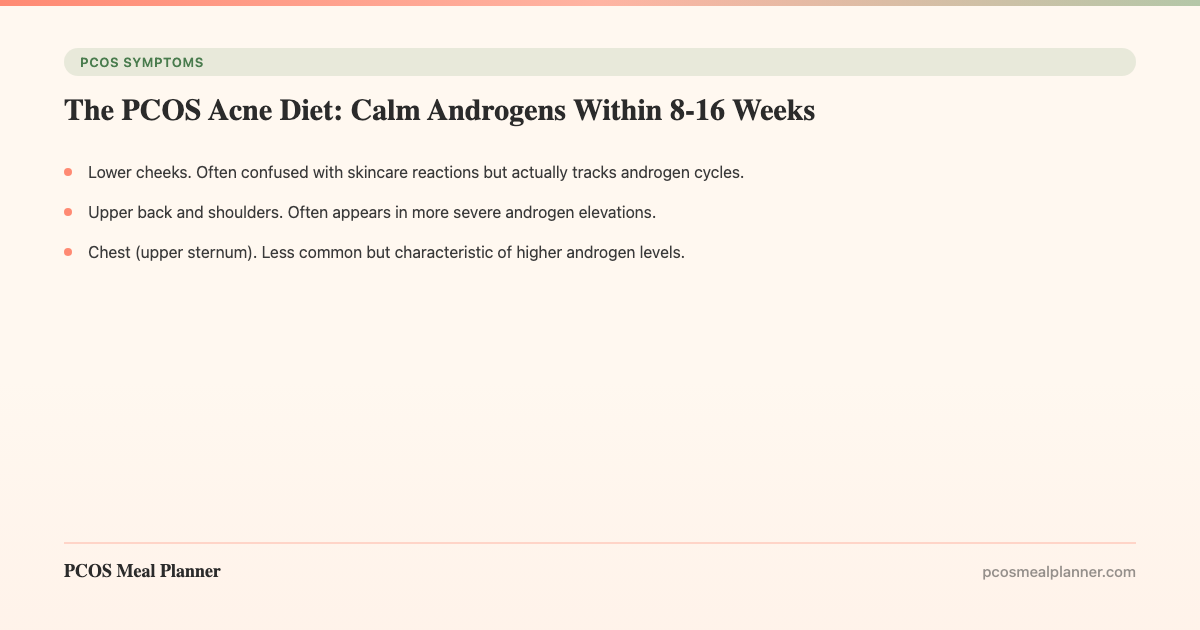
- Lower cheeks. Often confused with skincare reactions but actually tracks androgen cycles.
- Neck (front and sides). Especially under the jawline, often paired with skin tags or mild acanthosis in the same zone.
- Upper back and shoulders. Often appears in more severe androgen elevations.
- Chest (upper sternum). Less common but characteristic of higher androgen levels.
The same mechanism that produces PCOS skin tags and acanthosis nigricans (insulin-driven skin overgrowth) is producing PCOS acne, with the added step of androgen-driven sebum production. The trio is the same upstream signal showing up in three different skin behaviors.
What to eat to calm PCOS acne
The dietary protocol targets both insulin and androgens. There is significant overlap with the PCOS skin tag and acanthosis dietary strategy, plus three acne-specific additions.
1. Drop the glycemic load of every meal
Same move as skin tags and acanthosis. Lower-GI carbs (steel-cut oats, lentils, chickpeas, intact whole grains, berries) replace higher-GI carbs (white rice, white bread, sugary cereals, juice, sweetened beverages). A 2007 randomized trial in the American Journal of Clinical Nutrition compared a low-GI diet to a conventional carb diet in young men with moderate acne. The low-GI group showed significantly reduced acne lesion counts and lower insulin and androgen markers at 12 weeks. The mechanism applies more strongly in PCOS-related acne.
2. Reduce dairy, especially skim milk and whey protein isolate
This one is acne-specific. Multiple meta-analyses, including a 2018 meta-analysis in Nutrients covering 14 observational studies, found a consistent positive association between dairy intake (particularly skim milk and protein-isolated dairy products) and acne severity. The proposed mechanisms involve insulin-like growth factor (IGF-1) levels and androgen-related compounds in dairy. Whole dairy and fermented dairy (Greek yogurt, kefir, aged cheeses) show weaker associations than skim milk and isolated whey protein. The practical move: keep some whole or fermented dairy if you like it; minimize skim milk and skim-based protein drinks if your acne is moderate to severe.
3. Hit 25-30 percent of calories from protein with adequate zinc
Protein supports satiety and blunts insulin spikes. Zinc is the micronutrient with the strongest published evidence for acne specifically; it modulates androgen activity and has anti-inflammatory effects in skin. A 2020 review in Dermatologic Therapy summarized the zinc-acne evidence and concluded that adequate dietary zinc plus zinc supplementation in deficient people reduces inflammatory acne lesion counts in 8 to 12 weeks. Food sources: oysters (highest), pumpkin seeds, beef, chickpeas, cashews, hemp seeds. Practical translation: most PCOS women should aim for 8 to 11mg zinc per day from food.
4. Push omega-3 to at least 2g per day
Omega-3 fatty acids (EPA and DHA) reduce inflammatory signaling and have published evidence for moderate acne improvement. A 2014 randomized trial in Lipids in Health and Disease found that 3g per day of omega-3 reduced inflammatory acne lesion counts over 10 weeks. Food sources: fatty fish (salmon, sardines, mackerel) two to three times per week, plus ground flaxseed and chia seeds for additional plant-form omega-3 (though plant forms convert less efficiently to EPA/DHA). Most women without regular fatty fish intake benefit from an omega-3 supplement.
5. Keep added sugar under 25g per day
Same WHO ceiling that applies to PCOS skin tags and acanthosis. Sustained week-after-week pattern is what matters more than perfect days.
A PCOS-acne-aware day. Breakfast: steel-cut oats with ground flaxseed, 25g pea or whey isolate stirred in if you tolerate it, half a cup of berries, a handful of pumpkin seeds. Lunch: lentil and roasted vegetable bowl with chicken thigh, big serving of greens, tahini dressing. Dinner: salmon (3 times per week minimum), quinoa, big serving of greens, olive oil and lemon. Snack: Greek yogurt (whole, not skim) with pumpkin seeds and a square of 85 percent dark chocolate. The day lands at roughly 1,800 calories, 130g protein, 30g fiber, hits 10mg+ zinc, and exceeds 2g omega-3 with the salmon.
Foods that make PCOS acne worse
The specific categories that worsen PCOS acne, in order of impact:
- Skim milk and isolated whey protein. The dairy categories most strongly linked to acne in the published meta-analyses. If you currently drink skim milk daily and have moderate to severe PCOS acne, this is a high-leverage change.
- Sweetened beverages and juice. Same insulin-spike issue as for skin tags. Particularly bad for acne because of the dual insulin + IGF-1 effect.
- White flour products eaten alone. White bread, white pasta, white rice without protein/fat pairing. The same foods paired with protein and fat have much smaller insulin and IGF-1 impact.
- Fast food and ultra-processed foods. A 2020 JAMA Dermatology study of 24,000+ adults found a significant positive association between ultra-processed food consumption and current acne, with the relationship holding after adjustment for other factors.
- High-glycemic snacks (candy, sweetened cereal bars, sugary baked goods). Combine sugar load with low satiety, drive insulin spikes between meals.
None of these need to be permanently eliminated to see acne improvement. The question is the dominant pattern, not the occasional exception.
2026 research update: what a review of drinks and skin found for acne
A 2026 review in Clinics in Dermatology looked at what we know about drinks and skin. On acne, it found that sugar-sweetened drinks and milk are linked to acne in observational studies. Current acne guidelines still make no formal diet advice. Green tea helped acne mainly as an extract put on the skin, and drinking it showed limited effect. Spearmint tea lowered free testosterone in women with PCOS. A clear benefit for skin is not yet proven. Proof for plant milks, kombucha and energy drinks was thin or indirect. This is a narrative review, so it did not pool results or grade studies in a formal way. It backs the swaps above: cut sweet drinks and skim milk first. Spearmint tea is a low-risk extra, not a treatment. Unsal et al., Clin Dermatol, 2026.
How long does PCOS acne take to respond to diet?
The skin cell cycle that produces sebum, fills follicles, and creates a visible pimple runs roughly 6 to 8 weeks from start to surface. Diet changes that lower insulin start affecting androgen production in 2 to 4 weeks. The first visible improvement in inflammatory lesion count usually shows up between weeks 8 and 12. Continued improvement compounds for the next 8 to 12 weeks. The realistic timeline:
- Weeks 1 to 4. No visible change. Insulin and androgens are dropping invisibly. Often a brief period where acne can look slightly worse if the skin is purging clogged follicles that were already in formation.
- Weeks 8 to 12. Inflammatory lesion count drops noticeably. Cystic lesions become less frequent and less painful.
- Weeks 12 to 16. Skin texture improves overall. Post-acne pigmentation starts to fade. New cysts become rare.
- Months 4 to 6. Most of the dietary improvement has shown up by this point. Post-acne scarring takes longer to fade and may require additional treatments.
This is the timeline most people give up on. The week 1 to 4 stall is the dropout window. The first three weeks feel like nothing is happening, and then around week 8 the change starts to compound. Setting the expectation in months, not weeks, is what separates "this worked" from "this did not work."
What to leave to a dermatologist
Diet addresses the upstream drivers. Existing acne, scars, and severe inflammatory disease often need parallel medical treatment. See a dermatologist for:
- Existing cystic acne. Diet changes prevent new cysts. Existing deep cysts often need cortisone injection or oral medication to resolve quickly.
- Significant scarring. Pitted, ice-pick, or rolling scars do not respond to diet changes. Laser treatment, microneedling, or chemical peels are the appropriate tools.
- Severe inflammatory acne. If acne is causing significant pain, leaving permanent marks, or affecting mental health, parallel medical treatment (oral antibiotics, hormonal therapy, isotretinoin) is appropriate and not a sign that the diet approach is failing.
- Post-inflammatory hyperpigmentation. Diet helps prevent new acne; topical treatments (azelaic acid, niacinamide, retinoids) handle existing pigmentation more directly.
Diet and dermatology are complementary tools for PCOS acne, not competing ones. Address the upstream signal with food. Address the surface with topical treatment if existing acne is severe.
Often asked questions
Do I have to give up dairy entirely to see PCOS acne improve?
No. The evidence is strongest for skim milk and isolated whey protein products specifically. Whole milk, Greek yogurt, kefir, and aged cheeses have weaker associations with acne. If you love dairy, swap skim for whole, prioritize fermented forms, and minimize whey-isolate protein drinks. Watch your skin for 12 weeks.
Will spironolactone or birth control help PCOS acne faster than diet?
Yes, often. Spironolactone and combined oral contraceptives lower androgens pharmacologically and produce visible improvement in 6 to 12 weeks. Diet changes work on the same axis more slowly but address the upstream metabolic cause. Many women use both: medication while diet changes take effect, then taper medication if appropriate after long-term metabolic improvement. This is a doctor conversation.
Are dairy alternatives like oat milk and almond milk better for acne?
Possibly, with caveats. Most plant milks have less direct hormonal impact than skim milk. Watch for added sugar, especially in flavored or sweetened versions. Unsweetened oat milk, almond milk, or soy milk are reasonable swaps. Some people find soy worsens hormone-driven acne; the evidence is mixed.
Will eating more chocolate make my acne worse?
Dark chocolate (85 percent or higher) in small amounts has minimal impact and contains some helpful polyphenols. Milk chocolate and sweet milk-chocolate bars combine multiple problematic categories (sugar, dairy, and often unhealthy fats) and are more likely to drive acne. The pop-culture rule "chocolate causes acne" is too broad. Sugary milk chocolate, often. Small amounts of dark chocolate, not really.
Does taking a zinc supplement work as well as eating zinc-rich foods?
Both work for acne. Supplemental zinc at 30 to 50mg per day showed inflammatory lesion reduction in published trials. Food sources at 10 to 15mg per day support adequate zinc without the GI side effects that higher-dose supplementation can cause. Most PCOS women do well with food-source zinc; supplementation is reasonable if you are deficient or do not eat zinc-rich foods regularly.
Will inositol help my PCOS acne?
Indirectly, by improving insulin sensitivity and lowering androgen production. Myo-inositol plus D-chiro inositol in a 40:1 ratio at 4g per day total is the most-studied PCOS supplement protocol. It is not an acne-specific treatment but it supports the upstream mechanism that drives PCOS acne. Doctor conversation before adding supplements.
Why does my acne get worse the week before my period?
Premenstrual acne flares reflect the late-luteal-phase drop in estrogen relative to progesterone, plus a relative androgen elevation. The cycle effect is real and shows up even when overall PCOS care is going well. Diet changes reduce the size of the flare; they may not remove the pattern entirely.
Will the same diet help my skin tags, acanthosis, and acne?
Yes. The upstream insulin mechanism is the same. Timelines differ: skin tags slow forming in 8 to 12 weeks, acne improves in 8 to 16 weeks, acanthosis fades in 6 to 12 months. The food strategy is one strategy for all three.
Try a PCOS-aware meal plan
Take the PCOS type quiz in 60 seconds to identify your phenotype, or sign up free and generate a 7-day plan built around the low-GI, higher-protein, omega-3-supported, zinc-adequate pattern that addresses PCOS acne at the upstream insulin and androgen levels. First plan is free. No card required.
Related reading on PCOS Meal Planner
- PCOS skin tags: the insulin connection and what to eat
- PCOS acanthosis nigricans: foods that fade dark patches
- Insulin resistance meal plan for PCOS
- The PCOS grocery list
- PCOS protein calculator
How this article was researched
This guide draws on published research on diet and acne, including the 2007 American Journal of Clinical Nutrition randomized trial on low-GI diet and acne, the 2018 Nutrients meta-analysis of 14 observational studies on dairy and acne, the 2014 Lipids in Health and Disease randomized trial on omega-3 and acne, the 2020 Dermatologic Therapy review on zinc and acne, the 2020 JAMA Dermatology study on ultra-processed food and acne, and the 2023 International Evidence-based Guideline for the Assessment and Management of PCOS. This article is being prioritized for medical review by our contracted Registered Dietitian Nutritionist. See our editorial standards. Severe or scarring acne deserves both dietary intervention and medical treatment.
Community Comments
Add a comment