Easing into a 10-hour early eating window
A four-step descending ladder. Step zero at the top is the starting point, grazing across roughly fourteen or more hours of the day. Step one covers days one to four with a twelve-hour window from 8am to 8pm. Step two covers days five to nine with an eleven-hour window from 8am to 7pm. Step three, from day ten onward, is the ten-hour early window from 8am to 6pm, labelled as the length tested in the 2026 trial. Each step down shortens the eating window and lengthens the overnight fast. A note at the bottom states that earlier windows outperformed later ones and that meals should be protein-first.
Ease Into a 10-Hour Early Window
Shorten the eating window one step at a time over one to two weeks
Start here: grazing all day (14+ hours)
Note your real first bite and last bite for two days. That is your baseline.
Days 1 to 4: 12-hour window (8am to 8pm)
Just hit the edges. Breakfast no earlier than 8am, kitchen closed by 8pm.
Days 5 to 9: 11-hour window (8am to 7pm)
Bring dinner forward an hour. Lead every meal with protein.
Day 10 onward: 10-hour early window (8am to 6pm)
The length tested in the 2026 PCOS trial. Hold here.
What is time-restricted eating, and does it help PCOS?
Time-restricted eating means eating all your food inside a set number of hours each day, then fasting the rest. It is the gentlest form of intermittent fasting because it follows the clock, not calorie counting. For PMOS, the point is not the fasting itself. The point is lowering the insulin load across the day, because insulin resistance sits upstream of most PMOS symptoms.
The best evidence to date is direct. In 2026, Aminian and colleagues published a six-week randomized controlled trial in the European Journal of Nutrition in 75 women with PCOS. One group ate from 8am to 6pm (an early 10-hour window), a second group ate from 11am to 9pm (a later 10-hour window), and a control group ate without restriction. Both timed-eating groups beat the control on fasting blood sugar, fasting insulin, HOMA-IR, body weight and waist circumference. The early window showed additional benefits on top of that. Two numbers matter for you: the window was 10 hours, and earlier was better.
Step 1: Pick your window, and favour early
Choose a 10-hour eating window and place it as early in your day as your life allows. The trial that supports this used 8am to 6pm for the early group. If you cannot start at 8am, the principle still holds: shift the whole window earlier rather than later. A window of 7am to 5pm or 9am to 7pm keeps the same 10-hour length while respecting your schedule.
Why earlier wins comes down to your body clock. Your muscles and liver handle glucose better in the morning and worse late at night, so the same meal eaten at 8pm spikes blood sugar more than at noon. Eating earlier lines your food up with when your body is primed to use it. The most common mistake is a late window, such as noon to 10pm, which is easy socially but works against your metabolism. If you have to choose, protect an early dinner over an early breakfast.
Step 2: Ease in over one to two weeks
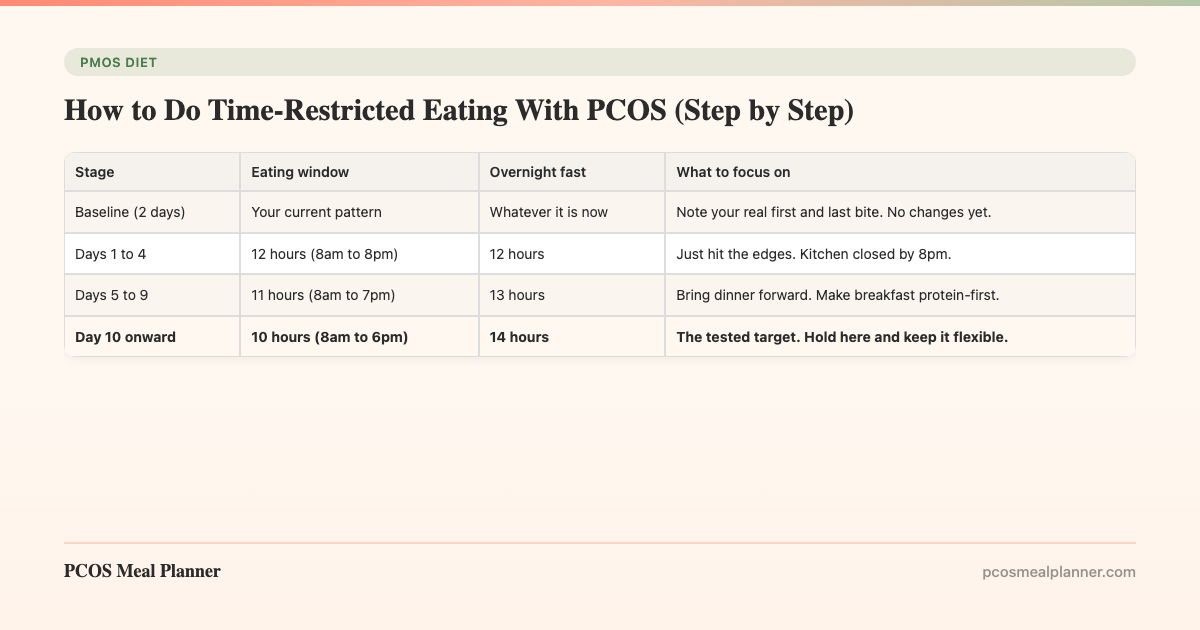
Do not jump from grazing all day to a 10-hour window overnight. Sudden long fasts trigger hunger, low mood and rebound eating, and in PMOS a hard fast can read as a stressor. Shorten the window in steps instead. The table below is the schedule most people find comfortable.
Stage
Eating window
Overnight fast
What to focus on
Baseline (2 days)
Your current pattern
Whatever it is now
Note your real first and last bite. No changes yet.
Days 1 to 4
12 hours (8am to 8pm)
12 hours
Just hit the edges. Kitchen closed by 8pm.
Days 5 to 9
11 hours (8am to 7pm)
13 hours
Bring dinner forward. Make breakfast protein-first.
Day 10 onward 10 hours (8am to 6pm) 14 hours The tested target. Hold here and keep it flexible.
If any step feels rough, stay there an extra few days before shortening again. There is no prize for rushing. Weekends can stay a little looser, and the routine still works.
Step 3: What to eat inside the window
The window sets when you eat. The food sets whether it works. A 10-hour window full of white bread, cereal and sugar will undo most of the benefit, so treat the timing as a layer on top of a PMOS-friendly plate, never a substitute for it.
Three rules cover most of it:
Protein-first, every meal. Eat your protein and vegetables before the starchy carbs. In a 2015 study by Shukla and colleagues, eating protein and vegetables before carb cut the post-meal glucose rise by about half compared with eating the carbs first. Same food, different order, lower spike.Fibre at every meal. Vegetables, beans, lentils, berries and whole grains slow digestion and steady blood sugar. Aim for a fist of vegetables or more at lunch and dinner.Quality still counts. Moderate carb, higher protein, and a Mediterranean fat profile with olive oil, nuts and oily fish. The window does not make refined carbs PMOS-friendly.
Because you have fewer hours to eat, protein is the piece that slips. Anchor each meal on a real protein source, roughly 25 to 40 grams, so you are not chasing your target late in the day.
Step 4: A sample early-window PMOS day (8am to 6pm)
Here is a full 8am to 6pm day built around protein-first meals. Grams are approximate and easy to hit with everyday food.
Time
Meal (protein-first order)
Protein
8:00 AM
Break your fast on protein. 3 eggs scrambled with a handful of spinach, then 40g rolled oats with 1 tbsp ground flaxseed and a small handful of berries.~24g
12:30 PM
120g grilled chicken or salmon over a big salad with chickpeas and olive oil, then a small serving of quinoa. Eat the protein and salad first.
~35g
3:30 PM
Optional snack: 150g plain Greek yogurt with a few walnuts and cinnamon.
~15g
5:30 PM
Last bite before 6pm. 120g baked salmon or firm tofu with roasted broccoli and a scoop of lentils. Vegetables and protein first, lentils last.~30g
That lands near 100 grams of protein across a 10-hour early window, with fibre at every meal and the last bite comfortably before the window closes. Swap the proteins to suit your budget and taste. The shape of the day is the part to keep.
Step 5: Coffee, water and what breaks the fast
In the fasting hours, only calorie-free drinks. Water, sparkling water, black coffee and plain tea all keep insulin flat and are the four safe choices. Black coffee in the morning is genuinely useful because it dulls early hunger while you get used to a later first meal.
What breaks the fast in a way that matters: milk and plant milks, juice, smoothies, honey, sugar, bone broth, and anything with a sweet taste, including diet drinks with sweeteners. Even a splash of milk in coffee nudges insulin. If plain coffee is a stretch, that is a sign to keep your window a touch shorter for now rather than adding milk to a long fast. Save all of it for inside your 10 hours.
Step 6: Combining it with exercise
Time-restricted eating and movement work well together, with one caveat about timing. Gentle movement in the fasting hours, such as a morning walk, is fine and can help insulin sensitivity. Hard or long sessions are better placed inside the eating window, or at least followed soon by a protein-forward meal, so you refuel and protect muscle.
With an 8am to 6pm window, a simple pattern is a morning walk before breakfast and any strength training in the late afternoon, finishing with your 5:30pm dinner. Muscle is your largest insulin-sensitive tissue, so two or three strength sessions a week amplifies what the eating window is already doing. One warning: do not stack a long fast on top of heavy training and low food. Under-fuelling around exercise is a fast route to lost periods, which is one of the reasons the cautions below matter. For the flip side of what to avoid, see our guide on the worst exercises for PCOS .
Step 7: Troubleshooting energy and cravings
Most problems in the first two weeks come from moving too fast or eating too little inside the window. Here is how to read the common ones.
Low energy or headaches. Usually too little food or too fast a jump. Widen the window back a step, and check you are eating enough protein and carbs inside it. This is not a race to eat less.Evening cravings. Often a protein shortfall earlier in the day. Front-load protein at breakfast and lunch, and add the mid-afternoon snack from the sample day.Poor sleep from an early dinner. Some people sleep worse hungry. Move your last bite slightly later, back to a 7pm close, and keep the window at 11 hours. A sustainable 11-hour window beats a 10-hour one you cannot keep.Cannot get through the fasting morning. Lean on black coffee and water, and remember the ease-in schedule exists for exactly this. Shorten the fast, then rebuild.Cycle changes or a missed period. Stop, and read the caution section below. This is a signal to pause, not to push harder.
Gut health also shapes how steady your blood sugar feels day to day. If you are combining timing with fibre and fermented foods, our note on synbiotics for PCOS covers how the two support each other.
Who should NOT do time-restricted eating with PCOS
Time-restricted eating is not for everyone with PMOS. Skip it, or get a doctor to sign off first, if any of these apply to you:
A history of disordered eating. Any rules-based eating pattern, including this one, can reopen restrictive or binge cycles. This is the single most important reason to avoid it.Missing or lost periods (functional hypothalamic amenorrhea). If your cycle has stopped, especially with low body weight or heavy training, adding a fast is the opposite of what your body needs. It needs more fuel, not less.A pattern of under-eating or over-exercising. A shorter window can quietly push intake too low, which stresses hormones rather than helping them.Pregnancy or breastfeeding. This is not the time to restrict your eating window. Energy needs are higher, not lower.Stress-driven, adrenal-type PMOS. If your driver is high cortisol and stress rather than insulin, a longer fast is another stressor and can make things worse.Glucose-lowering medication. If you take insulin, a sulfonylurea, or another glucose-lowering drug, longer gaps between meals can cause dangerous low blood sugar. Do not change your eating pattern without your prescriber.
If you are unsure which type of PMOS you have, or whether any of the above applies, treat that uncertainty as a reason to check with your doctor before starting.
For most people without these red flags, an early 10-hour window is a low-risk, evidence-backed lever. But it is a tool, not a rule, and a plan you can actually keep beats a stricter one you cannot.
How the PCOS Meal Planner fits your window
The timing is the easy half. The harder half is filling a 10-hour window with protein-first, PMOS-friendly meals day after day, on a real budget, without decision fatigue. That is the gap a system closes better than willpower. The PCOS Meal Planner builds your week around the same insulin-friendly pattern the trial relied on, front-loads protein, and fits neatly inside an early eating window so you are never staring at the fridge at 5:45pm wondering what counts. You set the window. It handles the meals. Build your plan now .
Often asked questions
What is the best time-restricted eating window for PCOS?
A 10-hour window placed early in the day. In a 2026 randomized trial, women with PCOS on an early 10-hour window (8am to 6pm) beat the control on fasting insulin, blood sugar, HOMA-IR, weight and waist, and did better than a later 10-hour window (11am to 9pm). So aim for about 10 hours, pushed as early as your schedule allows.
Share this answer
Is 16:8 fasting good for PCOS?
16:8 means an 8-hour window and a 16-hour fast, which is longer than the 10-hour window the 2026 PCOS trial tested. There is no need to push that hard for the benefit, and a longer fast can worsen under-eating and cravings, which matters more in PMOS. Start at a 10-hour early window and only go shorter with a doctor.
Share this answer
What can I eat or drink during the fasting hours with PCOS?
Only calorie-free drinks: water, sparkling water, black coffee and plain tea. Skip milk and plant milks, juice, smoothies, honey, sugar, bone broth, and diet drinks with sweeteners, because anything with calories or a sweet taste can trigger insulin and blunt the benefit. Save all food and milky drinks for inside your 10-hour window.
Share this answer
How long does it take to see results with time-restricted eating and PCOS?
The 2026 trial ran six weeks and showed improvements in fasting blood sugar, fasting insulin, HOMA-IR, weight and waist by the end. Steadier energy and fewer late cravings often show up in the first one to two weeks. Cycle changes take longer than metabolic markers, so recheck fasting glucose or insulin with a doctor after six to twelve weeks.
Share this answer
Who should not do time-restricted eating with PCOS?
Skip it, or get a doctor to sign off first, if you have a history of disordered eating, missing or lost periods, a pattern of under-eating or over-exercising, or if you are pregnant or breastfeeding. It is also the wrong tool for stress-driven, adrenal-type PMOS. If you take glucose-lowering medication, longer gaps between meals can cause dangerous lows, so never change your pattern without your prescriber.
Share this answer
Does what I eat still matter, or only when I eat?
What you eat matters more than the clock. Time-restricted eating is a timing layer on top of a PMOS-friendly diet, not a replacement. A window full of refined carbs blunts the benefit. Inside your window, keep meals protein-first, high in fibre and whole-food based, then let the earlier, shorter window add to that.
Share this answer
Sources and further reading
Time-restricted eating in PCOS
Protein-first food order and glucose
PCOS / PMOS pathophysiology and insulin resistance
Clinical guidelines and patient-facing summaries
Get PMOS-friendly meals that fit your eating window. Pick your 10-hour early window, and let our
AI PCOS Meal Planner fill it with protein-first, insulin-friendly meals that finish before your window closes. No 5:45pm fridge-staring, no guesswork.
Build your plan now .
How this article was made
The method follows what the trial actually tested. The 10-hour window, the early-versus-late comparison, and the six-week timeframe come from Aminian et al. 2026 in the European Journal of Nutrition, a randomized controlled trial in 75 women with PCOS. The protein-first ordering draws on Shukla et al. 2015 in Diabetes Care.
The insulin-resistance framing follows Diamanti-Kandarakis and Dunaif 2012, and the article is aligned with the 2023 International Evidence-Based Guideline for PCOS, plus NHS and Mayo Clinic patient summaries. PMOS is the new name for PCOS as of 12 May 2026; the underlying biology is unchanged. This article is for details only and is not medical advice. Talk to your own doctor before changing your eating pattern, especially if any caution in the article applies to you.
Related reading
Community Comments
Add a comment