Low GI vs keto diet adherence over 12 months in PCOS
At 12 weeks both diets show similar adherence (around 80%). By 6 months keto adherence has dropped to roughly 50% while low GI holds at 70%. At 12 months keto adherence is around 30% versus low GI at 65%. The gap is the reason long-term PCOS outcomes favour low GI for most women.
Diet adherence over 12 months in PCOS
100%
75%
50%
25%
0%
Week 0
Week 12
Month 6
Month 9
Month 12
The 2023 Shang et al. meta-analysis in Nutrients is the most-current head-to-head body of evidence. Across pooled trials in women with PCOS, both diets reduced fasting insulin by roughly 25%, lowered total testosterone, and produced 4-6 kg of weight loss at 12 weeks. The within-trial differences were not statistically significant.
The picture changes at 12 months. Across the broader weight-loss literature (Foster GD 2003 NEJM, the DIRECT trial, the A TO Z trial), keto and very-low-carb diets consistently lose their early lead because adherence collapses. Pooled keto adherence at 12 months runs 25-35% in adult populations. Low GI adherence runs 60-70%. The PCOS-specific 12-month data is more limited but follows the same trend.
Translation: keto is a sprint, low GI is a marathon. Which one wins depends on whether you measure at week 12 or month 12.
How a low GI diet works for PCOS
A low glycemic index diet preferentially eats foods that produce a small, slow rise in blood glucose. Specifically: carbs with a GI of 55 or below (steel-cut oats, lentils, most fruits, sweet potatoes, stone-ground whole-grain bread, Greek yogurt), paired with adequate protein and fat at every meal to flatten the post-meal glucose curve even further.
The mechanism for PCOS: smaller glucose spikes mean smaller insulin spikes. Lower chronic insulin means less suppression of sex-hormone-binding-globulin, which means less free testosterone in circulation. Lower insulin also reduces hepatic glucose output, which restores cellular insulin sensitivity over weeks to months.
Practical structure: roughly 40% calories from low-GI carbs, 30% protein, 30% fat. Carb intake often lands around 150-180g per day for an average 1,800 kcal day. No food group is fully excluded.
How a ketogenic diet works for PCOS
A ketogenic diet pushes carb intake low enough (often under 30-50g per day) that the body shifts from burning glucose to burning ketone bodies derived from fat. The blood-sugar response to most meals is essentially flat, which produces a very steep drop in fasting insulin.
For PCOS, keto often produces the fastest visible response of any dietary approach: weight loss in the first 4 weeks, acne improvement at 6-8 weeks, and often the return of menstrual cycles in previously amenorrheic women at 8-16 weeks. The 2005 Mavropoulos pilot study of 11 women with PCOS reported 12% weight loss and 54% insulin reduction at 24 weeks.
Practical structure: roughly 70-75% calories from fat, 20-25% protein, 5-10% carbs. Most fruit, all grains, starchy vegetables, legumes, and sugar are eliminated.
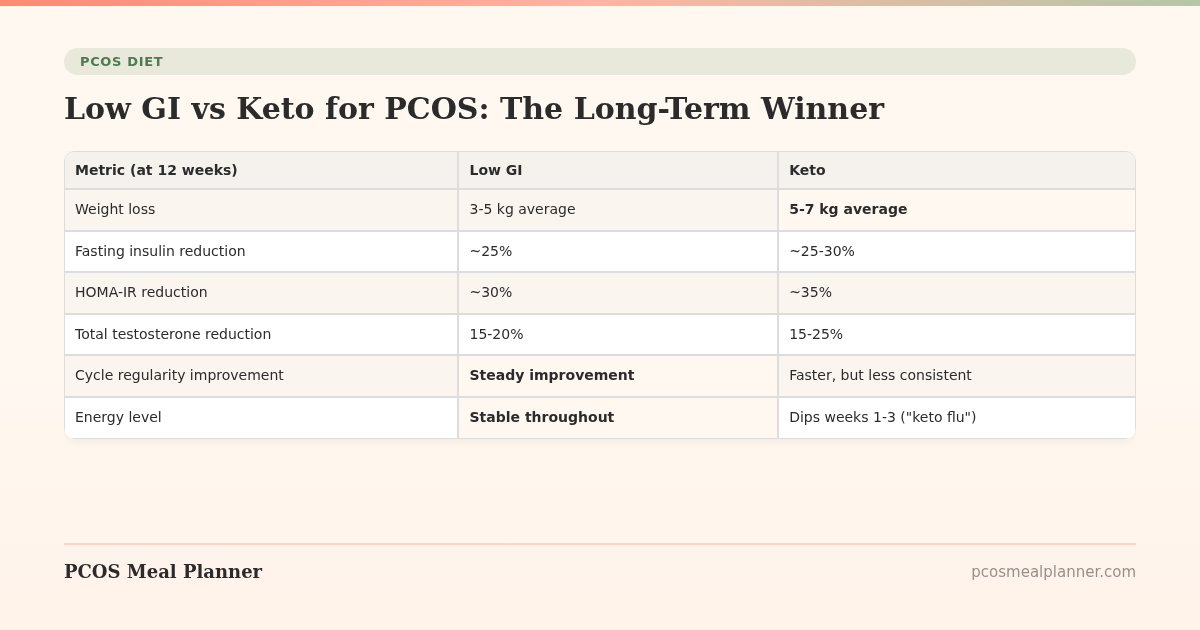
Low GI vs keto: 12-week metabolic comparison
Metric (at 12 weeks)
Low GI
Keto
Weight loss
3-5 kg average
5-7 kg average
Fasting insulin reduction
~25%
~25-30%
HOMA-IR reduction
~30%
~35%
Total testosterone reduction
15-20%
15-25%
Cycle regularity improvement
Steady improvement Faster, but less consistent
Energy level
Stable throughout Dips weeks 1-3 ("keto flu")
12-week adherence
80-85% 70-75%
Low GI vs keto: 12-month outcomes
Metric (at 12 months)
Low GI
Keto
12-month adherence
60-70% 25-35%
Weight loss maintained
4-6 kg average 3-4 kg average (post-rebound)
Metabolic gains held
Mostly Variable; mostly lost after lapse
LDL cholesterol shift
Neutral to slight improvement
Variable; can rise meaningfully
Micronutrient gaps
Rare Common: Ca, Mg, B-vitamins, fiber
Disordered eating risk
Low High; rigid food rules
Pregnancy compatibility
Yes Not recommended
The keto sustainability problem
Keto is the most-cited example of the "diet effect": fast early results that are not sustained. There are three structural reasons it tends to fail at 6+ months for women with PCOS specifically:
Social and practical friction. Restaurants, family meals, work events, travel, and grocery convenience all assume you eat carbs. Each interaction is a decision point that erodes adherence.The 80/20 trap. Many women relax keto rules expecting to keep the metabolic benefit. But the all-or-nothing nature of ketosis means even occasional carb meals knock you out of ketosis for 24-48 hours. "80% keto" is, mechanistically, just a moderate-carb diet without the rationale.The hormonal rebound. The same hormonal sensitivity that makes PCOS women respond well to carbs going out also makes them respond strongly to carbs going back in. The rebound weight from a glycogen refill is real water, not fat, but the scale move is psychologically discouraging.
Where low GI wins on the long timeline
Low GI is structurally easier to keep because:
No food group is fully excluded. Fruit, beans, whole grains, sweet potatoes are all in. This reduces decision fatigue and social friction.Restaurants and travel are workable. Most cuisines have low-GI options if you know what to ask for.Lapses are recoverable. A high-GI meal does not collapse a metabolic state. You return to the pattern at the next meal.The protein-first eating technique (Shukla 2015 in Diabetes Care ) lowers post-meal glucose by 29% on a low-GI meal without any keto-level restriction.
When keto is the right tool
Keto is genuinely the better choice in a few specific situations:
Pre-IVF metabolic reset. 8-12 weeks of strict keto before egg retrieval has small-trial evidence supporting improved egg quality and fertilization rates.Plateau breaker. If 6+ months of low GI has stalled, a 4-12 week keto block can re-engage weight loss and re-drop fasting insulin.Severe insulin resistance. HOMA-IR over 6 or fasting insulin over 25 microU/mL often responds faster to keto than to low GI in the first intervention window.Active migraine, epilepsy, or specific neurological conditions where the ketogenic state itself is therapeutic.
The hybrid approach: low GI as default, keto in bursts
The pattern that produces the best long-term PCOS outcomes for most of our users is:
Year-round default: low GI, protein-first, 30g+ protein per meal, healthy fats every meal. See our low-GI printable foods list .Targeted keto blocks (4-12 weeks): when a metabolic marker needs a faster push or before a defined event.Structured transitions: ramp carbs back in gradually (25g/week increments) after a keto block, starting with the lowest-GI options.Diet refresh every 3-6 months: review fasting insulin, body composition, cycles, and adjust before drifting.
Sample 1-day comparison
Meal
Low GI day
Keto day
Breakfast
3 eggs scrambled with spinach + 1/2 cup steel-cut oats + 1/2 cup berries (32g P / 35g C / 18g F)
3 eggs scrambled with spinach + 1/2 avocado + 2 strips bacon (28g P / 7g C / 35g F)
Lunch
Grilled chicken (5oz) + 3/4 cup quinoa + roasted vegetables + olive oil dressing (40g P / 45g C / 18g F)
Grilled chicken (5oz) + large green salad + 1/2 avocado + olive oil dressing (40g P / 10g C / 30g F)
Snack
Greek yogurt (3/4 cup) + 1 tbsp almond butter + cinnamon (18g P / 12g C / 10g F)
2 hard-boiled eggs + 12 almonds (15g P / 4g C / 18g F)
Dinner
6oz salmon + 1 medium sweet potato + steamed broccoli + olive oil (40g P / 30g C / 22g F)
6oz salmon + cauliflower rice + roasted broccoli + butter (40g P / 12g C / 28g F)
Daily totals (~) 130g P / 122g C / 68g F / 1,650 kcal 123g P / 33g C / 111g F / 1,620 kcal
Common myths about low GI and keto for PCOS
Myth: Keto cures PCOS.
Myth: Low GI is just "eat whole grains."
Myth: You have to be in deep ketosis for keto to help PCOS.
Myth: Low GI is too slow for serious PCOS.
Myth: Keto is dangerous for women.
The PCOS Meal Planner approach
Most PCOS dietary failures are adherence failures, not biology failures. The right diet is the one you can actually follow in the rhythm of your real life: your job, your family, your travel, your grocery store. The PCOS Meal Planner generates weekly plans that hit low-GI macros by default with the option to switch into a keto block for a defined window. The system is the durable layer; the diet rules are the configurable one. This is the opposite of static one-size-fits-all PCOS meal plans, which is exactly why most of them get abandoned by month 3.
Often asked questions
Is keto better than low GI for PCOS?
At 12 weeks the two are nearly identical. The 2023 Shang meta-analysis pooled trials and found similar reductions in fasting insulin, total testosterone, and weight. The divergence is at 12 months: low GI adherence holds at 60-70%, keto drops to 25-35%. The diet you can still do at month 12 is the one that delivers real PCOS outcomes.
How long does it take to see PCOS results on keto?
Fast. Most women in keto trials see fasting insulin drop within 2-3 weeks, measurable weight loss within 4 weeks, and cycle regularity beginning to return by week 8-12. The 2005 Mavropoulos pilot study showed 12% weight loss and 54% insulin reduction at 24 weeks.
How long does it take to see PCOS results on a low GI diet?
Slightly slower than keto in the first 12 weeks. The 2010 Marsh RCT showed measurable insulin improvements at 8-12 weeks and weight loss that caught up with keto by month 6.
Can I switch from keto to low GI for PCOS without losing results?
Yes, with a structured transition. Add 25g of low-GI carbs back per week over 6-8 weeks. Most insulin and androgen gains hold if the carbs added back are genuinely low GI.
Is keto safe long term for PCOS?
Short-term (up to 6 months) keto is well-tolerated in most PCOS studies. Long-term concerns: lipid panel changes, micronutrient gaps, gallbladder strain, thyroid hormone reduction in a subset, and disordered eating risk. Annual labs and a supplementation plan are advised for long-term keto.
Which PCOS symptoms respond best to each diet?
Keto tends to show faster gains in body weight, acne, and cravings. Low GI tends to show steadier gains in cycle regularity, sustained energy, and mood. For fertility goals, low GI is the more-studied option.
Can I do keto with PCOS while trying to conceive?
Not contraindicated but evidence base is thin. Low GI has the larger body of PCOS-fertility evidence. If keto is your preference during conception, ensure folate intake is adequate and discuss with your OB-GYN.
What is the best hybrid approach for PCOS?
Low GI as year-round default. Run a 4-12 week strict keto block when a metabolic marker needs a faster push or before a defined event. Return to low GI after, holding the gains while restoring sustainability.
Sources and further reading
This comparison draws on the published PCOS-specific dietary trials, the broader long-term diet adherence literature, and current clinical practice guidelines.
PCOS-specific diet trials
Long-term diet adherence and weight loss
Mechanism and protein-first eating
Keto safety and considerations
PCOS clinical guidelines
Patient-facing summaries
Get a meal plan that works with your PCOS. Our
AI PCOS Meal Planner generates personalised weekly plans that hit low-GI macros by default, with the option to switch into a keto block when you need a faster metabolic push.
Build your plan now .
How this article was made
This comparison draws on the published PCOS-specific trials of low GI and ketogenic diets (Marsh 2010 in Am J Clin Nutr, Mavropoulos 2005, Paoli 2020 in J Transl Med, Shang 2023 in Nutrients), the broader long-term weight-loss and adherence literature (Foster 2003 in NEJM, the DIRECT trial, the A TO Z trial, DIETFITS), the 2023 International Evidence-Based Guideline for PCOS from Monash University, the 2023 Endocrine Society Clinical Practice Guideline on PCOS, and the International Tables of Glycemic Index. We update this guide on a rolling cadence as new trial data appears.
Related reading
Community Comments
Add a comment