Probiotic plus prebiotic equals synbiotic, and the PMOS pathway it acts on
A diagram in three tiers. The top tier is an equation: a probiotic box (live beneficial bacteria such as yogurt, kefir and kimchi) plus a prebiotic box (fibre that feeds them, such as garlic, oats and legumes) equals a synbiotic box (both combined). An arrow runs down to the middle tier, a gut box, which sends three arrows to three targets: lower insulin, lower androgens and less inflammation. These are the three drivers of PMOS. The bottom tier lists the pooled outcomes from the 2026 meta-analysis of 11 trials and 780 women: lower fasting insulin, total testosterone, triglycerides, LDL, BMI and body weight, and higher HDL cholesterol.
Probiotic + Prebiotic = Synbiotic
And how it reaches the three drivers of PMOS
Probiotic
Live beneficial bacteria
Yogurt, kefir, kimchi
+
Prebiotic
Fibre that feeds them
Garlic, oats, legumes
=
Synbiotic
Both together, one meal
or one supplement
What are probiotics, prebiotics and synbiotics?
These three words get used interchangeably, but they are not the same thing. Getting them straight is the whole foundation of the topic.
A probiotic is live helpful bacteria. These are the strains found in yogurt with live active cultures, kefir, sauerkraut, kimchi, miso and tempeh, plus the capsules that concentrate them.A prebiotic is the fibre those bacteria eat. It is not alive. It is a specific kind of plant fibre, found in garlic, onion, oats, legumes and slightly green banana, that survives digestion and feeds the good bacteria in your colon.A synbiotic is both together. When you combine live bacteria with the fibre that feeds them, in one supplement or one meal, you have a synbiotic. The idea is that the fibre helps the bacteria survive and do more work.
The practical takeaway is simple: you can build a synbiotic on a plate. Kefir poured over oats is a synbiotic. Kimchi on a lentil bowl is a synbiotic. You do not need a product to get the combination.
What the 2026 meta-analysis found
The strongest recent evidence comes from Sun and colleagues, published in BMC Endocrine Disorders in 2026. It was a systematic review and meta-analysis, PROSPERO-registered and reported to PRISMA standards, that searched the literature to 19 March 2026 and pooled 11 randomised controlled trials covering 780 people with PCOS. Pooling trials this way gives a more reliable signal than any single small study.
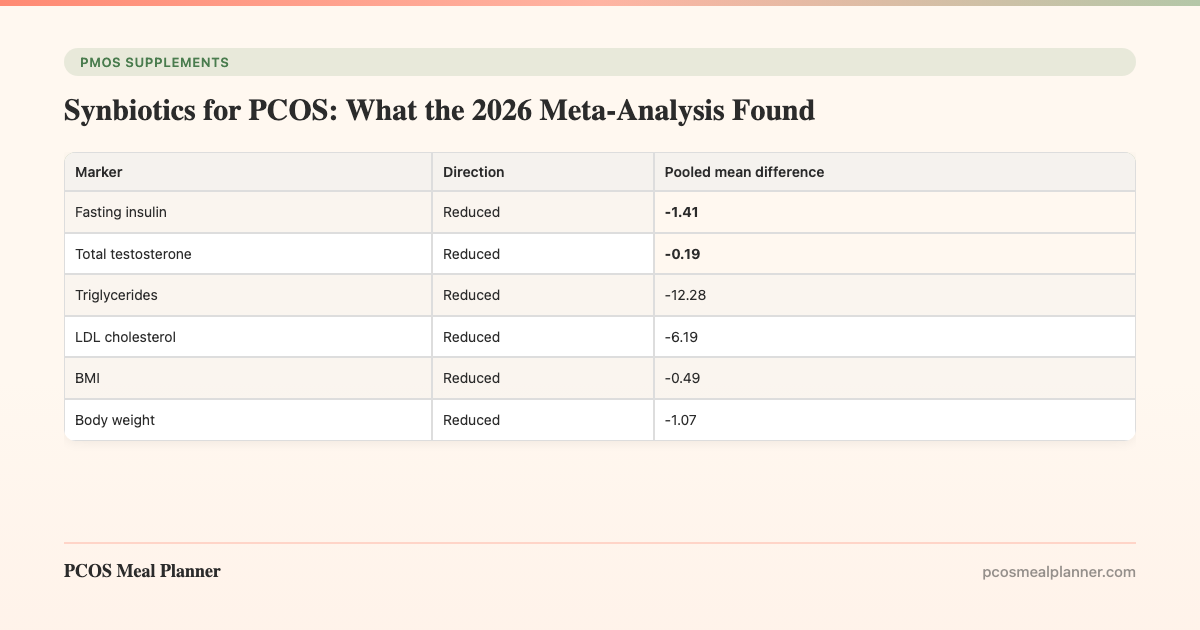
Compared with a control group, probiotic and synbiotic supplementation moved several markers in a favourable direction. The table below shows each marker, the direction of change, and the pooled mean difference reported. Units follow the source studies, and the values are averages across trials rather than a promise for any one person.
Marker
Direction
Pooled mean difference
Fasting insulin
Reduced
-1.41
Total testosterone
Reduced
-0.19
Triglycerides
Reduced
-12.28
LDL cholesterol
Reduced
-6.19
BMI
Reduced
-0.49
Body weight
Reduced
-1.07
HDL cholesterol
Increased
Higher
Read across the table and a theme appears. The biggest wins were metabolic: fasting insulin, triglycerides, LDL and weight. The hormonal shift, total testosterone, was smaller. That pattern fits the biology, because the gut mostly reaches your hormones through the metabolic side door of insulin.
How gut bacteria affect PMOS: insulin, androgens and inflammation
The gut is upstream of the three core drivers of PMOS. This is the mechanism that explains why a fibre and a few bacteria could touch your hormones at all.
Insulin. When gut bacteria ferment prebiotic fibre, they produce short-chain fatty acids like butyrate. These improve how your cells respond to insulin. Because insulin resistance is the engine behind most PMOS symptoms, as described by Diamanti-Kandarakis and Dunaif in their 2012 review, lowering insulin is the highest-leverage change you can make. The meta-analysis showing reduced fasting insulin is the gut acting on this exact lever.
Androgens. High insulin tells the ovaries to make more testosterone and lowers sex-hormone-binding globulin, which frees up even more active testosterone. So when the gut lowers insulin, testosterone tends to ease down with it. That is the likely path behind the modest drop in total testosterone in the pooled data.
Inflammation. A less healthy gut lining can let bacterial fragments leak into the bloodstream, which raises low-grade inflammation. Inflammation worsens insulin resistance, creating a loop. A better-fed microbiome strengthens the gut barrier and quiets this signal. For the deeper version of this story, see our guide on the PMOS gut-brain axis .
Food-first: where to get probiotics and prebiotic fibre
Before you buy a supplement, know that the bacteria in trials come from the same families you can eat, and the prebiotic fibres are ordinary plant fibres. The table below splits common foods into the two jobs. Combine one from each column and you have a food-based synbiotic.
Food
Type
What it provides
Yogurt with live active cultures
Probiotic
Live cultures plus protein for steadier blood sugar
Kefir
Probiotic
A wider range of strains than most yogurt
Sauerkraut (unpasteurised)
Probiotic
Live cultures plus fibre, near zero sugar
Kimchi
Probiotic
Live cultures plus cruciferous vegetables
Miso and tempeh
Probiotic
Fermented soy; tempeh also adds protein
Garlic, onion and leek
Prebiotic
Inulin fibre that feeds helpful bacteria
Oats
Prebiotic
Beta-glucan fibre, low glycemic load
Legumes (lentils, chickpeas)
Prebiotic
Resistant starch plus plant protein
Slightly green banana
Prebiotic
Resistant starch that feeds the microbiome
Asparagus and barley
Prebiotic
Inulin and beta-glucan fibre
Two easy food synbiotics to start with: kefir poured over oats with a few berries at breakfast, or kimchi stirred through a warm lentil and garlic bowl at lunch. Each pairs live bacteria with the fibre they feed on.
What to look for in a synbiotic supplement
If food is not enough or not practical, a supplement is a reasonable backup. Read the label for four things.
Named strains. Look for specific strains, not just a genus. Lactobacillus and Bifidobacterium species listed with strain codes are a good sign, because strains are what get studied.CFU count. Colony-forming units are the dose of live bacteria, commonly 1 to 50 billion. More is not automatically better; a sensible mid-range count from tested strains beats a huge number from an unnamed blend.Guaranteed through shelf life. A count that is guaranteed only at the time of manufacture can drop to almost nothing by the time you take it. Look for potency guaranteed to the expiry date.A prebiotic on the label, and third-party testing. A true synbiotic lists a prebiotic such as inulin or fructo-oligosaccharides. Third-party testing for purity and potency tells you the bottle contains what it claims.
One safety note before you buy: a supplement is not a replacement for medical care. If you are immunocompromised, seriously unwell, or pregnant, check with a doctor before starting a probiotic.
The honest limits: modest effects and variable quality
This is where most probiotic marketing goes quiet, so we will say it plainly. The pooled effects in the 2026 meta-analysis were statistically significant but modest. A fasting insulin drop of around 1.41 or a BMI drop of around 0.49 is a nudge, not a transformation. These are averages, and some people in the trials responded more while others barely moved.
Trial quality also varied. The included studies used different strains, doses and durations, which makes it hard to say precisely which product does what. There is no single proven PMOS probiotic. What the evidence supports is a direction: feeding your gut well tends to help the metabolic markers that drive PMOS. Treat a synbiotic as one helper among several, not as the thing that fixes your hormones.
How synbiotics fit the PMOS diet
A synbiotic is not a separate project bolted onto your diet. It slots into the same insulin-friendly pattern that already helps PMOS: protein-first meals, plenty of fibre, low glycemic load, and a Mediterranean fat profile. The prebiotic fibre column above is already what a good PMOS plate looks like, so you are mostly adding a daily fermented food.
Timing helps too. Because the gut works with your daily rhythm, pairing fibre and fermented foods with a consistent eating window can compound the benefit. Our guide on time-restricted eating for PCOS covers how meal timing supports insulin sensitivity. And if you are already building a supplement routine, magnesium is another well-evidenced option worth understanding alongside this one; see our magnesium for PCOS guide .
How the PCOS Meal Planner builds this in
This is where a system beats a bottle. Instead of taking a capsule and hoping the rest of your diet keeps up, the PCOS Meal Planner builds gut-friendly, insulin-friendly meals that already pair fermented foods with prebiotic fibre. You get the synbiotic combination on your plate, inside a plan tuned to your PMOS symptoms, without having to assemble it yourself. That way the fasting-insulin lever the meta-analysis measured is being pulled by your everyday food, not by a supplement you might forget. Build a gut-friendly PMOS plan now .
Often asked questions
Do probiotics help PCOS?
The evidence points modestly in favour. A July 2026 meta-analysis (Sun et al., BMC Endocrine Disorders) pooled 11 randomised trials and 780 women with PCOS, now called PMOS. Probiotics and synbiotics significantly reduced fasting insulin, total testosterone, triglycerides, LDL, BMI and weight, and raised HDL. The effects were real but modest, so treat them as a supporting player, not a standalone treatment.
Share this answer
What is the difference between a probiotic, a prebiotic and a synbiotic?
A probiotic is live helpful bacteria (yogurt, kefir, kimchi). A prebiotic is the fibre those bacteria feed on (garlic, oats, legumes). A synbiotic is both combined, in one supplement or one meal. Pairing a fermented food with a fibre-rich food makes a synbiotic from food, no product required.
Share this answer
What did the 2026 meta-analysis find for synbiotics and PCOS?
Sun et al. (2026) pooled 11 trials and 780 people, searched to 19 March 2026. Versus control, supplementation lowered fasting insulin (mean difference -1.41), total testosterone (-0.19), triglycerides (-12.28), LDL (-6.19), BMI (-0.49) and body weight (-1.07), and raised HDL. Units follow the source studies, and these are pooled averages.
Share this answer
Can I get the benefits from food instead of a supplement?
Often yes. The bacteria studied come from the same families found in everyday fermented foods, and the prebiotic fibres are ordinary plant fibres. Kefir over oats, or kimchi with a lentil bowl, is a food-based synbiotic that also brings protein and micronutrients a capsule cannot. Food is a reasonable and cheaper starting point for most people.
Share this answer
What should I look for in a PCOS probiotic supplement?
Look for named strains with codes, a sensible CFU count (commonly 1 to 50 billion) guaranteed through shelf life, not just at manufacture, and a listed prebiotic such as inulin for a true synbiotic. Choose a brand with third-party testing. Check with a doctor first if you are immunocompromised or pregnant.
Share this answer
Are synbiotics safe for PCOS?
For most people, fermented foods and food-based synbiotics are safe, with mild bloating as the gut adjusts being the usual side effect. Supplements are generally low risk but are not a replacement for medical care. People who are immunocompromised, seriously ill, or pregnant should check with a doctor before starting one.
Share this answer
Sources and further reading
Probiotics and synbiotics in PCOS
PCOS and insulin resistance
Clinical guidelines and patient-facing summaries
How this article was made
The headline evidence is Sun et al. 2026 in BMC Endocrine Disorders, a PROSPERO-registered systematic review and meta-analysis of 11 randomised controlled trials (780 people), searched to 19 March 2026 and reported to PRISMA standards. Pooled mean differences are quoted as reported, with units following the source studies, and effect sizes are described as modest because that is what the data show.
The insulin-resistance mechanism draws on Diamanti-Kandarakis and Dunaif 2012. Guidance is aligned with the 2023 International Evidence-Based Guideline for PCOS, with patient-facing context from the NHS and Mayo Clinic. PMOS is the new name for PCOS as of 12 May 2026; the underlying biology is unchanged. This article is educational and not medical advice. Supplements are not a replacement for medical care; check with a doctor before starting one, especially if you are immunocompromised or pregnant.
Related reading
Community Comments
Add a comment