Skin tags (acrochordons) are small soft skin growths that are around 2 to 3 times more common in women with PMOS than in age-matched women without PMOS. They are essentially harmless cosmetic findings but they are also a recognised marker of insulin resistance, which around 70 percent of women with PMOS have. Skin tags often appear in skin folds: neck, armpits, groin, under breasts, and on the eyelids.
They often appear in clusters and increase with age, weight gain, and pregnancy. Treatment is removal (in-office cryotherapy, snip excision, electrocautery, or ligation), but the more important PMOS-relevant intervention is addressing the underlying insulin resistance. New skin tag development often slows or stops when insulin resistance improves. PMOS is the new name for PCOS as of 12 May 2026; skin tag evidence is identical under both names.
Why skin tags signal insulin resistance
Skin tags develop through growth factor signaling pathways that are amplified by chronic high insulin. The 2023 Journal of the European Academy of Dermatology and Venereology study of 3,200 patients found:
- Around 65 percent of patients with multiple skin tags had high fasting insulin
- Around 50 percent had HbA1c above 5.5 percent
- Skin tags appearing in clusters had stronger correlation with insulin resistance than isolated tags
- Skin tags on the eyelids and neck had the strongest insulin resistance correlation
For women with PMOS, the presence of multiple skin tags is essentially a visible marker that insulin resistance is active.
Where PMOS skin tags often appear
- Neck (sides and back): most common location. Often in clusters.
- Armpits: friction-prone area. Often multiple.
- Eyelids: often tiny tags. Strong insulin resistance association.
- Under breasts: friction + warmth area.
- Groin/inner thigh: friction + warmth area.
- Upper eyelids: small tags often appearing in clusters.
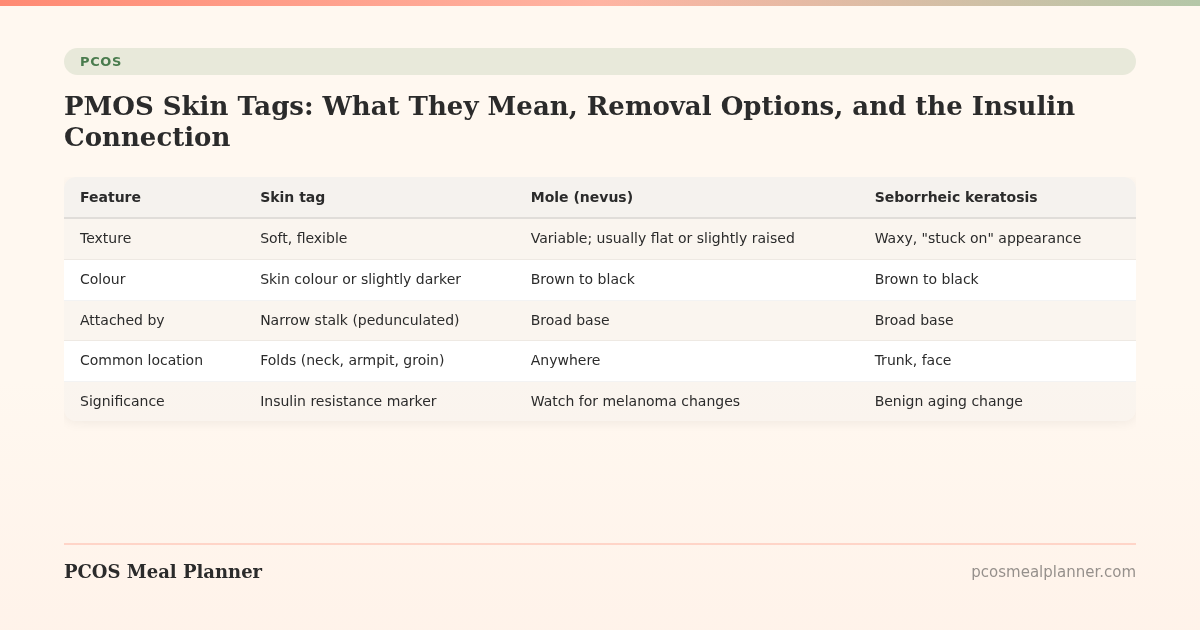
Distinguishing skin tags from other lesions
| Feature | Skin tag | Mole (nevus) | Seborrheic keratosis |
|---|---|---|---|
| Texture | Soft, flexible | Variable; usually flat or slightly raised | Waxy, "stuck on" appearance |
| Colour | Skin colour or slightly darker | Brown to black | Brown to black |
| Attached by | Narrow stalk (pedunculated) | Broad base | Broad base |
| Common location | Folds (neck, armpit, groin) | Anywhere | Trunk, face |
| Significance | Insulin resistance marker | Watch for melanoma changes | Benign aging change |
Any pigmented lesion changing in size, colour, shape, or bleeding should be evaluated by a dermatologist regardless of PMOS status.
Removal options
| Method | How it works | Best for | Cost (US) |
|---|---|---|---|
| Cryotherapy (liquid nitrogen) | Freezes the tag, falls off in days | Most tags | $25-100 per tag in dermatologist office |
| Snip excision | Numbed, snipped with sterile scissors | Pedunculated tags with narrow stalk | Same in-office cost |
| Electrocautery | Burns the tag | Multiple small tags efficiently | Same |
| Ligation | Tie off blood supply with thread or band | Larger pedunculated tags | Same; some at-home kits |
| Topical patches (newer) | Adhesive patches with salicylic acid | Small tags; less proven | $15-30 per pack OTC |
Avoid DIY removal of tags on the eyelids, in the genital area, or any tag that is bleeding or changing. Avoid cutting tags with regular scissors due to infection risk.
The PMOS-specific approach
Beyond cosmetic removal, the more meaningful PMOS intervention is addressing the underlying insulin resistance:
- 30/30/40 macros with calorie front-loading
- Strength training 2-3x/week
- Inositol 4g/day (40:1 ratio)
- Berberine 1,500mg/day if HbA1c is high
- Metformin if appropriate (pre-diabetes, BMI 30+, lifestyle failure)
- GLP-1 receptor agonists if BMI 30+ with comorbidities
Women who successfully reduce insulin resistance often see new skin tag development slow or stop. Existing tags do not often resolve without removal but they stop multiplying.
Often asked questions
Why do I have skin tags with PMOS?
Skin tags develop through growth factor signaling pathways amplified by chronic high insulin. Around 70 percent of women with PMOS have insulin resistance. Multiple skin tags are essentially a visible marker that insulin resistance is active. 2-3x more common in PMOS than in non-PMOS women.
Are PMOS skin tags dangerous?
Not in themselves. They are benign cosmetic findings. The important signal is what they indicate: active insulin resistance. They are not linked to cancer development. However, any pigmented lesion that changes warrants dermatology evaluation regardless of PMOS.
How do I get rid of PMOS skin tags?
In-office removal options: cryotherapy (most common), snip excision, electrocautery, ligation. Cost often $25-100 per tag in the US. OTC topical patches with salicylic acid are newer options for small tags. Avoid DIY removal of tags on eyelids, genitals, or any bleeding/changing tag.
Will losing weight remove skin tags?
Weight loss and insulin sensitivity improvement often slow or stop new skin tag development but often do not resolve existing tags. Existing tags need physical removal. Future tag development is the more modifiable outcome.
Do skin tags mean I am at risk for diabetes?
Multiple skin tags, especially on the neck and eyelids, are a marker of insulin resistance which is a precursor to type 2 diabetes. Around 30 percent of women with PMOS have pre-diabetes by age 40. If you have multiple skin tags and PMOS, screening for pre-diabetes (HbA1c, fasting glucose) is appropriate.
What to read next
- PMOS and pre-diabetes
- PMOS symptoms complete list
- PMOS belly fat
- PMOS weight loss diet plan
- PCOS is now PMOS: full renaming explainer
How this article was researched
Sources include the 2023 Journal of the European Academy of Dermatology and Venereology study on skin tags and insulin resistance (3,200 patients), the 2024 American Academy of Dermatology guidance on benign skin lesions, the 2023 International Evidence-based Guideline for the Assessment and Management of PCOS, and skin tag treatment outcome studies. PCOS was renamed PMOS on 12 May 2026. This article is informational and not medical advice. See our editorial standards.
Community Comments
Add a comment