PMOS in midlife (roughly ages 35 to 50) presents differently than in the 20s and early 30s: metabolic complications often become visible, fertility windows close, heart risk emerges, mental health symptoms can intensify, and many women find diagnosed-in-their-20s PMOS becoming more complicated rather than easier.
The 6 midlife shifts: pre-diabetes and type 2 diabetes risk peaks (around 30 percent of women with PMOS have pre-diabetes by age 40), non-alcoholic fatty liver disease becomes visible (around 60 percent prevalence), heart risk markers worsen, sleep apnoea diagnosis often happens now, mental health symptoms intensify (especially around perimenopausal transitions), and weight control gets harder due to declining muscle mass. The midlife PMOS management plan shifts emphasis from cycle and fertility toward metabolic protection, strength training to preserve muscle, and mental health support. PMOS is the new name for PCOS as of 12 May 2026; midlife management is identical under both names.
The 6 midlife PMOS shifts
1. Metabolic complications become visible
Pre-diabetes (HbA1c 5.7-6.4%) affects around 30 percent of women with PMOS by age 40 per the 2023 Lancet meta-analysis. Type 2 diabetes risk rises further in midlife. Non-alcoholic fatty liver disease (NAFLD/MASLD) is present in around 60 percent of midlife women with PMOS, often silent until liver enzymes are checked.
2. Fertility windows close
Even women with previously preserved ovarian reserve due to PMOS see fertility decline through midlife. AMH falls, egg quality declines, miscarriage rates rise. For women still planning pregnancy, the timeline becomes more time-sensitive. For women who have completed family planning, the fertility focus of earlier PMOS care can be retired.
3. Heart risk emerges
Women with PMOS have around double the lifetime heart disease risk. Most of this risk accrues in the 35-65 age window. Lipid abnormalities, blood pressure changes, and atherosclerotic markers worsen in midlife. Annual cardiovascular monitoring (lipid panel, blood pressure, possibly coronary artery calcium scoring if other risk factors) becomes important.
4. Sleep apnoea often diagnosed
Obstructive sleep apnoea is around 30 times more common in PMOS than in age-matched controls. Many midlife women receive their OSA diagnosis after years of attributing fatigue and morning headaches to "just PMOS" or "just busy life." Sleep studies become more commonly recommended in this age window.
5. Mental health symptoms intensify
Depression and anxiety rates remain 2-3 times higher than baseline (per the 2023 Lancet systematic review on PCOS mental health). Midlife stresses (career, caregiving, relationships, perimenopausal hormonal changes) often intensify symptoms. Mental health support becomes a primary pillar rather than an optional one.
6. Weight control gets harder
Muscle mass declines around 3-5 percent per decade after 30 without strength training. Combined with the around 4 percent lower baseline RMR in PMOS, weight gain becomes more likely at the same caloric intake that maintained weight at 25. Strength training and protein priority become essential for midlife PMOS body composition.
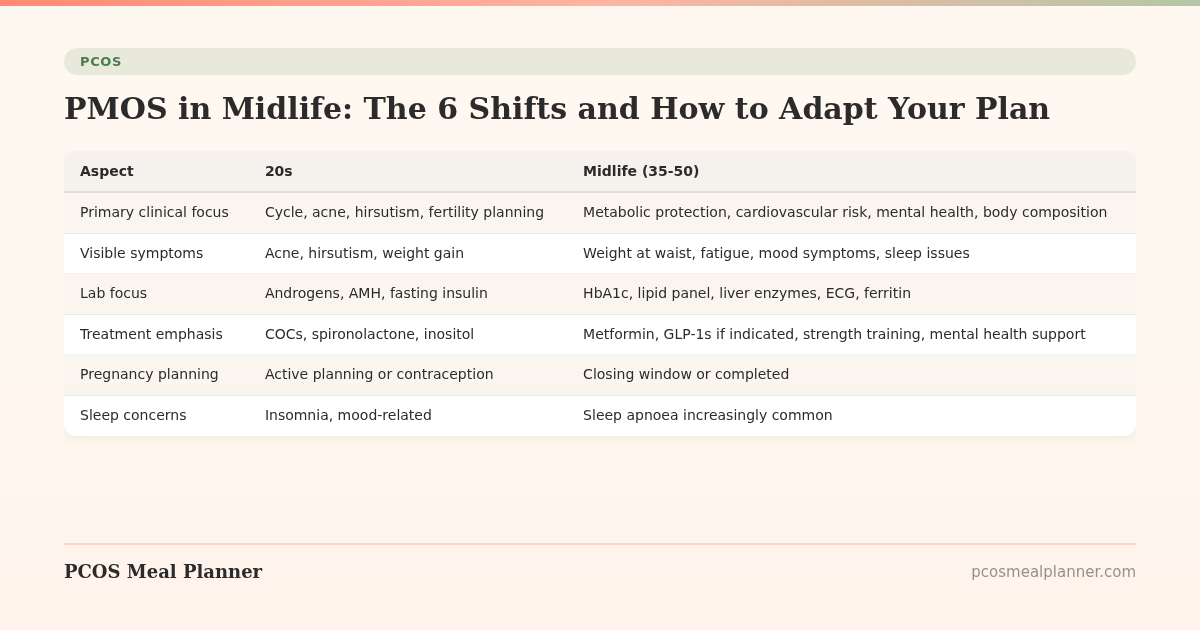
How midlife PMOS differs from PMOS in your 20s
| Aspect | 20s | Midlife (35-50) |
|---|---|---|
| Primary clinical focus | Cycle, acne, hirsutism, fertility planning | Metabolic protection, heart risk, mental health, body composition |
| Visible symptoms | Acne, hirsutism, weight gain | Weight at waist, fatigue, mood symptoms, sleep issues |
| Lab focus | Androgens, AMH, fasting insulin | HbA1c, lipid panel, liver enzymes, ECG, ferritin |
| Treatment emphasis | COCs, spironolactone, inositol | Metformin, GLP-1s if indicated, strength training, mental health support |
| Pregnancy planning | Active planning or contraception | Closing window or completed |
| Sleep concerns | Insomnia, mood-related | Sleep apnoea increasingly common |
The midlife PMOS management plan
Pillar 1: Annual metabolic screening
- HbA1c, fasting glucose, fasting insulin
- Lipid panel
- Liver enzymes (ALT, AST, GGT)
- Blood pressure
- Body composition (BMI, waist circumference, waist-to-hip ratio)
- FIB-4 calculator for liver fibrosis risk if any liver enzyme elevation
- Vitamin D, B12, ferritin
The 2023 PCOS Guideline recommends this annually for midlife women with PMOS, more often if abnormal findings.
Pillar 2: 30/30/40 PMOS eating pattern with protein priority
The 30/30/40 macro pattern continues but with slightly higher protein priority (1.4-1.6 g/kg body weight) to support muscle preservation through midlife. Calorie front-loading, fibre target, and Mediterranean fat profile unchanged.
Pillar 3: Strength training as foundation
Strength training 2-3 times per week is essential in midlife PMOS to preserve muscle mass and metabolic rate. The 2024 JCEM meta-analysis showed 30 percent average HOMA-IR reduction in PCOS strength training trials. Compound movements (squats, deadlifts, push/pull/hinge/carries) with progressive overload.
Pillar 4: Sleep prioritisation and apnoea screening
Get a sleep study if any signs of obstructive sleep apnoea (waking unrefreshed, morning headaches, partner notices snoring or breathing pauses, daytime fatigue not explained by sleep duration). Treating undiagnosed OSA in midlife often dramatically improves PMOS metabolic and mental health symptoms.
Pillar 5: Mental health screening and support
Annual depression and anxiety screening becomes essential. CBT, ACT, mindfulness practices, and medications (SSRIs, SNRIs) all have a place. The midlife PMOS mental health load is real and treatable.
Pillar 6: Bone density baseline
Bone density scan (DEXA) baseline at age 50, or earlier if risk factors (low BMI, previous fractures, family history, long-term corticosteroid use). PMOS women on long-term metformin may have slightly high osteoporosis risk; calcium and vitamin D adequacy matters.
Midlife PMOS by life situation
If you have completed family planning
The cycle and fertility focus of earlier PMOS care can be retired. Long-term reversible contraception (Mirena, copper IUD, or continued COCs for endometrial protection) plus the metabolic and mental health management above. Many women feel relief when fertility pressure ends.
If you are still planning pregnancy in midlife
Time-sensitive. See PMOS pregnancy planning and TTC for the protocol. AMH and antral follicle count testing helps assess ovarian reserve. Reproductive endocrinology referral often appropriate. Closer obstetric monitoring during pregnancy due to age plus PMOS combined risks.
If you are caring for aging parents
"Sandwich generation" stress amplifies PMOS through cortisol pathways. Sleep often suffers. Self-care becomes harder. Practical adaptations: lower the perfection bar on PMOS adherence during high-stress periods (aim for the 30/30/40 pattern at 70 percent rather than 90 percent), prioritise the highest-leverage interventions (protein breakfast, walking, magnesium evening), seek mental health support proactively.
If you are in a high-demand career phase
Long hours, frequent travel, and high cognitive demands compound PMOS stress. See PMOS at work for the workplace plan. Strength training and sleep often become the things that get cut first; protecting them matters most in this phase.
The midlife PMOS lab panel
| Test | Why for midlife PMOS | Frequency |
|---|---|---|
| HbA1c | Pre-diabetes and T2D screening (30% prevalence by 40) | Annually |
| Fasting insulin, glucose | HOMA-IR calculation | Annually |
| Lipid panel | Heart risk (2x lifetime risk in PMOS) | Annually |
| Blood pressure | Heart risk | Every visit; home monitoring helpful |
| ALT, AST, GGT | NAFLD screening (60% prevalence) | Annually |
| TSH, free T4 | Thyroid (3x rate in PMOS) | Annually |
| Vitamin D, B12, ferritin | Common deficiencies | Annually |
| AMH, FSH, oestradiol | Reproductive planning if applicable | If planning pregnancy or assessing perimenopause |
| Sleep study | OSA (30x more common in PMOS) | If any symptoms suggest |
| DEXA scan | Bone density | Baseline at 50, earlier if risk factors |
Often asked questions
How does PMOS change in midlife?
6 main shifts: metabolic complications (pre-diabetes, fatty liver, T2D) become visible, fertility windows close, heart risk emerges, sleep apnoea often diagnosed, mental health symptoms intensify, weight control gets harder due to declining muscle. Clinical focus shifts from cycle/fertility to metabolic protection and mental health.
What labs should I do for midlife PMOS?
Annually: HbA1c, fasting insulin and glucose, lipid panel, blood pressure, liver enzymes (ALT/AST/GGT), thyroid (TSH/free T4), vitamin D, B12, ferritin. As needed: AMH and FSH if reproductive planning relevant, sleep study if OSA signs, DEXA at 50.
Will PMOS symptoms get worse in midlife?
Mixed. Androgen-driven symptoms (acne, hirsutism, scalp hair loss) often stabilise or mildly improve as ovarian androgens decline. Metabolic symptoms (weight at waist, insulin resistance, fatty liver, heart risk) often worsen. Mental health symptoms can intensify around perimenopausal transitions. Sleep often gets worse.
Should I still see a gynaecologist for midlife PMOS?
Yes, but the focus shifts. Endocrinologists become more central for the metabolic and mental health pieces. Gynaecologists remain important for cycle management, endometrial protection (especially if still cycling irregularly), perimenopausal transitions, and any reproductive planning.
Do I still need to take inositol in midlife?
If it has been helpful (insulin sensitivity, mood, energy), continue. The 4g/day (40:1 ratio) dose is unchanged through midlife. Some women add berberine or transition to metformin if pre-diabetes develops. Discuss with your doctor.
What is the most important midlife PMOS intervention?
Strength training. The combination of declining muscle mass with age plus the PMOS metabolic baseline makes muscle preservation the highest-leverage intervention. 2-3 sessions per week, compound movements, progressive overload. Alongside the standard 30/30/40 eating pattern.
Is GLP-1 medication appropriate for midlife PMOS?
Increasingly common. GLP-1s (semaglutide, tirzepatide) at midlife BMI 30+ with metabolic complications can produce significant weight loss and metabolic improvement. Particularly useful when pre-diabetes or fatty liver has developed. See GLP-1s for PMOS.
When does PMOS midlife become perimenopause?
Gradually. Perimenopause often starts late 30s to mid 40s and lasts until menopause (average age 51-52). Many women experience symptoms from both PMOS and perimenopause overlapping. See PMOS in perimenopause for the specific transition guidance.
Build a PMOS plan for midlife
Midlife PMOS care emphasises metabolic protection and muscle preservation.
The 30/30/40 PMOS pattern with strength training does double duty for both. Take the free phenotype quiz to start.
What to read next
- PMOS in perimenopause
- PMOS and pre-diabetes
- PMOS and fatty liver (NAFLD)
- PMOS at the gym
- PCOS is now PMOS: full renaming explainer
How this article was researched
Sources include the 2023 International Evidence-based Guideline for the Assessment and Management of PCOS, the 2023 Lancet meta-analysis on PCOS and type 2 diabetes risk, the 2023 systematic review of NAFLD in PCOS, the 2023 Lancet systematic review on mental health in PCOS, the 2024 JCEM strength training in PCOS meta-analysis, and the 2024 American Heart Association guidance on heart risk in PCOS. PCOS was renamed PMOS on 12 May 2026; midlife management evidence is unchanged. This article is informational and not medical advice. See our editorial standards.
Community Comments
Add a comment