Why most meal-prep advice fails for PCOS specifically
Generic meal prep advice fails for PCOS for three predictable reasons. First, most meal-prep templates default to "rice + chicken + steamed vegetables" five days a week, which is a 50-percent-carb pattern that aggravates the insulin spikes that drive PCOS symptoms. Second, the typical meal-prep ratio is built around calorie targets rather than macro targets, which leaves protein under-served (most prep templates serve 18-22g protein per meal; PCOS responds best at 25-35g per meal). Third, generic prep doesn't account for hormonal energy variation across the cycle — what tastes good on day 7 of a cycle is not what tastes good on day 25.
The PCOS-aware meal prep system below addresses all three. It is a 5-day system, not 7, because building 5 days of dinners and leaving room for spontaneity over the weekend produces better adherence than rigid 7-day prep. It uses a "build-blocks" approach (proteins, vegetables, starches, sauces) rather than fully-assembled meals, which lets you mix and match across the week without food fatigue. And it front-loads bigger breakfasts to align with the insulin-sensitivity window early in the day.
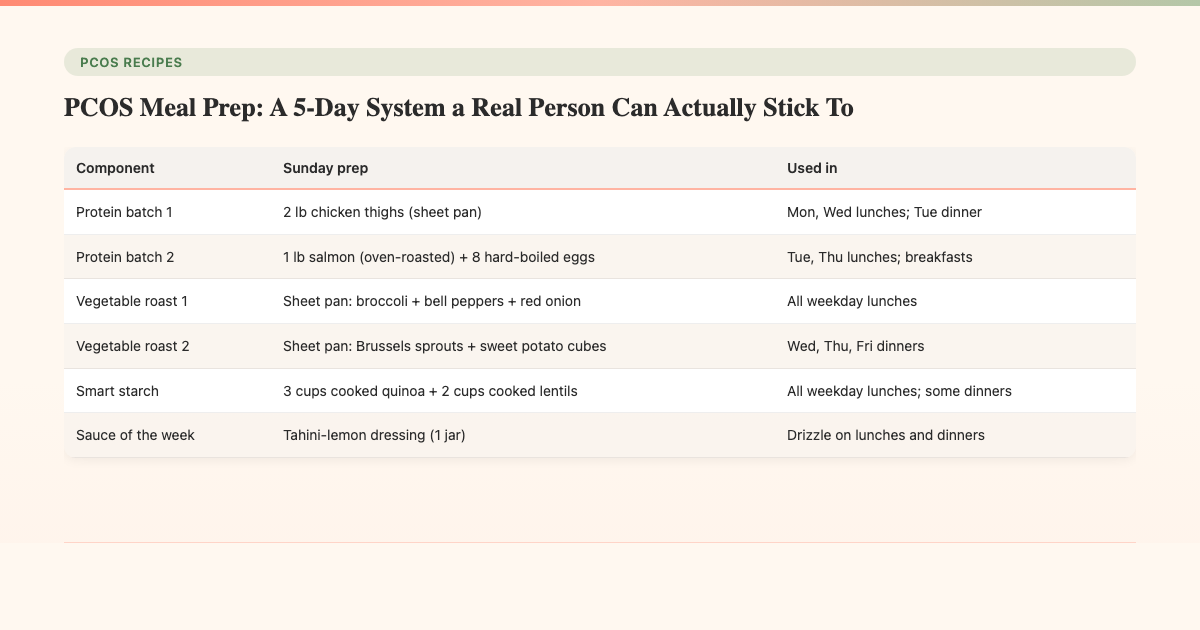
The 5-day system in one diagram
Sunday: 90 minutes of prep produces all five weekday breakfasts and lunches plus the building blocks for dinners. Monday through Friday: assemble + cook 10-20 minutes per dinner from prepped components. Saturday: a flex day, no prep required.
| Component | Sunday prep | Used in |
|---|---|---|
| Protein batch 1 | 2 lb chicken thighs (sheet pan) | Mon, Wed lunches; Tue dinner |
| Protein batch 2 | 1 lb salmon (oven-roasted) + 8 hard-boiled eggs | Tue, Thu lunches; breakfasts |
| Vegetable roast 1 | Sheet pan: broccoli + bell peppers + red onion | All weekday lunches |
| Vegetable roast 2 | Sheet pan: Brussels sprouts + sweet potato cubes | Wed, Thu, Fri dinners |
| Smart starch | 3 cups cooked quinoa + 2 cups cooked lentils | All weekday lunches; some dinners |
| Sauce of the week | Tahini-lemon dressing (1 jar) | Drizzle on lunches and dinners |
| Breakfast prep | Overnight oats (5 jars) + veggie egg muffins (10) | All 5 weekday breakfasts |
Sunday prep: 90 minutes, what to actually do
Minute 0-10: setup
Preheat oven to 425°F. Pull out two sheet pans, two mixing bowls, the slow cooker or rice cooker, a large saucepan, and storage containers (glass, with airtight lids). Run hot water over the protein you're using if it was frozen.
Minute 10-25: protein batch (2 sheet pans, 2 proteins)
Sheet pan 1: 2 lb chicken thighs, salt, pepper, garlic powder, paprika, drizzle of olive oil. Sheet pan 2: 1 lb salmon fillets, lemon, salt, dill, drizzle of olive oil. Both go in the oven at 425°F for 18-22 minutes (chicken to 165°F internal, salmon to 145°F).
Minute 15-30: vegetable roast (overlap with protein in oven)
While proteins are in the oven on the bottom rack, prep two vegetable trays for round two. Tray 1: 2 heads broccoli + 2 bell peppers + 1 red onion, all chopped, tossed with olive oil + salt. Tray 2: 1 lb Brussels sprouts (halved) + 2 medium sweet potatoes (cubed), tossed with olive oil + salt + paprika. They go in at 425°F for 25-30 minutes the moment the proteins come out.
Minute 25-45: smart starch (parallel)
Quinoa: 1.5 cups dry + 3 cups water + pinch salt, simmer covered 15 minutes, fluff with fork. Lentils (canned, drained, rinsed) heat briefly in a saucepan with a splash of olive oil and a clove of garlic. Both keep 5-7 days refrigerated.
Minute 35-50: sauce of the week + boil eggs
Tahini-lemon dressing in a jar: 1/3 cup tahini + 1/4 cup lemon juice + 1/4 cup water + 1 garlic clove (crushed) + salt + 1 tsp honey. Shake. Keeps 7 days. Hard-boil 8 eggs: cold water, bring to a boil, cover, off heat, 11 minutes, ice bath. Peel and store in shells (or peel and store in salt water for easier breakfast access).
Minute 50-70: overnight oats + egg muffins
Overnight oats (5 single-serve jars): half cup rolled oats + 1 scoop protein powder + 1 tbsp chia + 1 cup unsweetened almond milk + 1 tbsp almond butter per jar. Top with frozen berries. Refrigerate. Veggie egg muffins (10 muffins): 8 eggs whisked + leftover chopped vegetables + crumbled feta, divided into a greased muffin tin, baked 18 minutes at 350°F (run after the sheet pans come out).
Minute 70-90: portion + clean
Portion proteins, vegetables, and starches into 5 lunch containers (mix and match across the week to vary). Wash sheet pans and bowls. Done.
Breakfasts: 5 days, 3 swappable formulas
- Overnight oats (Mon, Wed, Fri): jar from prep + extra berries on top. ~30g protein, 35g carbs, 18g fat.
- Egg muffins + cottage cheese (Tue): 3 muffins + half cup cottage cheese + half cup berries. ~35g protein, 18g carbs, 18g fat.
- Smoked salmon plate (Thu): 3 oz smoked salmon + 2 hard-boiled eggs (from prep) + cherry tomatoes + half avocado. ~35g protein, 8g carbs, 26g fat.
Lunches: bowl-style assembly from Sunday's components
Each weekday lunch is the same template: a bowl with one prepped protein + one prepped starch + one prepped vegetable + a drizzle of sauce + a fresh element (avocado, cucumber, herbs, or feta).
- Mon: Chicken + quinoa + roasted broccoli/peppers + tahini sauce + half avocado.
- Tue: Salmon + lentils + roasted broccoli/peppers + tahini sauce + cucumber.
- Wed: Chicken + quinoa + roasted Brussels/sweet potato + tahini sauce + crumbled feta.
- Thu: Salmon + quinoa + roasted broccoli/peppers + tahini sauce + half avocado.
- Fri: Chicken + lentils + roasted Brussels/sweet potato + tahini sauce + cherry tomatoes.
Dinners: fresh-cooked + Sunday-boosted hybrid
Dinners are 10-20 minutes of fresh cooking using a piece of unprepped protein plus prepped vegetables and starches. This avoids the "five days of leftovers" food-fatigue problem.
- Mon: Pan-seared shrimp + roasted Brussels/sweet potato + side salad with tahini dressing. (~38g protein, 30g carbs, 22g fat)
- Tue: Chicken (from prep) reheated with marinara + zucchini noodles + parmesan + side green salad. (~40g protein, 20g carbs, 22g fat)
- Wed: Sirloin steak (fresh) + roasted Brussels/sweet potato + chimichurri. (~40g protein, 25g carbs, 22g fat)
- Thu: Tofu or tempeh stir-fry + brown rice + mixed vegetables + tamari and sesame oil. (~32g protein, 38g carbs, 18g fat)
- Fri: Sheet-pan salmon (fresh) + lemon-roasted asparagus + half cup quinoa from prep. (~38g protein, 25g carbs, 22g fat)
Snacks: 4 PCOS-friendly options to keep on hand
- Greek yogurt pots: Half cup plain Greek yogurt + 1 tbsp ground flax + half cup berries. Pre-portion into 5 small containers Sunday.
- Hard-boiled eggs + handful of almonds.
- Hummus + raw vegetables: half cup hummus + carrots, bell peppers, cucumber.
- Apple + nut butter: 1 small apple + 2 tbsp natural peanut butter or almond butter.
When meal prep doesn't work: fallback options
Three patterns that stop meal prep from sticking:
- Overcooking on Sunday and burning out by Wednesday. Solution: prep for only 4 days, not 7. Saturday is your fresh day; eat out or cook simple.
- Hating leftovers by day 3. Solution: prep components, not assembled meals. The bowl template above mixes the same proteins and starches into different lunch combinations.
- Cycle-induced cravings derailing you. Solution: stock 2-3 "always-options" that are PCOS-aligned but feel indulgent. Examples: unsweetened Greek yogurt + 1 tbsp dark cocoa + drizzle of honey; frozen banana "ice cream" with peanut butter; 1 oz dark chocolate + walnuts.
Downloadable templates
For a printable Sunday-prep checklist, weekday assembly cards, and a shopping list calibrated to this system, the PCOS Meal Planner app generates personalized versions weekly based on your phenotype, household size, and food preferences.
How PCOS Meal Planner builds this for you
The 5-day system above is the template; PCOS Meal Planner automates a personalized version every week. The app generates the Sunday prep list, the daily assembly cards, the shopping list, and adjusts portion sizes to your weight and activity. Start a 7-day trial.
Frequently Asked Questions
How much time does PCOS meal prep take per week?
The system above is built around a 90-minute Sunday prep window using a sheet-pan-protein + sheet-pan-vegetable + grain-cooker workflow. The first 2-3 weeks are slower (often 100-110 minutes) while you learn the rhythm; by week 4 most people land at 60-75 minutes.
Is meal prep worth it if I live alone?
Yes. Solo meal prep is actually easier because you control all the variables. Cook for 3-4 days at a time rather than the full week to avoid food fatigue, freeze portions of less-fresh items (cooked grains, soups, batched proteins), and use the weekend as your fresh-cook days.
Can I meal-prep PCOS recipes that include eggs and yogurt?
Yes. Hard-boil eggs Sunday (they keep 5-7 days unpeeled). Yogurt-based items can be portioned but layered with crunchy elements stored separately (granola in a separate compartment, berries in a small jar) to prevent sogginess.
What containers are best for PCOS meal prep?
Glass containers with airtight lids (Pyrex, Glasslock, Anchor Hocking, OXO Smart Seal). Avoid microwave-heating in plastic. For salads with dressing-on-the-side, a small jar or silicone cup keeps the dressing separate until eating.
Will meal prep alone help my PCOS symptoms?
Indirectly, yes. Meal prep itself doesn't move PCOS markers; consistent adherence to a PCOS-supportive macro pattern does. Meal prep removes the willpower bottleneck that causes most off-plan eating, which makes the underlying eating pattern easier to stick to. Most women who consistently meal prep PCOS-aligned meals see measurable improvements in cycle, energy, and skin within 8-12 weeks.
How do I avoid food fatigue with meal prep?
Three tactics. First, prep components (protein, vegetable, starch) instead of assembled meals so each weekday lunch can be combined differently. Second, change the sauce of the week (tahini-lemon, chimichurri, peanut-lime, harissa) every 1-2 weeks. Third, prep for 5 days, not 7 — the weekend off is the reset that prevents burnout.
Sources
- Teede HJ, Tay CT, Laven JJE, et al. Recommendations from the 2023 International Evidence-based Guideline for the Assessment and Management of Polycystic Ovary Syndrome. Fertility and Sterility. 2023;120(4):767-793. PubMed: 37580056
- Lim SS, Hutchison SK, Van Ryswyk E, Norman RJ, Teede HJ, Moran LJ. Lifestyle changes in women with polycystic ovary syndrome. Cochrane Database of Systematic Reviews. 2019;3(3):CD007506. PubMed: 30921478
- Hammons AJ, Fiese BH. Is frequency of shared family meals related to the nutritional health of children and adolescents? Pediatrics. 2011;127(6):e1565-1574. PubMed: 21536618
- USDA FoodKeeper App. Food storage and refrigeration guidelines. FoodSafety.gov
- Moran LJ, Ko H, Misso M, et al. Dietary composition in the treatment of polycystic ovary syndrome. Journal of the Academy of Nutrition and Dietetics. 2013;113(4):520-545. PubMed: 23420000
Related reading on PCOS Meal Planner
- The PCOS Grocery List
- Free 7-Day PCOS Meal Plan
- PCOS Breakfast Ideas
- Insulin Resistance Meal Plan for PCOS
- PCOS 101: Complete Guide
How this article was researched
This system was built from the eating pattern recommendations in the 2023 International Evidence-based Guideline for the Assessment and Management of PCOS, USDA cold food storage guidelines, and the 2019 Cochrane systematic review on lifestyle changes for PCOS. This article is being prioritized for medical review by our contracted Registered Dietitian Nutritionist as part of our retroactive review program. See our editorial standards.
Community Comments
Add a comment