Last updated: July 27, 2026 · PMOS is the new name for PCOS as of 12 May 2026. Reviewed against current research comparing GLP-1 medications and metformin.
Quick answer
- Both improve insulin resistance and support weight loss. They are the two medications that come up most for PMOS (the new name for PCOS as of 12 May 2026) with insulin resistance, but they are not interchangeable.
- GLP-1 drugs tend to drive greater weight loss. A meta-analysis of 8 trials found GLP-1 receptor agonists (Ozempic, Wegovy, Mounjaro) beat metformin on BMI and insulin sensitivity, at the cost of more nausea and headache (Han et al., 2019).
- Metformin is cheaper, longer-established, and pregnancy-compatible. It costs a few dollars a month and can be continued in pregnancy under medical guidance. GLP-1s are stopped before trying to conceive.
- Stopping a GLP-1 usually regains the weight. These drugs work while you take them. The eating pattern underneath is what holds results when a medication stops.
- The right choice depends on your goals and a prescriber. Both are prescription medications. This page is educational, not medical advice, and food is the foundation under either.
Medication or not, the plate does the quiet work. Build an insulin-friendly PMOS plan.
What is metformin, and how does it help PCOS?
Metformin is an oral medication first approved for type 2 diabetes and used in PCOS for decades. It lowers the amount of glucose the liver releases and makes muscle and fat cells more responsive to insulin. Because insulin resistance drives much of PMOS, from irregular cycles to excess androgens, improving insulin signalling sits upstream of many symptoms (Diamanti-Kandarakis and Dunaif, 2012).
In practice, metformin produces modest weight loss, can improve cycle regularity over months, and is inexpensive. It is taken as a daily tablet, usually built up slowly to reduce stomach upset. In PCOS it is prescribed off-label, which means it is well-established for the condition but not formally licensed for it in every country. Decades of clinical use are one of its quiet strengths: doctors know how it behaves.
What is Ozempic, and how do GLP-1 medications help PCOS?
Ozempic is a brand of semaglutide, a GLP-1 receptor agonist. GLP-1, or glucagon-like peptide-1, is a gut hormone that signals fullness and helps regulate blood sugar. These medications slow how fast the stomach empties, reduce appetite, and improve the body's own insulin release, which together lower blood sugar and drive weight loss.
The GLP-1 family includes semaglutide (sold as Ozempic and Wegovy) and liraglutide. Tirzepatide (Mounjaro) is closely related but is a dual GIP and GLP-1 receptor agonist, so it acts on two gut-hormone pathways rather than one. Most are given as a weekly injection. Like metformin in PCOS, they are prescribed off-label: they are approved for type 2 diabetes and obesity, not specifically for PCOS. For a deeper look at this drug class in PMOS, see our guide to GLP-1 medications for PMOS.
Ozempic vs metformin for PCOS: the head-to-head evidence
The most direct comparison comes from a 2019 systematic review and meta-analysis by Han and colleagues in Reproductive BioMedicine Online. It pooled 8 randomised controlled trials that compared GLP-1 receptor agonists against metformin in women with PCOS. On three measures, the GLP-1 drugs came out ahead:
- Insulin sensitivity improved more (standardised mean difference -0.40, 95% CI -0.74 to -0.06).
- BMI fell more (SMD -1.02, 95% CI -1.85 to -0.19).
- Abdominal girth, or waist size, reduced more (SMD -0.45, 95% CI -0.89 to -0.00).
The trade-off was tolerability: GLP-1 medications caused more nausea and headache than metformin. The authors concluded that GLP-1 receptor agonists may be a good choice for women with PCOS who carry excess weight, especially with insulin resistance, but they flagged that the pooled evidence was moderate-to-low quality and larger trials are needed. One point worth naming: the analysis did not show a clear advantage for either drug on androgens, so the case for GLP-1s rests mainly on weight and insulin, not on directly lowering testosterone.
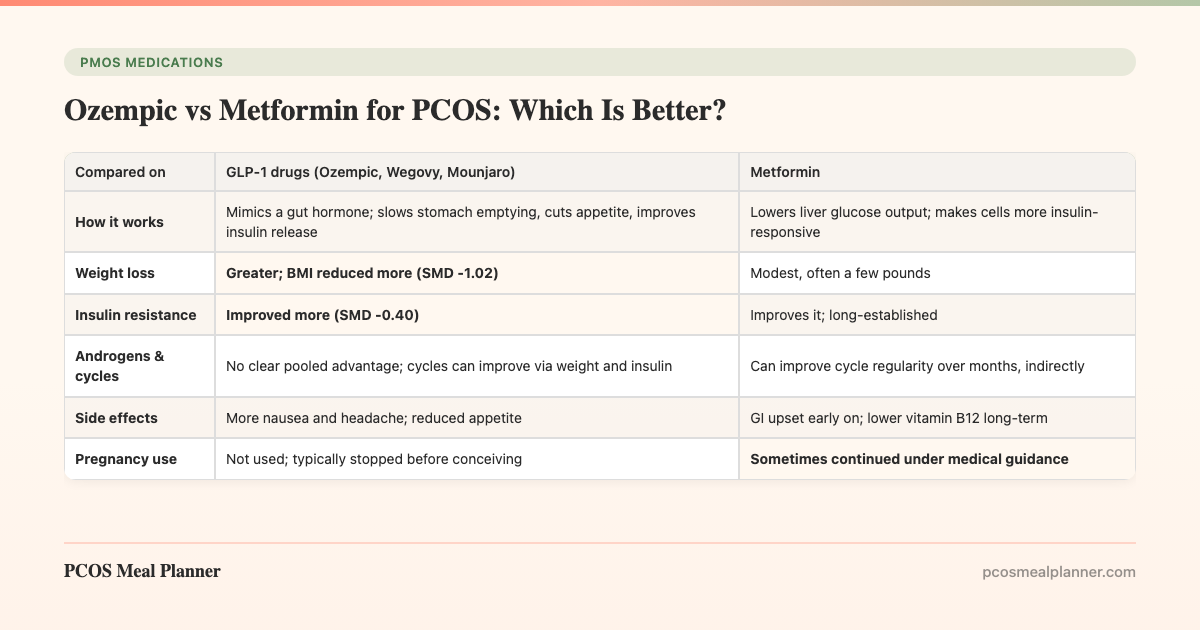
Ozempic vs metformin for PCOS at a glance
| Compared on | GLP-1 drugs (Ozempic, Wegovy, Mounjaro) | Metformin |
|---|---|---|
| How it works | Mimics a gut hormone; slows stomach emptying, cuts appetite, improves insulin release | Lowers liver glucose output; makes cells more insulin-responsive |
| Weight loss | Greater; BMI reduced more (SMD -1.02) | Modest, often a few pounds |
| Insulin resistance | Improved more (SMD -0.40) | Improves it; long-established |
| Androgens & cycles | No clear pooled advantage; cycles can improve via weight and insulin | Can improve cycle regularity over months, indirectly |
| Side effects | More nausea and headache; reduced appetite | GI upset early on; lower vitamin B12 long-term |
| Pregnancy use | Not used; often stopped before conceiving | Sometimes continued under medical guidance |
| Cost & access | Expensive; hundreds a month; supply-limited | Generic; a few dollars a month; widely available |
| Evidence base | 8 RCTs in PCOS; moderate-to-low quality | Decades of PCOS use and research |
| Best for whom | Significant excess weight or strong insulin resistance; pregnancy not imminent | Lower cost; trying to conceive or may soon; milder weight concerns |
Weight loss: where GLP-1s pull ahead
If weight loss is the main goal, the GLP-1 medications generally outperform metformin. Metformin tends to produce small changes, often a few pounds. GLP-1 drugs act directly on appetite and stomach emptying, so the weight loss is usually larger and more consistent. The meta-analysis reflected this with a much bigger BMI reduction on GLP-1s.
That matters in PMOS because even a 5 to 10 percent weight reduction can improve cycles, ovulation, and insulin resistance. Losing weight is not the whole story of managing PMOS, but for women whose symptoms are tightly linked to weight and insulin, it moves several levers at once. The catch is that this effect depends on staying on the medication, which brings cost and the question of what happens when you stop into play.
Side effects: what each one feels like
Both are generally tolerated, but the side-effect profiles differ. Metformin's main issue is gastrointestinal: nausea, loose stools, and cramping, usually worst at the start and eased by a slow dose build-up and taking it with food. Long-term use can lower vitamin B12, so periodic checks are sensible.
GLP-1 medications more often cause nausea and headache, per the meta-analysis, along with reduced appetite, and sometimes vomiting or constipation. These tend to settle as the dose is increased gradually. Any side effect that is severe or persistent is a reason to speak to your prescriber, not to adjust the dose yourself. Eating pattern helps here too: gentler, protein-forward meals sit better than large, greasy, or very sugary ones on either drug.
Can you take Ozempic and metformin together for PCOS?
Yes, some prescribers combine them, always under supervision. Metformin and a GLP-1 receptor agonist work through different mechanisms, so using both can target insulin resistance and appetite at the same time. This is a medical decision that weighs side effects, cost, and your wider health, not something to start on your own.
If you are already on metformin and considering a GLP-1, or the reverse, that conversation belongs with your prescriber. The eating pattern described further down supports either medication and the combination, so it is worth putting in place whichever route you take.
Pregnancy and trying to conceive: the biggest practical difference
This is where the two diverge most, and it often decides the choice. GLP-1 medications such as Ozempic are not used in pregnancy and are often stopped before trying to conceive, usually a set period in advance that a prescriber will specify. Metformin, by contrast, is sometimes continued through conception and early pregnancy under medical guidance.
For women with PMOS who want to get pregnant soon, that difference can outweigh the extra weight loss a GLP-1 offers. If pregnancy is on your horizon, raise it early, because it changes both the timing and the choice. Never stop or start either medication around conception without medical advice.
Cost, access, and what happens when you stop
Cost is a real-world dividing line. Metformin is generic and often costs only a few dollars a month. GLP-1 medications are expensive, often hundreds of dollars a month without insurance, and have faced supply shortages. Because they are approved for diabetes and obesity rather than PCOS, insurance cover for PCOS specifically is often limited.
There is also the question of durability. GLP-1 drugs work while you take them; they do not permanently reset appetite. When people stop, hunger returns and a meaningful share of the lost weight, along with its insulin and cycle benefits, tends to come back. That is a strong argument for building eating habits that hold up whether or not you are on a medication. The drug can create a window; the food is what keeps the room warm after the window closes.
Who each medication suits
There is no single winner. On the current evidence and typical prescribing patterns:
- Metformin often suits women who want a lower-cost, long-established option, who are trying to conceive or may soon, or who have milder weight concerns.
- A GLP-1 medication may suit women with PCOS and significant excess weight or strong insulin resistance, where larger weight loss is the priority and pregnancy is not imminent.
Prescribing to women with PCOS has shifted fast. According to Truveta data reported by Reuters, GLP-1 prescribing to women with PCOS rose from 2.4 percent in 2021 to 17.6 percent in 2025, about a seven-fold increase. Popularity is not the same as being right for you, though. Some women prefer to start with non-drug options first; we weigh two of the most common in inositol vs berberine for PMOS. Both Ozempic and metformin are prescription medications, and the decision belongs with a prescriber who knows your history.
Why food is the foundation under either
Whatever you and your doctor decide, the eating pattern underneath does the quiet work. Both metformin and GLP-1 medications target insulin resistance, and so does the way you eat. A moderate-carb, higher-protein, higher-fibre pattern with protein-first meals reduces the glucose and insulin spikes that drive PMOS symptoms.
On a medication, that pattern amplifies the benefit and steadies side effects. If you are on a GLP-1 and eating far less, protein and micronutrients matter even more, which is why we wrote a dedicated guide on what to eat on a GLP-1 with PMOS. Off a medication, the same pattern is what keeps results from unravelling. This is the case for a system rather than a one-off plan, and it is exactly what the PCOS Meal Planner builds. When people weigh Ozempic vs metformin for PCOS, the honest answer is that the medication is a tool and the plate is the foundation. Build the insulin-friendly plate first, then decide on medication with your doctor.
Often asked questions
Is Ozempic or metformin better for PCOS?
Neither is universally better; it depends on your goals and your prescriber. Han et al. (2019) pooled 8 trials and found GLP-1 drugs like Ozempic improved insulin sensitivity and reduced BMI and waist more than metformin. Metformin is cheaper, longer-established, and pregnancy-compatible. Both are prescription drugs; the choice belongs with your doctor.
Is Ozempic more effective than metformin for PCOS weight loss?
On average, yes, in head-to-head trials. The 2019 meta-analysis found GLP-1 receptor agonists reduced BMI significantly more than metformin (SMD -1.02) and reduced waist size more. But the trials were moderate-to-low quality, results vary, and weight is often regained when the medication stops. This is educational details, not a recommendation.
Can you take metformin and Ozempic together for PCOS?
Sometimes, and only under medical supervision. They work through different mechanisms, so some prescribers combine them for PCOS when weight and insulin resistance are the main targets. This is a decision for your doctor. Do not combine or adjust prescription medications on your own. An insulin-friendly way of eating supports both.
Can you take Ozempic or metformin while trying to get pregnant with PCOS?
This is the biggest practical difference. GLP-1 medications like Ozempic are not used in pregnancy and are often stopped before trying to conceive, a set time in advance your prescriber will specify. Metformin is sometimes continued through conception and pregnancy under medical guidance. Always discuss timing with your doctor. This is not medical advice.
What happens when you stop taking Ozempic for PCOS?
Appetite usually returns and weight is often regained. GLP-1 medications work while you take them; they do not permanently reset appetite or metabolism. When people stop, hunger comes back and much of the lost weight, with its insulin and cycle benefits, tends to return. The food habits you build are what stay. Decide any stop with your prescriber.
Which is cheaper for PCOS, Ozempic or metformin?
Metformin, by far. It is generic and often costs a few dollars a month. GLP-1 medications like Ozempic, Wegovy, and Mounjaro are expensive, often hundreds a month without insurance, and have faced shortages. Because they are approved for diabetes and obesity, not PCOS, coverage for PCOS is often limited. Cost and access are real factors.
Sources and further reading
GLP-1 versus metformin in PCOS
Prescribing trend
- Truveta electronic-health-record analysis, reported by Reuters: GLP-1 prescribing to women with PCOS rose from 2.4% in 2021 to 17.6% in 2025, roughly a seven-fold increase.
Insulin resistance and PCOS pathophysiology
Clinical guidelines and patient-facing summaries
- International Evidence-Based Guideline for PCOS (Monash, 2023)
- NHS: Polycystic ovary syndrome (PCOS)
- Mayo Clinic: PCOS
How this article was made
The head-to-head figures are pooled results from Han et al. 2019 in Reproductive BioMedicine Online, the direct meta-analysis of GLP-1 receptor agonists versus metformin in PCOS (8 RCTs). The insulin-resistance framing draws on Diamanti-Kandarakis and Dunaif 2012. The prescribing-trend figure is from Truveta data reported by Reuters. Aligned with the 2023 International Evidence-Based Guideline for PCOS, the NHS, and Mayo Clinic. PMOS is the new name for PCOS as of 12 May 2026; the underlying biology is unchanged. Ozempic, Wegovy, Mounjaro, and metformin are prescription medications, and prescribing them for PCOS is off-label. This article is informational and not medical advice; it does not recommend starting, stopping, or dosing any medication, and every treatment decision belongs with your prescriber.
Community Comments
Add a comment