PMOS is linked to high risk for two specific cancers: endometrial cancer (2 to 6 times higher lifetime risk, primarily driven by chronic anovulation and unopposed estrogen exposure to the uterine lining) and possibly a small elevation in ovarian cancer risk (less consistent evidence). PMOS is NOT linked to high breast cancer risk. Endometrial cancer risk is largely modifiable: regular withdrawal bleeds (either through ovulatory cycles, combined oral contraceptives, or progesterone challenges) protect the endometrium.
Cumulative protective factors include weight loss to within normal BMI, insulin sensitivity improvements, and at least 4 periods per year. Screening: report any abnormal bleeding promptly and consider endometrial sampling if you have not had a period for 3+ months with PMOS. PMOS is the new name for PCOS as of 12 May 2026; cancer risk evidence is identical under both names.
Cancers with high risk in PMOS
1. Endometrial cancer (clearly high)
The strongest cancer association in PMOS. The 2024 BMJ systematic review and meta-analysis of 14 studies and 1.2 million women found:
- Around 2-6 times higher lifetime endometrial cancer risk in women with PCOS vs without
- Risk is highest in women with chronically irregular cycles (less than 4 periods per year for many years)
- Risk is concentrated before menopause (premenopausal endometrial cancer is much less common than postmenopausal in the general population; PMOS shifts the age distribution earlier)
- BMI above 30 amplifies the risk further
- Diabetes co-existing amplifies the risk further
Why: chronic anovulation in PMOS means the endometrium is exposed to estrogen without the protective progesterone that normally follows ovulation. Over months and years, this unopposed estrogen exposure can cause endometrial hyperplasia (abnormal thickening) which can progress to cancer.
2. Ovarian cancer (small possible elevation)
Less consistent evidence. Some studies suggest a small (1.2-1.5x) high risk; others find no association. The 2023 International Journal of Cancer pooled analysis of 26 case-control studies showed no statistically significant elevation overall but suggested a small possible increase in specific subtypes (low-grade serous ovarian cancer).
The clinical takeaway: ovarian cancer screening in PMOS follows general population guidance (no routine screening for low-risk women), with attention to symptoms (persistent bloating, pelvic pain, urinary changes, early satiety) prompting evaluation.
Cancers NOT high in PMOS
- Breast cancer. Despite older suggestions, the 2024 BMJ systematic review and other large analyses found no high breast cancer risk in PMOS. Some studies suggest a slightly lower risk (possibly related to lower lifetime ovulations and lower estrogen exposure in some subtypes).
- Colorectal cancer. Not high in PMOS.
- Cervical cancer. Not high. Cervical cancer is HPV-driven and not influenced by PMOS biology.
- Lung cancer. Not high.
2026 research update: one large US study disagrees on breast and cervical cancer
This new study does not agree with the list above, so here it is in full. A 2026 study in Fertility and Sterility used US insurance claims from 2000 to 2022. It matched 422,613 women with PCOS, aged 18 to 50, to 2,113,065 women without it, and followed them for an average of 3.6 years. Women with PCOS had higher rates of uterine cancer (hazard ratio 5.76), ovarian or fallopian tube cancer (4.38), breast cancer (2.66) and cervical cancer (2.22). The authors adjusted for weight, smoking, diabetes, birth control use and other factors. The limits are real. Claims data can only show links, follow-up was short, and women with PCOS may see doctors more often, so more cancers may simply be found sooner. Weigh it against the 2024 review above, which pooled 14 studies and 1.2 million women and found no breast cancer link. One short study does not overturn that review, so breast risk is still not clearly raised. Screening rules stay the same. It is one more reason to report odd bleeding or breast changes early and to keep up with routine cervical screening. Alur-Gupta et al., Fertil Steril, 2026.
The endometrial cancer protection plan for PMOS
Pillar 1: Ensure regular withdrawal bleeds
The endometrium needs to shed at least 4 times per year (and ideally more) to clear accumulated lining and prevent hyperplasia. Options:
- Natural ovulatory cycles: the best option if achievable. Regular cycles with confirmed ovulation provide natural progesterone exposure that protects the endometrium.
- Combined oral contraceptives: produce monthly withdrawal bleeds during the placebo week, even though they suppress ovulation. Endometrially protective.
- Progesterone challenges: if cycles are absent, your doctor can prescribe 10-14 days of progesterone (medroxyprogesterone or micronised progesterone), which triggers a withdrawal bleed when stopped. Standard protective protocol: 4-6 progesterone challenges per year if cycles are absent.
- Mirena (hormonal IUD with levonorgestrel): delivers continuous low-dose progestin locally to the endometrium. Effective endometrial protection even though periods often stop entirely. Often used for women with PMOS and chronically irregular cycles who do not want monthly bleeding.
Pillar 2: Manage weight and insulin resistance
BMI above 30 amplifies endometrial cancer risk. Insulin resistance independently contributes. The PMOS eating pattern, strength training, and (when warranted) medication that lowers insulin all reduce risk.
Pillar 3: Report abnormal bleeding promptly
Abnormal bleeding in PMOS warrants evaluation rather than dismissal as "just PCOS." Warning signs:
- Heavy bleeding lasting more than 7 days
- Bleeding between periods
- Bleeding after sex (post-coital)
- Any bleeding after menopause (always abnormal)
- Bleeding after months of no periods (different from a true ovulatory cycle returning)
The standard evaluation is transvaginal ultrasound to measure endometrial thickness, often followed by endometrial sampling (pipelle biopsy) if the lining is thicker than 4-5mm in postmenopausal women, or thicker than 10-12mm in premenopausal women with bleeding concerns.
Pillar 4: Consider periodic endometrial monitoring
For PMOS women with chronically irregular cycles (less than 4 periods per year) and not on protective hormones, periodic transvaginal ultrasound and possibly endometrial sampling every 1-2 years is sometimes recommended depending on individual risk factors. Discuss with your gynaecologist.
What about cancer screening for PMOS women?
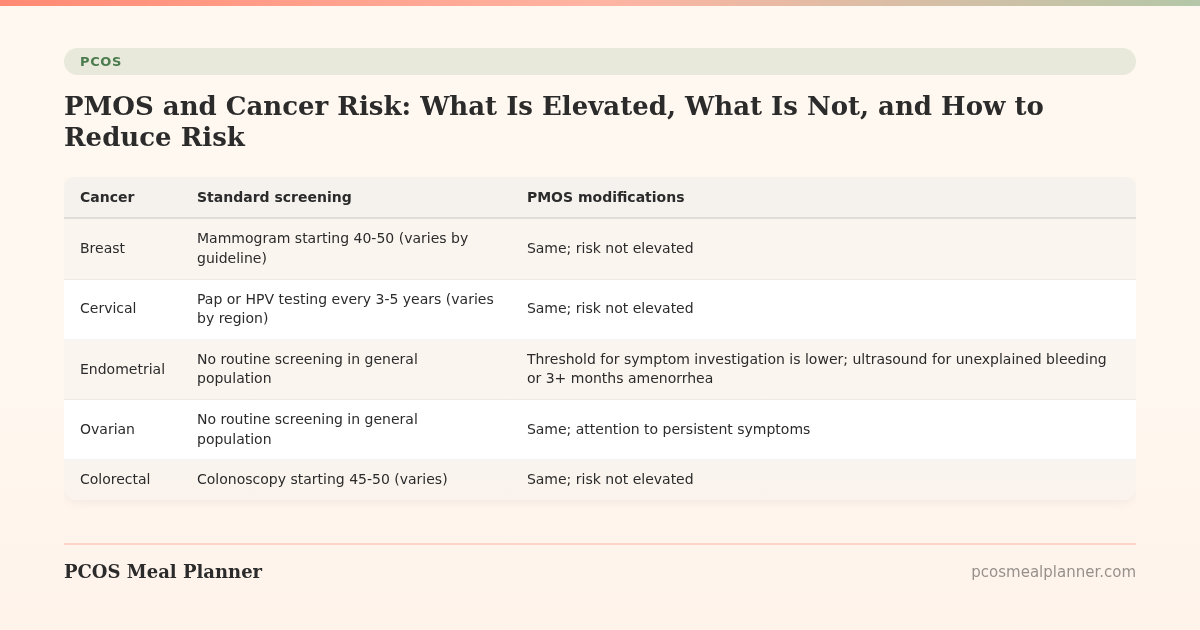
Standard cancer screening for women with PMOS follows general population guidelines, with one nuance: more attention to symptoms suggesting endometrial cancer.
| Cancer | Standard screening | PMOS changes |
|---|---|---|
| Breast | Mammogram starting 40-50 (varies by guideline) | Same; risk not high |
| Cervical | Pap or HPV testing every 3-5 years (varies by region) | Same; risk not high |
| Endometrial | No routine screening in general population | Threshold for symptom investigation is lower; ultrasound for unexplained bleeding or 3+ months amenorrhea |
| Ovarian | No routine screening in general population | Same; attention to persistent symptoms |
| Colorectal | Colonoscopy starting 45-50 (varies) | Same; risk not high |
The hormonal contraceptive consideration
Combined oral contraceptives (COCs) have a complex cancer profile that women with PMOS should understand:
COC benefits
- Around 40 percent reduction in endometrial cancer risk during use, with protection continuing for 20+ years after stopping
- Around 30 percent reduction in ovarian cancer risk with similar long-term protection
- Around 15-20 percent reduction in colorectal cancer risk
COC risks
- Small (around 25 percent relative, 1-2 cases per 100,000 person-years absolute) increase in breast cancer risk during current use, dissipating to no increase 5-10 years after stopping
- Small increased risk of cervical cancer with very long-term use (10+ years), almost entirely in women with persistent HPV
For most women with PMOS, the net cancer effect of COCs is favourable (the endometrial and ovarian protection outweighs the small breast risk). Individual decisions depend on family history and personal risk factors. Discuss with your doctor.
Diabetes, PMOS, and cancer
Type 2 diabetes itself is linked to high risk of several cancers (endometrial, liver, pancreatic, colorectal). Women with PMOS who develop T2D have compounded risk for some of these. Preventing or reversing pre-diabetes (around 30 percent prevalence in PMOS by age 40) reduces the cancer risk pathway.
See PMOS and pre-diabetes for the reversal plan.
Common questions about cancer risk and PMOS
Should I worry about cancer with PMOS?
Awareness without alarm is the right framing. Endometrial cancer risk is real (2-6x high) but largely modifiable through regular withdrawal bleeds and metabolic management. Most other cancers are not high. Symptom-based vigilance plus standard screening is the right approach.
How do I know if I have endometrial cancer with PMOS?
Most cases present with abnormal bleeding: heavy bleeding, bleeding between cycles, bleeding after sex, bleeding after long amenorrhea, or any bleeding after menopause. Evaluation is by transvaginal ultrasound and endometrial sampling. Early-stage endometrial cancer is highly treatable with around 95 percent 5-year survival.
What is the best contraceptive for cancer protection with PMOS?
Combined oral contraceptives reduce endometrial and ovarian cancer risk meaningfully. Mirena (hormonal IUD) provides excellent endometrial protection. Both options have small breast cancer considerations balanced against the protection. Individual choice depends on broader risk factors.
Often asked questions
Does PMOS increase cancer risk?
PMOS is linked to 2-6 times high endometrial cancer risk and possibly a small ovarian cancer risk increase. Breast, cervical, colorectal, and lung cancers are not high. The 2024 BMJ systematic review of 14 studies and 1.2 million women confirmed the endometrial cancer association and lack of breast cancer association.
Why does PMOS cause endometrial cancer?
Chronic anovulation in PMOS means the endometrium is exposed to estrogen without the protective progesterone that normally follows ovulation. Over months and years, this unopposed estrogen exposure can cause endometrial hyperplasia which can progress to cancer.
How can I reduce endometrial cancer risk with PMOS?
4-pillar protection: ensure at least 4 withdrawal bleeds per year (ovulatory cycles, COCs, progesterone challenges, or Mirena), manage weight and insulin resistance, report abnormal bleeding promptly, and consider periodic endometrial monitoring if cycles are chronically absent.
Does PMOS increase ovarian cancer risk?
Evidence is less consistent than for endometrial cancer. Some studies suggest a small 1.2-1.5x elevation; others find no association. The 2023 International Journal of Cancer pooled analysis showed no statistically significant overall elevation. Standard screening guidance applies.
Does PMOS increase breast cancer risk?
No. Multiple large studies and the 2024 BMJ systematic review found no high breast cancer risk in PMOS. Some studies suggest slightly lower risk, possibly related to lower lifetime ovulations.
Will birth control protect me from cancer with PMOS?
Combined oral contraceptives reduce endometrial cancer risk by around 40 percent during use and continuing for 20+ years after, and ovarian cancer by around 30 percent. Small breast cancer risk during current use dissipates to no risk 5-10 years after stopping. Net cancer effect is favourable for most women with PMOS.
Should I have my uterus checked regularly with PMOS?
Not routinely for asymptomatic women on protective hormones (COCs or Mirena) with regular bleeding. For women with chronically irregular cycles (less than 4 periods per year) not on protective hormones, periodic transvaginal ultrasound and possibly endometrial sampling every 1-2 years may be recommended depending on individual risk factors. Discuss with your gynaecologist.
If my mother had PMOS and uterine cancer, am I at higher risk?
Family history of endometrial cancer (independent of PMOS) is a known risk factor and can warrant earlier or more frequent monitoring. If you also have PMOS, the risks compound. Discuss family history with your gynaecologist for personalised guidance.
Build a PMOS plan that includes cancer risk reduction
The PMOS eating pattern serves cancer prevention alongside symptom control.
Lower insulin resistance, better weight control, and consistent cycle protection all reduce the cancers PMOS elevates. Take the free phenotype quiz to start.
What to read next
- PMOS and birth control
- PMOS cycle restoration
- PMOS and pre-diabetes
- PMOS lab tests explained
- PCOS is now PMOS: full renaming explainer
How this article was researched
Sources include the 2024 BMJ systematic review and meta-analysis of cancer risk in PCOS (14 studies, 1.2 million women), the 2023 International Journal of Cancer pooled ovarian cancer analysis, the 2023 International Evidence-based Guideline for the Assessment and Management of PCOS, and the 2024 American Cancer Society and NICE cancer screening guidance. PCOS was renamed PMOS on 12 May 2026; cancer risk evidence is unchanged. This article is informational and not medical advice. Cancer screening and risk management should be discussed with a qualified doctor. See our editorial standards.
Community Comments
Add a comment