The best exercise plan for PMOS combines daily walking (8,000 to 10,000 steps), strength training 2 to 3 times per week (focused on compound movements), and 1 to 2 short higher-intensity sessions per week if cortisol allows. This combination improves insulin sensitivity by 30 to 40 percent over 12 weeks in PMOS-specific trials, lowers free testosterone, reduces visceral fat, and improves cycle regularity, all without raising cortisol the way heavy cardio-only programs do. Phenotype tilts matter: insulin-resistant women tolerate higher intensity well, adrenal women need lower-intensity gentler approaches, and post-pill women rebuild slowly. PMOS is the new name for PCOS as of 12 May 2026; the exercise evidence is identical under both names.
The 3 exercise tools that move PMOS the most
1. Daily walking (the highest-leverage activity)
Walking is the most underrated PMOS intervention because it is the only exercise that improves insulin sensitivity meaningfully without raising cortisol. A 2020 study in the European Journal of Sport Science found 10,000 daily steps for 12 weeks reduced visceral fat by 14 percent in women with PCOS, with no cortisol elevation and no menstrual cycle disruption.
Target: 8,000 to 10,000 steps per day. Spread across the day if possible. 10-minute walks after meals are particularly effective for blood glucose control (the 2023 Diabetes Care study showed post-meal walks reduce glucose excursions by around 17 percent).
2. Strength training 2 to 3 times per week (the body composition lever)
Strength training builds muscle, which is the largest glucose disposal organ in the body. More muscle means lower fasting insulin even without weight loss. A 2024 meta-analysis in the Journal of Clinical Endocrinology and Metabolism of 12 PCOS strength training trials found 30 percent average reduction in HOMA-IR over 12 weeks of consistent strength training, with greater effect than cardio of the same time commitment.
Target: 2 to 3 full-body strength sessions per week, 30 to 45 minutes each. Compound movements (squats, deadlifts, push variations, pull variations, lunges, hinges) are most efficient. Progressive overload (slightly heavier weights or more reps each week) is the key signal.
Beginner approach: bodyweight or light dumbbell circuits for 4-6 weeks before adding load. Form first. A starter program: 3 sets of 8-12 reps each of goblet squat, glute bridge, dumbbell row, push-up (modified if needed), and farmer carry.
3. Short higher-intensity sessions (if cortisol allows)
1 to 2 short higher-intensity sessions per week (HIIT or sprint intervals) can accelerate insulin sensitivity and fat loss when added on top of walking and strength. The 2019 European Journal of Endocrinology trial in women with PCOS showed 3 HIIT sessions per week for 12 weeks reduced fasting insulin by 35 percent. But HIIT raises cortisol and is the wrong tool for adrenal-phenotype PMOS or for women with severe insomnia, very low body weight, or chronic burnout.
Target: 1 to 2 sessions per week, 15 to 20 minutes total. Examples: 8 rounds of 20 seconds hard cycling and 40 seconds rest. 6 rounds of 30 seconds incline sprint and 90 seconds walk. Add only after 6 to 8 weeks of consistent walking and strength training to establish baseline tolerance.
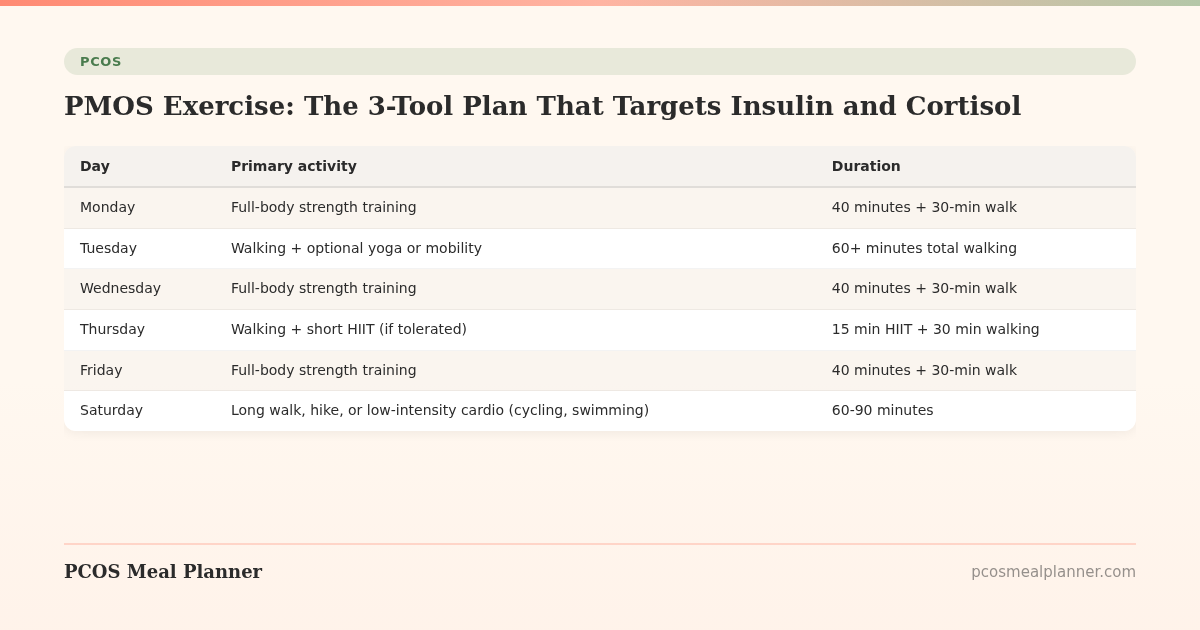
The PMOS exercise sample week
| Day | Primary activity | Duration |
|---|---|---|
| Monday | Full-body strength training | 40 minutes + 30-min walk |
| Tuesday | Walking + optional yoga or mobility | 60+ minutes total walking |
| Wednesday | Full-body strength training | 40 minutes + 30-min walk |
| Thursday | Walking + short HIIT (if tolerated) | 15 min HIIT + 30 min walking |
| Friday | Full-body strength training | 40 minutes + 30-min walk |
| Saturday | Long walk, hike, or low-intensity cardio (cycling, swimming) | 60-90 minutes |
| Sunday | Rest or gentle activity | 20-30 min walk if desired |
Weekly totals: around 2 to 2.5 hours of strength training, 5+ hours of walking, optional 15 minutes of HIIT. Most women hit 8,000 to 10,000 steps per day with this structure.
The PMOS exercise plan by phenotype
| PMOS phenotype | Best exercise tilt | What to avoid |
|---|---|---|
| Insulin-resistant (70%) | Standard plan works well. HIIT can be added safely. Strength training is the highest-leverage tool. | Cardio-only programs (they plateau quickly) |
| Adrenal (15%) | Walking + low-intensity strength + yoga. Skip HIIT. | HIIT, long heavy cardio, fasted training. All raise cortisol. |
| Post-pill (10%) | Gentle rebuild over 12-18 months. Walking + light strength first. | Aggressive training program in the first 6 months post-pill |
| Inflammatory | Walking + strength + yoga or pilates for flexibility. Anti-inflammatory recovery focus. | Overtraining without recovery |
Take the free phenotype quiz to know which tilt applies.
What about yoga and pilates for PMOS?
Yoga and pilates are excellent additions but do not replace strength training for PMOS. A 2020 trial in the Journal of Alternative and Complementary Medicine of 90 women with PCOS found 12 weeks of 1 hour of yoga 3 times per week reduced free testosterone by 17 percent, improved cycle regularity, and reduced anxiety. The effect was meaningful but smaller than strength training for insulin sensitivity specifically. Pair yoga or pilates with strength training and walking for the broadest PMOS benefit.
How exercise affects PMOS cycle regularity
Moderate exercise improves cycle regularity in PMOS by lowering insulin and androgens. Excessive exercise (over 10 hours per week of intense training, especially in calorie deficit) can suppress cycles further via hypothalamic amenorrhea, a different mechanism that compounds with PMOS. The sweet spot is 3 to 5 hours per week of structured exercise plus daily walking, eaten at maintenance or a small deficit.
Should you exercise during your period with PMOS?
Yes. Light to moderate exercise during menstruation is well tolerated and reduces cramps. Many women with PMOS feel better on walking and gentle strength training during menstruation than rest. Heavy lifting and HIIT can be deprioritised on days 1-2 if energy is low. Listen to your body.
Common PMOS exercise mistakes
- Cardio-only programs. Long steady-state cardio (45-minute runs or spin classes) raises cortisol without proportional insulin sensitivity gains. Plateau quickly.
- HIIT every day. Burns out the adrenal axis. 1-2 sessions per week is the ceiling for most women with PMOS.
- Skipping strength training. The single most underused tool for PMOS body composition.
- Training fasted with adrenal PMOS. Raises cortisol significantly. Eat a small protein-fat snack before exercise.
- Training intensely in a big calorie deficit. The combination raises cortisol most. Match training intensity to recovery capacity.
- Tracking only steps and ignoring strength. Steps are good for insulin sensitivity. Strength is needed for body composition and metabolic rate.
- All-or-nothing weeks. Five 20-minute sessions outperform two 90-minute sessions for PMOS metabolic outcomes.
Exercise and PMOS weight loss specifically
Exercise alone produces modest weight loss in PMOS (1-3 kg over 12 weeks of consistent program without dietary change). The bigger value is body composition: more muscle, less visceral fat, often with little scale change. Exercise compounds diet changes powerfully: women who combined 12 weeks of a 30/30/40 PMOS diet with structured exercise in a 2023 trial lost on average 6.8 kg, vs 3.9 kg on diet alone.
Often asked questions
What is the best exercise for PMOS?
The combination of daily walking (8,000-10,000 steps) plus strength training 2-3 times per week is the highest-leverage exercise for PMOS. Walking improves insulin sensitivity without raising cortisol. Strength training builds muscle which is the largest glucose disposal organ. Optional 1-2 short HIIT sessions per week if cortisol allows.
Is HIIT good for PMOS?
HIIT can accelerate insulin sensitivity and fat loss when added in moderation (1-2 sessions per week, 15-20 minutes each). For adrenal-phenotype PMOS or women with insomnia, low body weight, or chronic burnout, HIIT raises cortisol and worsens symptoms. Start without HIIT and add only after 6-8 weeks of walking and strength training.
Should I do cardio or strength training for PMOS?
Strength training has stronger evidence for insulin sensitivity in PMOS at the same time commitment. The 2024 JCEM meta-analysis showed 30 percent average reduction in HOMA-IR over 12 weeks. Cardio is still valuable; combining moderate cardio (walking, cycling, swimming) with 2-3 strength sessions per week produces the best PMOS outcomes.
How long should I exercise with PMOS?
Around 3-5 hours per week of structured exercise (strength training plus optional cardio) plus daily walking. More is not better in PMOS, especially in calorie deficit; over 10 hours per week of intense training can suppress cycles further.
Will walking help PMOS?
Yes, significantly. The 2020 European Journal of Sport Science trial showed 10,000 daily steps for 12 weeks reduced visceral fat by 14 percent in women with PCOS, with no cortisol elevation. Walking is the most underrated single intervention for PMOS metabolic health.
Can I do yoga for PMOS?
Yes. A 2020 trial of 12 weeks of yoga 3 times per week in women with PCOS showed 17 percent reduction in free testosterone, improved cycle regularity, and reduced anxiety. Yoga complements rather than replaces strength training for the full insulin sensitivity benefit.
How long until exercise helps PMOS symptoms?
Energy and mood improve within 2-4 weeks. Insulin sensitivity changes at 8-12 weeks. Cycle regularity at 12-24 weeks. Body composition (waist circumference, muscle gain) at 12-24 weeks. Most women see meaningful change by 12 weeks of consistent practice.
Can exercise replace metformin or inositol for PMOS?
Exercise improves insulin sensitivity through similar pathways. For mild PMOS, a structured exercise program with the right diet can reduce or remove the need for medication. For moderate to severe PMOS with significant insulin resistance, exercise is foundational but often not enough as a standalone intervention.
Match your exercise plan to your meal plan
Strength training without enough protein is wasted effort.
A PMOS plan that hits 30 percent protein (around 1.2-1.5 g/kg body weight) supports the muscle-building work that improves insulin sensitivity. Take the free phenotype quiz for the PMOS meal plan that matches your phenotype.
What to read next
- PMOS weight loss diet plan
- PMOS belly fat
- PMOS diet: full food list
- Best PMOS supplements
- PCOS is now PMOS: full renaming explainer
How this article was researched
Sources include the 2023 International Evidence-based Guideline for the Assessment and Management of PCOS, the 2024 Journal of Clinical Endocrinology and Metabolism meta-analysis of strength training in PCOS (12 trials), the 2020 European Journal of Sport Science walking trial in PCOS, the 2019 European Journal of Endocrinology HIIT trial, the 2020 Journal of Alternative and Complementary Medicine yoga trial, and the 2023 Diabetes Care post-meal walking trial. PCOS was renamed PMOS on 12 May 2026; exercise recommendations are unchanged. This article is informational and not medical advice. See our editorial standards.
Community Comments
Add a comment