First-party disclosure. PCOS Meal Planner is a competing product to Eat This Much. We have written this comparison to be useful to women with PCOS who currently use Eat This Much or are deciding between the two. Eat This Much is the most algorithmic of the major meal planners and one of the cheapest. The "Honest side-by-side" section near the end is the only place we make a direct recommendation.
Eat This Much has been around since 2010, longer than almost any other meal planner still operating. Its core bet is the opposite of personalization: an algorithm generates a full day of meals from your calorie target, macro split, and dietary preferences. Hit "generate," accept or shuffle, done. For women with PCOS, the question is not "is Eat This Much a good tool." It is, especially at the price. The question is "does an algorithm that optimizes for calories and macros also optimize for the things that drive PCOS." This is an honest comparison of what each tool does and where each one stops being useful.
What Eat This Much does well
Eat This Much is the most automatic meal planner on the market. You enter calorie targets and macro ratios; it returns a complete day of meals. For users who want planning to take five minutes a week, it is the lowest-effort option available.
The specific things Eat This Much does well:
- Algorithmic generation. Most meal planners ask dozens of questions and still need manual cleanup. Eat This Much generates a full day or week from a small set of inputs. No browsing required.
- Calorie and macro precision. The strongest feature. If you need to hit 1,800 calories with 130g protein, 180g carbs, and 60g fat, Eat This Much will get you within a tight margin every day.
- Free tier that actually works. Unlike PlateJoy and most paid competitors, Eat This Much has a usable free tier (one daily plan, full pantry tracking). Premium is $5/mo or $59/yr.
- Grocery delivery integration. Connects to Amazon Fresh, Walmart Grocery, and AmazonFresh. Less universal than PlateJoy's Instacart, but free and built-in.
- Pantry tracking. You can mark ingredients you already own and the planner avoids re-buying them. Few competitors do this well.
- Restaurant menu integration. Eating out is handled by pulling menu items from chain restaurants and slotting them into the plan. PlateJoy and Mealime do not do this.
If you want the cheapest, most algorithmic meal planner that hits calorie and macro targets reliably and integrates with grocery delivery, Eat This Much is the strongest choice in the category.
Where Eat This Much falls short for PCOS specifically
Eat This Much optimizes for calories and macros. It does not optimize for the metabolic, hormonal, and cycle-driven realities of PCOS. The gaps are structural, not feature requests.
1. The algorithm treats all carbs as the same
Eat This Much sees 30g of carbs from white rice and 30g from steel-cut oats as identical. They are not, especially for the 70 to 80 percent of women with PCOS who have insulin resistance. Glycemic index and glycemic load are the variables that change post-meal insulin response, androgen stimulation, and symptom severity. Eat This Much does not weight on them. A perfectly calorie-balanced day with three high-GL meals will still spike insulin and worsen PCOS symptoms; the calorie math is fine, but the math is not what is driving the condition.
2. No PCOS phenotype awareness
The intake asks about diet style (paleo, vegan, vegetarian, Mediterranean, keto, low-carb, standard) and macro targets. It does not ask whether you have insulin-resistant PCOS, lean PCOS, adrenal PCOS, or post-pill PCOS. Those phenotypes need different plans. Insulin-resistant PCOS responds to low-GL eating and slight calorie deficit; lean PCOS often needs adequate calories with stress-aware carb timing; adrenal PCOS responds to lower stimulant intake and balanced cortisol-supporting meals. The same macro split is not the right answer for all four.
3. No micronutrient weighting for PCOS
The algorithm hits macro targets and calorie targets. It does not optimize for chromium, magnesium, omega-3, zinc, vitamin D, or B vitamins, which are the micronutrients with the strongest PCOS evidence base. A week of Eat This Much plans can hit your protein target perfectly while delivering almost no omega-3 or chromium. The macro view is too coarse.
4. No cycle, symptom, or hormonal tracking
PCOS symptoms shift across the cycle when one exists. Cravings spike pre-menstrually; energy and insulin sensitivity move with luteal-phase progesterone; sleep and cortisol respond to ovulation. Eat This Much sees none of this. It does not know if you are in a fertile window, a luteal phase, or experiencing a symptom flare. The plan is the same on every day of every cycle, which is not how PCOS responds.
5. No PCOS-trained AI guidance
Eat This Much has no in-app coaching. If you have a question like "should I cut dairy with PCOS-related acne" or "what supplements actually work for insulin-resistant PCOS," there is no answer in the app. You go back to Google. That is the actual reason most PCOS women cycle through general meal planners every few months: the constant unanswered questions accumulate into decision fatigue.
What PCOS Meal Planner does differently
PCOS Meal Planner is built around the insulin-resistance phenotype that affects 70 to 80 percent of women with PCOS, and adapts for the lean, adrenal, and post-pill phenotypes alongside. The structural choices are different from a calorie-and-macro app:
- Glycemic load weighting per meal. Every recipe is tagged with a GL score, and the plan generator avoids stacking three high-GL meals in a row. This is the variable that moves insulin response, not calories.
- Personalization touches PCOS phenotype. Your primary focus (trying to conceive, manage blood sugar, lose weight, manage symptoms, or all of the above) maps the plan to fertility-leaning, low-GI-leaning, calorie-controlled, or anti-inflammatory Mediterranean defaults.
- Recipes tagged for PCOS-relevant micronutrients. Chromium, magnesium, omega-3, zinc, vitamin D, B vitamins. The plan generator weights toward these, so a week of meals actually hits the micronutrients PCOS responds to, not just macros.
- A PCOS-trained AI coach. Built into the dashboard. Knows the difference between insulin-resistant, lean, adrenal, and post-pill PCOS phenotypes and answers food and supplement questions accordingly.
- 55,000+ recipes filtered for PCOS-friendliness. Eat This Much has thousands of algorithmically composed plans; we have a recipe library you can actually browse and filter. Both approaches have tradeoffs; this one trades raw automation for choice.
- Symptom severity scorecard. A structured way to track androgen, metabolic, cycle, and emotional symptoms over time so you can see whether food changes are actually moving anything.
Where PCOS Meal Planner falls short compared to Eat This Much
Honest disclosure. Eat This Much beats us on a few real things:
- Price. Eat This Much Premium is $5/mo or $59/yr. We are $29/mo or $149/yr. If price is the deciding factor and you do not need PCOS-specific personalization, Eat This Much is the value pick.
- Pure algorithmic automation. Eat This Much will generate a complete day with three inputs. We surface a sample day faster than most competitors, but we still ask you to confirm dietary restrictions, focus, and cuisine preferences before generating. Slightly more friction.
- Macro precision. If you have a specific macro target (130g protein, 180g carbs, 60g fat), Eat This Much will hit it more tightly than we will. We optimize for glycemic load and PCOS-relevant micronutrients first; macros are a secondary constraint.
- Pantry tracking. Eat This Much has well-developed pantry inventory features. Our grocery list tracks the current plan but does not yet remember what you already own across plans.
- Restaurant menu integration. Eat This Much pulls chain restaurant menus into the planner. We do not. If you eat out four times a week, this is a real workflow advantage.
- Free tier breadth. Eat This Much's free tier is genuinely usable for a single day of planning. Our free experience includes a sample day and quiz; the full 7-day generator is paid.
Honest side-by-side
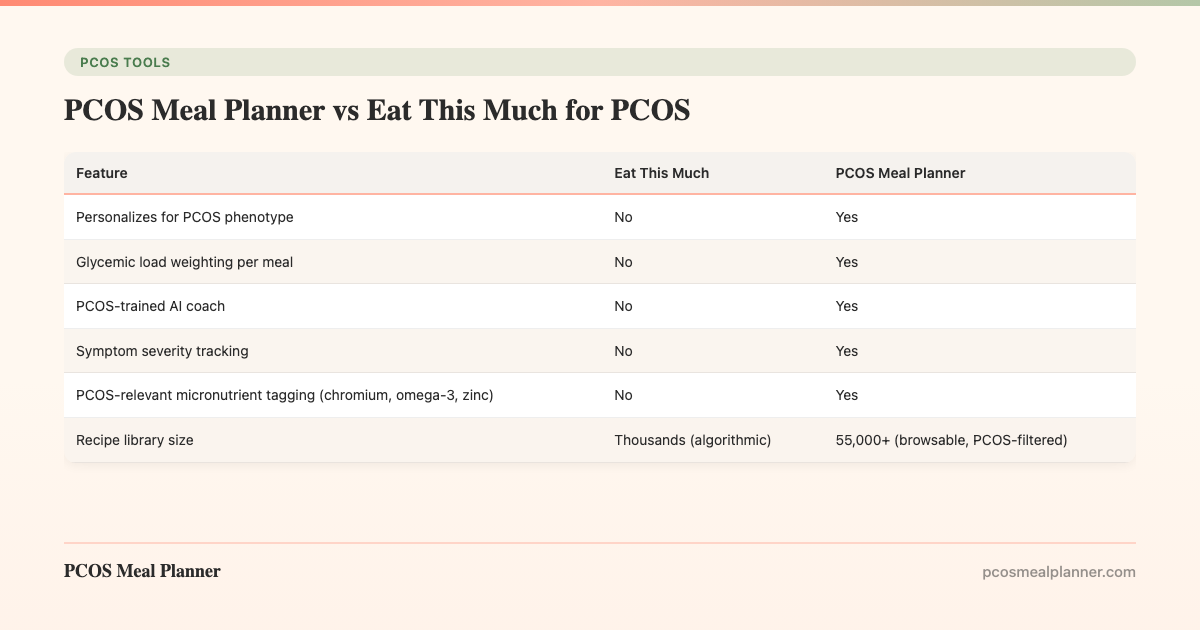
| Feature | Eat This Much | PCOS Meal Planner |
|---|---|---|
| Personalizes for PCOS phenotype | No | Yes |
| Glycemic load weighting per meal | No | Yes |
| PCOS-trained AI coach | No | Yes |
| Symptom severity tracking | No | Yes |
| PCOS-relevant micronutrient tagging (chromium, omega-3, zinc) | No | Yes |
| Recipe library size | Thousands (algorithmic) | 55,000+ (browsable, PCOS-filtered) |
| Calorie and macro target precision | Tight | Secondary to GL and micronutrient targeting |
| Algorithmic full-day generation | Yes (lowest friction in category) | Yes, with quiz inputs |
| Pantry tracking | Yes (well-developed) | Not yet |
| Restaurant menu integration | Yes | No |
| Grocery delivery integration | Yes (Amazon Fresh, Walmart Grocery) | No (interactive grocery checklist only) |
| Free tier | Yes (one daily plan) | Yes (sample day + quiz) |
| Paid tier | $5/mo or $59/yr | $29/mo or $149/yr |
The honest recommendation. If you do not have a metabolic condition driving your food choices, you want the cheapest serious meal planner on the market, and you live by calorie and macro targets, Eat This Much is excellent. If your food choices are being driven by PCOS, the variables Eat This Much optimizes on (calories, macros) are not the variables that matter most for you.
Glycemic load, PCOS-relevant micronutrients, phenotype, and symptom tracking are. The price gap exists because the work is different. Some women use Eat This Much for the macro math and pantry tracking, and PCOS Meal Planner for the PCOS-aware meal selection and AI coach. That is a reasonable setup. If you can only pick one and your PCOS is symptomatic, pick the PCOS-aware tool.
Often asked questions
Is Eat This Much worth $5 a month for PCOS?
For the macro math and grocery delivery integration, yes, the price is excellent value. For PCOS-specific personalization, no, because the app does not have PCOS-specific personalization to offer at any price. You are paying for a calorie-and-macro tool and doing the PCOS-translation work yourself in your head, every meal.
Does Eat This Much have a low-glycemic or PCOS-specific mode?
Not as a dedicated mode. Eat This Much has dietary presets (paleo, vegan, vegetarian, Mediterranean, keto, low-carb, standard) and you can set macro splits. Picking "low-carb" moves you toward keto-leaning recipes, which is not the same as low-glycemic-load eating for insulin-resistant PCOS. Low-carb and low-GL diverge in real meals once you compare a steel-cut oats breakfast against a bacon-and-eggs breakfast.
Can the macro targets in Eat This Much be set up for PCOS?
Partially. A reasonable PCOS macro split is roughly 30 percent protein, 35 to 40 percent carbs from low-GL sources, 30 to 35 percent fat. You can configure Eat This Much to that split, and it will hit it tightly. What it cannot do is enforce that the 35 to 40 percent carbs come from low-GL sources rather than from a mix that includes white rice, juice, or refined flour. The macro math will look right while the glycemic load is wrong.
How does the algorithmic generation compare to PCOS Meal Planner's quiz?
Eat This Much asks for fewer inputs and returns a plan faster. Three to four inputs (calories, macros, diet style) and you have a day. PCOS Meal Planner asks about your PCOS focus area, dietary restrictions, and cuisine preferences first, then generates. The tradeoff is roughly two minutes of additional onboarding in exchange for PCOS-phenotype-aware output. If your goal is generic healthy eating, Eat This Much is faster. If your goal is PCOS-aware eating, the extra inputs are doing meaningful work.
Can I use Eat This Much and PCOS Meal Planner together?
Yes. The common setup is Eat This Much for pantry tracking, restaurant menu integration, and macro math; PCOS Meal Planner for PCOS-aware meal selection, the AI coach, and symptom tracking. The combined cost is around $35/mo, which is reasonable if each tool is doing what it is best at.
Does Eat This Much integrate with Instacart, Amazon Fresh, or Walmart Grocery?
Yes, Eat This Much integrates with Amazon Fresh and Walmart Grocery for direct ordering. Instacart is not currently supported. The grocery delivery integration is one of the strongest features in the app and is available on the free tier.
Does the PCOS Meal Planner AI coach actually know more about PCOS than ChatGPT?
The coach is built specifically around PCOS phenotypes (insulin-resistant, lean, adrenal, post-pill, fertility-focused) and the published 2023 International Evidence-based Guideline for the Assessment and Management of PCOS. A general-purpose LLM can give general PCOS details; the in-app coach is tuned to answer "which version of PCOS are we talking about and what does that change about the answer."
If I am vegan and have PCOS, which is the better fit?
Both support vegan. Eat This Much's vegan plans are well-built for general macro targets; ours filter the 55,000+ recipe library by vegan plus PCOS-friendliness, which leaves a much larger pool to draw from. For vegan PCOS specifically, the recipe pool size matters because you are filtering on two dimensions instead of one. PCOS Meal Planner is the better fit here.
Try the PCOS-aware version
Take the PCOS type quiz in 60 seconds to see what kind of plan fits your phenotype, or sign up free and generate your first 7-day plan. First plan is free. No card required.
Related reading on PCOS Meal Planner
- PCOS Meal Planner vs Mealime: which adapts to PCOS
- PCOS Meal Planner vs PlateJoy: which personalizes for what
- How to use MyFitnessPal for PCOS (and where it falls short)
- PCOS 101: complete dietitian-reviewed guide
- Insulin resistance meal plan for PCOS
How this article was researched
This comparison was built from hands-on use of Eat This Much (mid-2026), published Eat This Much documentation and pricing, the 2023 International Evidence-based Guideline for the Assessment and Management of PCOS, and the 2019 Cochrane systematic review on lifestyle changes for PCOS. The first-party perspective is disclosed at the top. Eat This Much pricing and features were current at time of review and may change. See our editorial standards for how we approach competitor comparisons.
Community Comments
Add a comment