If you have PCOS and you are eating around 15g of fibre a day (the average for women in the UK and US), you are leaving one of the most effective free tools on the table. No supplements. No medication changes. Just more of the right foods.
This guide gives you the exact amounts, the best food sources ranked by insulin impact, and a 3-week plan to double your fibre without the bloating that makes most people quit.
What Is Fibermaxxing and Why Does It Matter for PCOS?
Fibermaxxing is the practice of intentionally maximizing your daily fibre intake. The term started on social media, but the science behind it is solid, especially for PCOS.
Fibre does three things that directly target PCOS root causes:
- Slows glucose absorption. Soluble fibre forms a gel in your gut that slows how fast sugar enters your bloodstream. This means lower insulin spikes after meals. A study in Diabetes Care (2019) found that adding 10g of soluble fibre to a meal reduced the post-meal glucose spike by 36%.
- Feeds helpful gut bacteria. Your gut microbiome produces short-chain fatty acids (SCFAs) when it ferments fibre. SCFAs reduce systemic inflammation, which is high in 70% of women with PCOS according to research in Human Reproduction Update (2021).
- Binds excess hormones. Fibre binds to estrogen and bile acids in your digestive tract, helping your body clear excess hormones instead of recirculating them. This improves your estrogen-to-androgen ratio over time.
The bottom line: fibre tackles insulin resistance, inflammation, and hormone imbalance at the same time. Few single diet changes hit all three.
How Much Fibre Do You Actually Need with PCOS?
The minimum target is 25g per day. The optimal range for PCOS is 28-32g per day based on current research.
Most women with PCOS eat about 12-16g per day. That is a significant gap.
The fibre gap in numbers: If you eat 15g now and need 28g, you need to add 13g per day. That is roughly 1 cup of cooked lentils, or 2 tablespoons of ground flaxseed plus a pear plus a half cup of black beans. It is doable without overhauling your entire diet.
Here is a quick reference for fibre targets:
| Category | Daily Fibre Target | Notes |
|---|---|---|
| Average woman (no PCOS) | 25g | NHS and USDA recommendation |
| Woman with PCOS (optimal) | 28-32g | Based on insulin reduction studies |
| Upper safe limit | 40g | Above this may reduce mineral absorption |
Which Types of Fibre Help PCOS Most?
There are two types of fibre, and both matter for PCOS, but they do different jobs.
Soluble fibre dissolves in water and forms a gel. This is the type that slows blood sugar spikes and feeds gut bacteria. Best sources: oats, lentils, beans, chia seeds, flaxseed, apples, and psyllium husk.
Insoluble fibre does not dissolve. It adds bulk and keeps your digestion moving. Best sources: vegetables, whole grains, nuts, seeds, and the skin of fruits.
For PCOS, prioritize soluble fibre for the insulin and gut benefits, but eat both types. A good ratio is roughly 60% soluble, 40% insoluble.
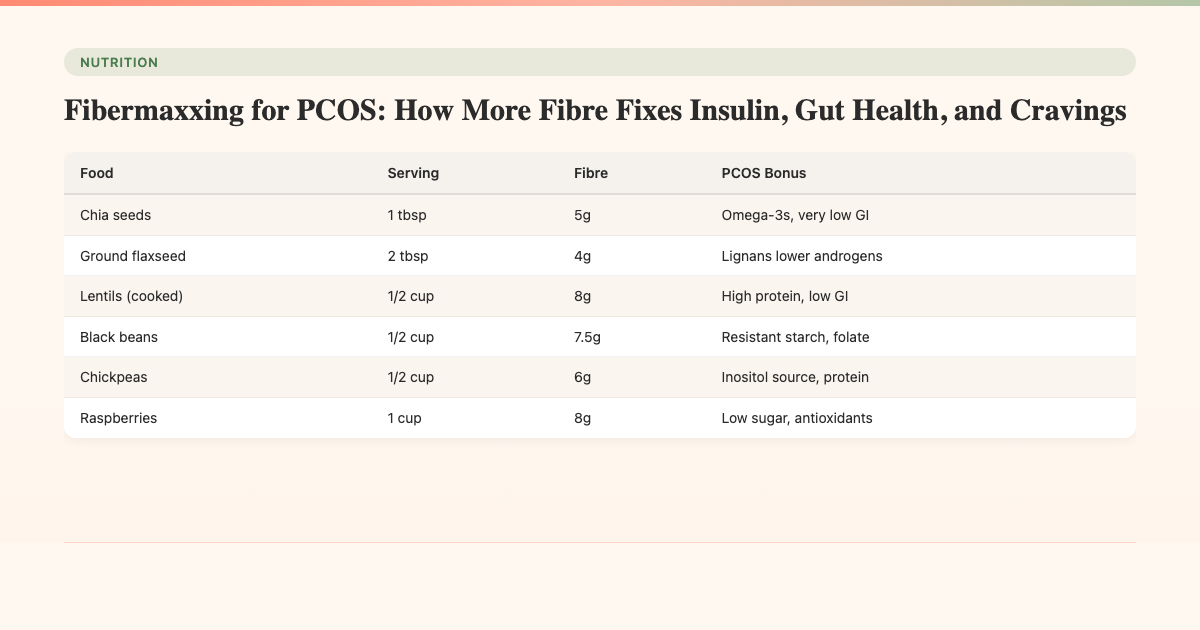
The 15 Best High-Fibre Foods for PCOS, Ranked by Insulin Impact
Not all fibre sources are equal for PCOS. These foods combine high fibre with low glycemic impact and additional PCOS-friendly nutrients.
| Food | Serving | Fibre | PCOS Bonus |
|---|---|---|---|
| Chia seeds | 1 tbsp | 5g | Omega-3s, very low GI |
| Ground flaxseed | 2 tbsp | 4g | Lignans lower androgens |
| Lentils (cooked) | 1/2 cup | 8g | High protein, low GI |
| Black beans (cooked) | 1/2 cup | 7.5g | Resistant starch, folate |
| Chickpeas (cooked) | 1/2 cup | 6g | Inositol source, protein |
| Oats (rolled) | 40g dry | 4g | Beta-glucan lowers cholesterol |
| Avocado | 1/2 medium | 5g | Healthy fats, potassium |
| Broccoli | 1 cup | 5g | DIM supports estrogen metabolism |
| Almonds | 30g | 3.5g | Magnesium, vitamin E |
| Raspberries | 1 cup | 8g | Low sugar, high antioxidants |
| Pear (with skin) | 1 medium | 5.5g | Pectin, low GI for a fruit |
| Sweet potato | 1 medium | 4g | Vitamin A, moderate GI |
| Brussels sprouts | 1 cup | 4g | DIM, vitamin C, folate |
| Psyllium husk | 1 tbsp | 5g | Pure soluble fibre, easy add |
| Quinoa (cooked) | 1 cup | 5g | Complete protein, iron |
Notice that the top-ranked foods combine high fibre with additional PCOS benefits like omega-3s (flaxseed), inositol (chickpeas), or DIM compounds (broccoli, Brussels sprouts) that support hormone metabolism.
Your 3-Week Fibermaxxing Ramp-Up Plan
Do not go from 15g to 30g overnight. Your gut bacteria need time to adjust. Increasing too fast causes bloating, gas, and cramping, which is why most people quit.
Follow this gradual approach:
Week 1: Add 5g per day (target: ~20g total)
- Add 2 tbsp ground flaxseed to breakfast (4g)
- Eat one piece of fruit with skin as a snack (1-2g)
- Drink one extra glass of water with each fibre addition
Week 2: Add another 5g per day (target: ~25g total)
- Swap white rice or pasta for lentils or chickpeas at one meal (5-8g)
- Or add a side of beans to lunch or dinner
- Keep water intake at 2+ litres per day
Week 3: Add the final 3-5g per day (target: ~28-30g total)
- Add 1 tbsp chia seeds to a smoothie or yogurt (5g)
- Snack on raw vegetables with hummus instead of processed snacks
- You should notice less bloating and more stable energy by now
A Full Day of Fibermaxxing Meals for PCOS
Here is what 30g of fibre looks like in a real day of eating. Every meal also pairs fibre with protein and healthy fat to keep blood sugar stable.
| Meal | What to Eat | Fibre |
|---|---|---|
| Breakfast | 40g rolled oats + 2 tbsp ground flaxseed + 1/2 cup raspberries + 10 walnut halves | 12g |
| Lunch | Lentil soup (1 cup cooked lentils) + side salad with 1/2 avocado + olive oil dressing | 11g |
| Snack | 1 pear + 30g almonds | 9g |
| Dinner | Grilled salmon + 1 cup roasted broccoli + 1/2 cup quinoa | 7.5g |
| Total | 39.5g |
That is nearly 40g without a single fibre supplement, powder, or bar. All whole foods. And every meal includes protein and fat to slow digestion further.
If planning meals like this feels like a lot, that is exactly what PCOS Meal Planner does for you. It builds a full week of PCOS-friendly meals with the right fibre, protein, and fat balance already calculated. You do not need another plan. You need a system that does the thinking for you.
How Fibre Affects Your Hormones with PCOS
Fibre improves PCOS hormone balance through three pathways:
1. Reducing insulin. Insulin tells your ovaries to produce more androgens (testosterone, DHEA-S). When you lower insulin with fibre, androgen production drops. A study in Fertility and Sterility (2020) found that a high-fibre diet reduced free testosterone by 12% over 16 weeks in women with PCOS.
2. Binding excess estrogen. Fibre binds to estrogen in your intestines through a process called enterohepatic circulation. Without enough fibre, estrogen gets reabsorbed into your bloodstream. With adequate fibre, it leaves your body through stool. This matters because estrogen dominance worsens PCOS symptoms like heavy periods and mood swings.
3. Reducing inflammation. When your gut bacteria ferment fibre, they produce butyrate and other short-chain fatty acids. Butyrate strengthens your gut lining and reduces the low-grade chronic inflammation that affects up to 70% of women with PCOS. Lower inflammation means lower CRP levels, which is linked to better ovulation rates.
Fibre and Gut Health: The PCOS Connection Most People Miss
Women with PCOS have measurably different gut bacteria compared to women without PCOS. A 2020 study in Nature Reviews Endocrinology found that women with PCOS have lower microbial diversity, fewer Lactobacillus species, and higher levels of inflammatory bacteria.
Fibre is the single most effective way to improve gut diversity. Here is how it works:
- Prebiotic fibre (found in garlic, onions, leeks, asparagus, and oats) feeds helpful bacteria directly. These bacteria then produce SCFAs that reduce inflammation and improve insulin sensitivity.
- Resistant starch (found in cooled potatoes, cooked and cooled rice, green bananas, and legumes) acts like fibre in your gut. It feeds bacteria in your large intestine that are specifically linked to lower inflammation.
The practical takeaway: eat a variety of fibre sources, not just one. Lentils feed different bacteria than oats, which feed different bacteria than broccoli. Diversity of fibre sources equals diversity of gut bacteria.
Common Fibermaxxing Mistakes to Avoid with PCOS
Mistake 1: Going too fast. Adding 15g of fibre in one day will cause painful bloating. Ramp up by 5g per week maximum. Your gut bacteria need time to grow the populations that ferment fibre without producing excess gas.
Mistake 2: Not drinking enough water. Fibre absorbs water. Without adequate hydration (at least 2 litres per day), fibre can cause constipation instead of relieving it. Drink a glass of water with every high-fibre meal or snack.
Mistake 3: Relying on fibre supplements instead of whole foods. Supplements like Metamucil give you fibre but miss the vitamins, minerals, and phytonutrients that come with whole food sources. Flaxseed gives you fibre plus lignans plus omega-3s. A supplement gives you fibre only.
Mistake 4: Eating fibre without protein or fat. Fibre alone helps blood sugar, but pairing it with protein and fat makes it much more effective. A bowl of oats alone spikes blood sugar more than oats with walnuts and flaxseed.
Mistake 5: Ignoring fibre timing with medication. If you take metformin, space fibre-heavy meals at least 2 hours from your medication. High fibre can reduce metformin absorption. The same applies to thyroid medication and iron supplements.
Fibermaxxing on a Budget
High-fibre eating does not have to be expensive. The cheapest high-fibre foods are also some of the best for PCOS:
- Dried lentils: roughly $1.50/lb, each pound makes about 6 servings at 8g fibre each
- Dried black beans: roughly $1.20/lb, similar yield to lentils
- Rolled oats: roughly $0.15 per serving, 4g fibre each
- Frozen broccoli: roughly $1.50/bag, same fibre as fresh at half the price
- Ground flaxseed: roughly $0.10 per serving, 4g fibre each
A full day of high-fibre PCOS meals can cost under $8. Compare that to the cost of fibre supplements ($15-25/month for just one nutrient) and whole foods win every time.
If budgeting meals feels overwhelming on top of everything else, PCOS Meal Planner builds your weekly meals around budget-friendly, high-fibre ingredients. It takes the guesswork out so you can focus on eating, not calculating.
The bottom line on fibermaxxing for PCOS: Aim for 28-30g of fibre per day from whole food sources. Ramp up by 5g per week. Prioritize soluble fibre from lentils, oats, flaxseed, and chia seeds. Always pair fibre with protein and fat. Drink plenty of water. This one change targets insulin resistance, gut health, and hormone balance at the same time.
Community Comments
Add a comment