This is not about coffee being "bad." It is about caffeine having a specific hormonal effect that matters more when you have PCOS. This guide covers why decaf is usually the smarter choice, when regular coffee is fine, how to switch without headaches. What to actually look for in a decaf brand.
Why Caffeine Is a Problem for PCOS
Caffeine triggers a cortisol response. That is its core mechanism — it blocks adenosine receptors, which tells your adrenal glands to release cortisol and adrenaline. That is what makes you feel alert.
For women without PCOS, this is usually manageable. For women with PCOS, it feeds a cycle that is already running too hot:
Caffeine → Cortisol spike → Increased insulin resistance → Higher insulin → More androgen production → Worse PCOS symptoms
A study published in Psychosomatic Medicine found that 200mg of caffeine (roughly 2 cups of coffee) increased cortisol by 30% in regular coffee drinkers and up to 50% in occasional drinkers. Women with PCOS already tend to have high baseline cortisol — particularly those with adrenal PCOS, where DHEA-S is the primary high androgen.
High cortisol does three things that directly worsen PCOS:
- Increases hepatic glucose output — your liver dumps more sugar into the bloodstream, spiking insulin.
- Reduces glucose uptake in muscles — your cells become more insulin resistant.
- Promotes belly fat storage — cortisol specifically directs fat to the midsection, the pattern most linked to metabolic dysfunction in PCOS.
This does not mean one cup of coffee will ruin your hormones. It means caffeine adds fuel to a hormonal fire that is already burning. Decaf removes that fuel while keeping everything else coffee offers.
What Decaf Coffee Still Gives You
This is the part most people miss. Decaf is not just "coffee without the good stuff." It retains most of the compounds that make coffee helpful:
- Chlorogenic acid — the polyphenol most studied for improving glucose metabolism. A study in the American Journal of Clinical Nutrition found chlorogenic acid reduced glucose absorption by 6.9%. Decaf retains 70-80% of the chlorogenic acid found in regular coffee.
- Caffeic acid and other polyphenols — anti-inflammatory compounds that reduce CRP and IL-6, both chronically high in PCOS.
- Melanoidins — formed during roasting, these have prebiotic effects that support gut microbiome diversity (increasingly linked to PCOS outcomes).
- Magnesium and chromium — both minerals relevant to insulin sensitivity, present in similar amounts in decaf.
A study in the Journal of Nutrition found that coffee polyphenols reduced inflammatory markers regardless of whether the coffee was caffeinated or decaf. Another study in Nutrition Journal found that both regular and decaf coffee intake was linked to reduced type 2 diabetes risk — suggesting the polyphenols, not the caffeine, drive the metabolic benefit.
- Caffeine — reduced from 80-100mg to 2-15mg per cup. This is enough to remove the cortisol spike.
- Some volatile aromatics — decaf can taste slightly less complex, depending on the process and brand.
Put simply: decaf keeps the medicine and removes the trigger. For PCOS, that trade-off usually makes sense.
When Regular Coffee Is Fine
Decaf is the safer default for PCOS, but regular coffee is not off the table for everyone. You can likely tolerate 1-2 cups of regular coffee if:
- Your PCOS is well-managed (regular cycles, controlled symptoms).
- You drink it with or after breakfast, never on an empty stomach.
- You keep it before noon — caffeine has a half-life of 5-6 hours and can disrupt sleep even if you feel fine.
- You do not have adrenal PCOS (high DHEA-S as the primary androgen).
- You do not experience anxiety, heart palpitations, or energy crashes after coffee.
- You are not actively trying to conceive or dealing with high cortisol on lab work.
If you check all of those boxes, 1 cup of black coffee or espresso in the morning with breakfast is unlikely to meaningfully worsen your PCOS. For the complete caffeine and PCOS breakdown, including exact amounts and timing, see our Is Coffee Good for PCOS? Complete Guide.
If you do not check all of those boxes — or if you are not sure — decaf is the smarter move.
The Decaf Process Matters: Swiss Water Process vs. Chemical Solvents
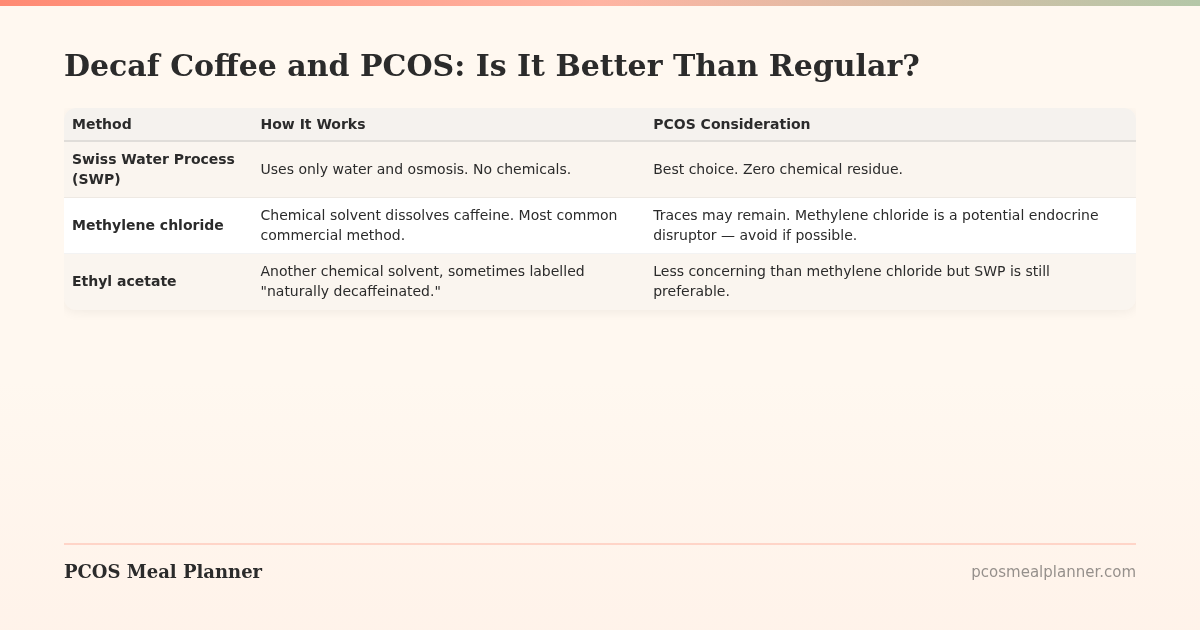
Not all decaf is created equally, and this matters for PCOS. There are three main decaffeination methods:
| Method | How It Works | PCOS Consideration |
|---|---|---|
| Swiss Water Process (SWP) | Uses only water and osmosis. No chemicals. | Best choice. Zero chemical residue. |
| Methylene chloride | Chemical solvent dissolves caffeine. Most common commercial method. | Traces may remain. Methylene chloride is a potential endocrine disruptor — avoid if possible. |
| Ethyl acetate | Another chemical solvent, sometimes labelled "naturally decaffeinated." | Less concerning than methylene chloride but SWP is still preferable. |
Women with PCOS already have a higher burden of endocrine disruption. Adding chemical solvent residues — even in small amounts — is an unnecessary risk when Swiss Water Process decaf is widely available. The "naturally decaffeinated" label on ethyl acetate brands is marketing; it is still a chemical process.
How to tell: Look for "Swiss Water Process" or "SWP" on the label. If the decaffeination method is not stated, it is almost certainly methylene chloride. Good brands are transparent about this.
Best Decaf Coffee Brands for PCOS
These brands use Swiss Water Process and are widely available:
- Kicking Horse Decaf — SWP certified, organic, fair trade. Rich dark roast flavour. Widely available online and in stores.
- Peet's Decaf Major Dickason's Blend — SWP, full-bodied, widely available in the US.
- Allegro Coffee Decaf Organic Breakfast Blend — SWP, available at Whole Foods.
- Swiss Water Decaf branded beans — the company behind the process also sells certified beans directly at swisswater.com.
For espresso lovers, look for SWP decaf espresso roasts from speciality roasters. Most local speciality coffee shops now carry at least one SWP decaf option — ask your barista.
How to Switch From Regular to Decaf (Without the Headaches)
If you currently drink 2 or more cups of regular coffee daily, do not go cold turkey. Caffeine withdrawal causes headaches, fatigue, irritability. Difficulty concentrating — symptoms that can last 2-9 days and that overlap with PCOS symptoms enough to make the whole experience miserable.
Instead, taper over 1-2 weeks:
| Days | Mix | Approx. Caffeine |
|---|---|---|
| 1-3 | 75% regular + 25% decaf | ~70mg per cup |
| 4-7 | 50% regular + 50% decaf | ~45mg per cup |
| 8-10 | 25% regular + 75% decaf | ~25mg per cup |
| 11-14 | 100% decaf | ~5mg per cup |
If you use a drip coffee maker or French press, this is easy — just blend the grounds before brewing. If you buy coffee out, order a "half-caff" for the middle phase, then switch to full decaf.
Expect to feel slightly more tired on days 4-7. This is temporary. Your body is recalibrating its adenosine receptors. By week 3, most women report feeling more stable energy throughout the day because they have eliminated the cortisol rollercoaster.
What to Add (and Avoid) in Your Decaf
The coffee itself is only half the equation. What you put in it matters just as much for PCOS:
- Cinnamon — Ceylon cinnamon improves insulin sensitivity. A meta-analysis in the Journal of Medicinal Food found cinnamon supplementation greatly reduced fasting blood glucose. A quarter teaspoon in your coffee is enough.
- Unsweetened almond milk — low calorie, no lactose, no blood sugar impact.
- Coconut milk (unsweetened) — provides MCTs that support energy without spiking insulin.
- Collagen peptides — adds protein, supports gut lining, dissolves easily in hot or cold coffee.
- Sugar and flavoured syrups — a single pump of vanilla syrup adds 5g of sugar. That is a direct insulin spike.
- Artificial creamers (Coffee-Mate, etc.) — contain corn syrup solids, hydrogenated oils, and artificial ingredients.
- Oat milk — commercial oat milk contains 7g of sugar per cup and often seed oils. It spikes blood sugar more than you would expect.
- Whipped cream and flavoured toppings — these turn a PCOS-friendly drink into a dessert.
A good PCOS-friendly decaf order: SWP decaf with a splash of unsweetened almond milk and a sprinkle of cinnamon. Simple, no blood sugar impact, full of polyphenols.
Decaf vs. Herbal Alternatives: How They Compare
Decaf is not the only low-caffeine option. Here is how it stacks up against other popular drinks for PCOS:
| Drink | Caffeine | PCOS Benefit |
|---|---|---|
| Decaf coffee | 2-15mg | Antioxidants, chlorogenic acid, anti-inflammatory polyphenols |
| Spearmint tea | 0mg | Anti-androgen — research shows it reduces free testosterone. Two cups daily for 30 days lowered testosterone in a clinical trial. |
| Green tea | 25-50mg | L-theanine + caffeine = calm focus without cortisol spike. EGCG supports insulin sensitivity. |
| Cinnamon tea | 0mg | Improves insulin sensitivity. Use Ceylon cinnamon to avoid coumarin in Cassia. |
| Dandelion root "coffee" | 0mg | Coffee-like taste, supports liver detoxification. No direct PCOS research yet. |
You do not have to choose just one. A practical daily rotation: decaf coffee in the morning (for polyphenols), spearmint tea in the afternoon (for anti-androgen effect), cinnamon tea in the evening (for insulin support and warmth). Each serves a different purpose in a PCOS care strategy.
How Decaf Fits Into a PCOS-Friendly Day
Coffee — even decaf — is one piece of a larger system. What you eat alongside it matters more than the coffee itself. Pairing your decaf with an insulin-stabilizing breakfast prevents blood sugar spikes. Having it with a balanced lunch keeps energy stable through the afternoon.
Morning: Decaf coffee with cinnamon and almond milk + overnight oats with ground flaxseed, walnuts, and berries
Mid-morning: Spearmint tea
Lunch: Salmon bowl with quinoa, leafy greens, avocado, and olive oil dressing + decaf if you want a second cup
Afternoon: Green tea (for a gentle energy lift with L-theanine)
Dinner: Lentil curry with roasted vegetables and turmeric + cinnamon tea after
Building this kind of consistent, insulin-friendly routine is what actually moves the needle on PCOS symptoms. The PCOS Meal Planner creates your personalized weekly meal plan around exactly these principles — anti-inflammatory ingredients, insulin-stabilizing macros, and foods that support hormone balance. It costs $9 and your plan is delivered within 24 hours, complete with menus, grocery lists, and prep guides. Your beverage choices matter, but the food surrounding them matters more.
The Bottom Line
For most women with PCOS, switching to decaf is one of the simplest changes you can make with a measurable hormonal upside. You keep the antioxidants, the polyphenols, the ritual, and the taste — and you remove the cortisol spike that feeds insulin resistance and androgen production.
Choose Swiss Water Process. Add cinnamon instead of sugar. Skip the artificial creamers. And if you are not sure whether caffeine is affecting your PCOS, try two weeks of full decaf and track how you feel. Most women notice better energy stability, less anxiety, and fewer afternoon crashes by week two.
Decaf is one piece of a PCOS care system. Pair it with the right food and you are addressing the root drivers — insulin resistance and inflammation — from multiple angles at once. Get your personalized PCOS meal plan and build the full system around what you are already drinking.
Frequently Asked Questions
Is decaf coffee good for PCOS?
Yes. Decaf coffee retains 70-80% of the antioxidants and chlorogenic acid found in regular coffee — the compounds that improve insulin sensitivity and reduce inflammation. The key difference is caffeine content: 2-15mg per cup versus 80-100mg. This eliminates the cortisol spike that drives the cortisol-insulin-androgen cycle in PCOS. Decaf is particularly helpful for women with adrenal PCOS, high cortisol, anxiety, or disrupted sleep.
Does decaf coffee affect hormones?
Decaf has minimal hormonal impact compared to regular coffee. Regular coffee's caffeine triggers a 30-50% cortisol increase, which raises insulin levels and downstream androgen production. Decaf's negligible caffeine content produces almost no cortisol response. The polyphenols in decaf may actually support hormone balance by reducing inflammation and improving insulin sensitivity — both of which help lower androgen production in PCOS.
Is decaf coffee better than regular for insulin resistance?
For most women with PCOS, yes. Both contain chlorogenic acid, which improves glucose metabolism. But regular coffee's caffeine raises cortisol, and cortisol directly worsens insulin resistance by promoting hepatic glucose output and reducing glucose uptake in muscles. Decaf delivers the insulin-sensitizing polyphenols without triggering this counter-productive cortisol response. Research in Nutrition Journal found that both caffeinated and decaf coffee reduced type 2 diabetes risk, suggesting polyphenols — not caffeine — are responsible for the metabolic benefit.
How much decaf coffee can I drink with PCOS?
3-4 cups per day is safe for most women with PCOS. Each cup of decaf contains only 2-15mg of caffeine. Even 4 cups totals under 60mg — well below the 200mg threshold where cortisol effects become significant. Focus on what you add: skip sugar syrups and artificial creamers. Use cinnamon and unsweetened almond milk instead. Choose Swiss Water Process decaf to avoid chemical solvent residues.
Is decaf coffee anti-inflammatory?
Yes. Decaf coffee contains chlorogenic acid, caffeic acid, and other polyphenols that have documented anti-inflammatory effects. Research in the Journal of Nutrition found that coffee polyphenols reduced CRP and IL-6 levels regardless of caffeine content. For women with PCOS, where chronic low-grade inflammation drives insulin resistance and androgen production, these anti-inflammatory benefits make decaf a worthwhile daily addition to an overall PCOS-friendly diet.
What is the best decaf coffee brand for PCOS?
Choose brands that use Swiss Water Process decaffeination, which uses only water — no chemical solvents. Recommended options: Kicking Horse Decaf (SWP, organic, fair trade), Peet's Decaf Major Dickason's Blend (SWP). Allegro Coffee Decaf Organic Breakfast Blend (SWP, available at Whole Foods). Avoid conventional decaf processed with methylene chloride or ethyl acetate. If the decaffeination method is not stated on the label, assume it is chemical-processed.
Community Comments
Add a comment