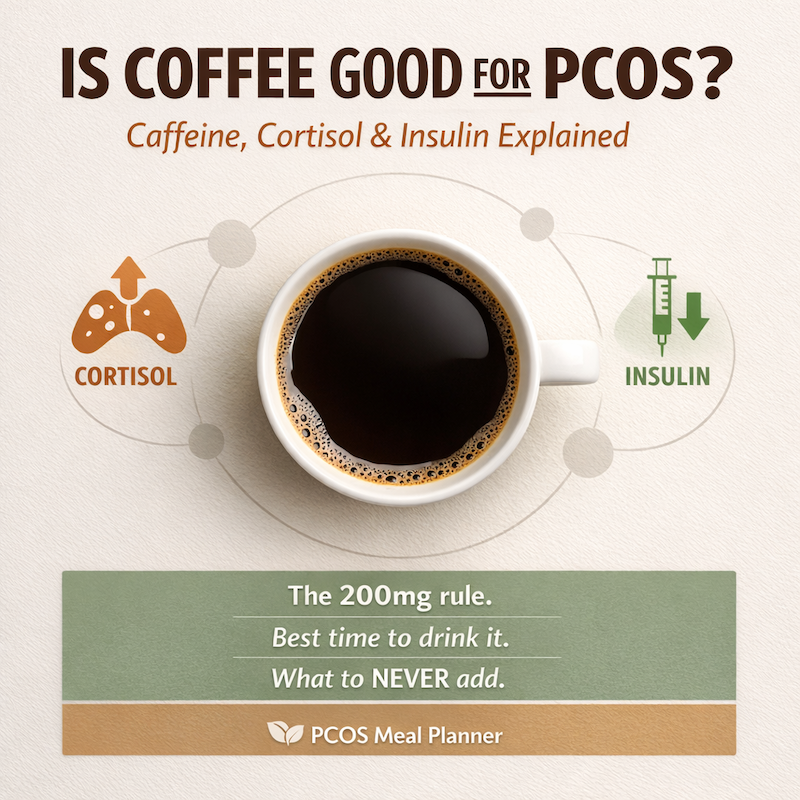
The difference between coffee helping your PCOS and making it worse comes down to three things: dose, timing, and what you put in it. A single black coffee with breakfast is a completely different metabolic event than a 400mg caffeine venti caramel frappuccino on an empty stomach at 3pm.
This guide gives you the exact caffeine limit backed by research, the best and worst times to drink coffee with PCOS. What to add (and never add) to your cup. If you are ordering out, our Starbucks PCOS guide ranks every drink option.
How Caffeine Affects PCOS: The Science
Caffeine interacts with three systems that are already disrupted in PCOS: cortisol, insulin, and androgens. Understanding these pathways explains why coffee is not a simple yes or no answer.
Caffeine and Cortisol
Caffeine blocks adenosine receptors in your brain, which triggers your adrenal glands to produce cortisol and adrenaline. A study published in Psychosomatic Medicine found that 200mg of caffeine (roughly 2 cups of coffee) increased cortisol by 30% in habitual drinkers and up to 50% in people who do not regularly consume caffeine.
This matters for PCOS because cortisol and insulin are connected. When cortisol rises, your liver releases stored glucose into your bloodstream. Your pancreas then produces more insulin to clear that glucose. Over time, this cycle worsens insulin resistance — the root metabolic issue in 70-80% of PCOS cases. High cortisol also signals your adrenal glands to produce more DHEA-S, an androgen that contributes to acne, hair loss, and hirsutism.
Caffeine and Insulin Sensitivity
Here is where coffee gets complicated. Caffeine itself acutely reduces insulin sensitivity. A study in Diabetes Care found that caffeine pills (equivalent to 4 cups of coffee) reduced insulin sensitivity by 15% for several hours after intake.
However, coffee contains hundreds of other bioactive compounds beyond caffeine. Chlorogenic acid, the primary antioxidant in coffee, actually improves insulin sensitivity. A large meta-analysis in Diabetes Care (2014) found that people who drank 3-4 cups of coffee per day had a 25% lower risk of developing type 2 diabetes compared to non-drinkers. This protective effect was seen with both regular and decaf coffee, suggesting the antioxidants — not the caffeine — are responsible.
For PCOS, this means moderate coffee provides antioxidant benefits, but excessive caffeine undermines those benefits through cortisol elevation.
Caffeine and Androgens
The relationship between caffeine and androgen levels is indirect but important. Caffeine raises cortisol. Chronic cortisol elevation stimulates the adrenal glands to produce more androgens (DHEA-S and androstenedione). A 2012 study in Fertility and Sterility found that women consuming more than 500mg of caffeine daily had higher levels of circulating estrogen during the follicular phase, which can disrupt the delicate hormone balance already compromised in PCOS.
At moderate intake (under 200mg), this androgen effect is minimal. The problem arises with chronic high intake — multiple large coffees plus energy drinks or pre-workout supplements throughout the day.
How Much Coffee Is Safe with PCOS?
The research converges on a clear answer. Here is the caffeine breakdown by source so you can track your total daily intake.
| Drink | Serving Size | Caffeine | PCOS Limit |
|---|---|---|---|
| Brewed coffee | 8 oz (240ml) | 80-100mg | 1-2 cups/day |
| Espresso | 1 shot (30ml) | 63mg | 1-3 shots/day |
| Cold brew | 8 oz (240ml) | 100-150mg | 1 cup/day |
| Decaf coffee | 8 oz (240ml) | 2-15mg | No practical limit |
| Green tea | 8 oz (240ml) | 25-50mg | 2-4 cups/day |
| Matcha | 1 tsp (2g) | 35-70mg | 1-2 cups/day |
| Black tea | 8 oz (240ml) | 40-70mg | 2-3 cups/day |
| Energy drink (Red Bull) | 8.4 oz (250ml) | 80mg | Avoid entirely |
| Pre-workout supplement | 1 scoop | 150-300mg | Use caffeine-free version |
Daily Caffeine Targets by PCOS Situation
| Your Situation | Daily Caffeine Limit | Equivalent |
|---|---|---|
| General PCOS care | 200mg max | 2 cups brewed or 3 espresso shots |
| Trying to conceive (TTC) | 100-200mg max | 1-2 cups brewed |
| High anxiety or adrenal PCOS | 50-100mg max | 1 cup brewed or switch to green tea |
| Sleep issues | 100mg max, before 10am | 1 cup brewed, morning only |
| Pregnant with PCOS | 200mg max (ACOG guideline) | 2 cups brewed, consult your doctor |
When to Drink Coffee with PCOS (Timing Is Critical)
The time of day you drink coffee changes its hormonal impact greatly. This is not general wellness advice — it is based on how cortisol rhythms interact with caffeine in PCOS.
Best: 9:30am-11:00am (With or After Breakfast)
Cortisol naturally peaks between 6:00am and 9:00am as part of your cortisol awakening response (CAR). Drinking coffee during this peak adds caffeine-driven cortisol on top of your natural peak — a double hit. By waiting until 9:30am or later, your natural cortisol has started declining, and the caffeine fills in the gap rather than stacking on top.
Always eat before or with your coffee. A breakfast containing protein and fat (eggs, oatmeal with nut butter, or a protein smoothie) provides a buffer that blunts the cortisol response. For breakfast ideas to pair with your coffee, see our best breakfast for PCOS guide.
Acceptable: 7:00-8:00am (With a Full Breakfast)
If you need coffee early, make sure it accompanies a substantial breakfast — not just a quick sip before running out the door. A meal with at least 20g of protein and some fat greatly reduces the cortisol spike from caffeine. For a great pairing, try our PCOS-friendly oatmeal with your morning cup.
Avoid: Before Eating Anything
Coffee on an empty stomach is the worst combination for PCOS. Caffeine triggers cortisol release, which triggers glucose release from your liver, which triggers insulin secretion — all without any food to stabilize the response. The result is a blood sugar roller coaster that causes cravings, energy crashes, and anxiety within 2-3 hours. This pattern is especially harmful for women with PCOS who already have impaired glucose regulation.
Avoid: After 2:00pm
Caffeine has a half-life of 5-6 hours. Coffee at 2pm means you still have significant caffeine in your system at 8pm. Sleep disruption worsens PCOS through multiple pathways: it increases cortisol, reduces insulin sensitivity, raises ghrelin (hunger hormone), and impairs ovulation. Even if you fall asleep fine, afternoon caffeine reduces deep sleep quality by up to 20% according to research published in the Journal of Clinical Sleep Medicine.
What to Put in Your Coffee with PCOS
What you add to coffee matters as much as the coffee itself. A plain black coffee has zero calories and zero sugar. A typical coffee shop drink can have 40-60g of sugar — more than a can of soda.
Good Additions
| Addition | Amount | PCOS Benefit |
|---|---|---|
| Cinnamon | 1/2 tsp | May improve insulin sensitivity by 10-29%, adds natural sweetness |
| Collagen peptides | 1 scoop | 10-12g protein, dissolves clear, no taste change |
| Unsweetened almond milk | 2-4 tbsp | 30 cal, no sugar, creamy texture |
| MCT oil or coconut oil | 1 tsp | Sustained energy, may support metabolism |
| Unsweetened cocoa powder | 1/2 tsp | Magnesium, mocha flavor, antioxidants |
| Stevia or monk fruit | 1-2 drops or 1 packet | Zero glycemic impact, satisfies sweet craving |
| Full-fat cow's milk (splash) | 1-2 tbsp | Small amount adds protein, minimal lactose |
| Coconut cream | 1 tbsp | Rich, creamy texture, dairy-free healthy fat |
Additions to Avoid
| Addition | Why to Avoid |
|---|---|
| Sugar (white, brown, raw) | 4g sugar per tsp, spikes blood sugar, adds to insulin load |
| Flavored syrups (vanilla, caramel, hazelnut) | 20g sugar per pump, most coffee drinks have 4-6 pumps |
| Whipped cream | 80-110 calories, 5g sugar, plus nitrous oxide propellant |
| Coffee-Mate and similar creamers | Corn syrup solids, hydrogenated oils, artificial flavors |
| Oat milk (commercial) | 7g sugar per cup, contains rapeseed/canola oil, spikes blood sugar |
| Honey or agave | 16-17g sugar per tbsp, "natural" does not mean low glycemic |
| Sweetened condensed milk | 22g sugar per tbsp, extremely high glycemic impact |
Coffee Drink Comparison: What to Order and What to Skip
If you buy coffee out, the calorie and sugar difference between drinks is staggering. Here is what a typical coffee shop order looks like for PCOS.
| Drink | Calories | Sugar | Caffeine | PCOS Rating |
|---|---|---|---|---|
| Black coffee (8oz) | 2 | 0g | 95mg | Best |
| Americano (12oz) | 10 | 0g | 150mg | Best |
| Cold brew, black (12oz) | 5 | 0g | 150mg | Best |
| Espresso with almond milk | 15 | 0g | 63mg | Good |
| Flat white (12oz) | 170 | 13g | 130mg | OK |
| Latte with whole milk (16oz) | 220 | 17g | 150mg | Fair |
| Vanilla latte (16oz) | 250 | 35g | 150mg | Poor |
| Caramel frappuccino (16oz) | 420 | 54g | 90mg | Avoid |
| Pumpkin spice latte (16oz) | 380 | 50g | 150mg | Avoid |
| Mocha with whip (16oz) | 400 | 43g | 175mg | Avoid |
A caramel frappuccino contains 54g of sugar — more than 13 teaspoons. That is the equivalent of drinking a can and a half of Coca-Cola. And it gets marketed as "coffee."
Coffee Alternatives for PCOS
If you are caffeine-sensitive, dealing with adrenal PCOS, or want to cut back, these alternatives provide similar ritual and energy benefits without the cortisol spike.
Green Tea
Green tea is arguably the best hot beverage for PCOS. It contains 25-50mg of caffeine (enough to feel alert) plus L-theanine, which promotes calm focus without jitters. EGCG (epigallocatechin gallate) in green tea has been studied for reducing androgen levels in PCOS. A 2017 study in the Journal of Education and Health Promotion found that green tea extract reduced free testosterone in women with PCOS after 12 weeks. Drink 2-3 cups per day.
Matcha
Matcha is whole green tea leaves ground into powder, so you consume the entire leaf and get 10 times more antioxidants than steeped green tea. It has 35-70mg of caffeine per serving, released gradually over 3-4 hours due to the L-theanine. This produces sustained energy without the crash. Make it with unsweetened almond milk and a pinch of cinnamon for a PCOS-friendly latte alternative.
Spearmint Tea
Spearmint tea is specifically helpful for PCOS. Research published in Phytotherapy Research showed that drinking 2 cups of spearmint tea daily for 30 days greatly reduced free testosterone levels in women with PCOS. It is caffeine-free, making it perfect for afternoon or evening. Drink 2 cups daily — one in the morning and one in the afternoon.
Chicory Root Coffee
Chicory root coffee tastes similar to regular coffee but contains zero caffeine. It is a prebiotic fiber source that feeds helpful gut bacteria. Brands like Teeccino and Dandy Blend are widely available. The inulin fiber in chicory root may help blood sugar regulation, making it a functional swap for PCOS.
Roasted Dandelion Root Tea
Dandelion root tea has a dark, bitter flavor profile similar to coffee. It is traditionally used to support liver function, which is relevant because the liver processes excess estrogen and androgens. It is caffeine-free and can be consumed any time of day.
Coffee and PCOS Medications
If you take PCOS medications, caffeine interactions matter. Here is what you need to know.
Metformin
Coffee may actually complement metformin. Both coffee and metformin activate AMPK (AMP-activated protein kinase), an enzyme that improves glucose uptake. A study in Diabetologia found that coffee intake alongside metformin did not reduce metformin effectiveness. However, caffeine can increase the gastrointestinal side effects of metformin (nausea, stomach upset). If you experience stomach issues, drink your coffee 1-2 hours after taking metformin with food, not at the same time. For more on metformin management, see our inositol vs metformin guide.
Inositol
Inositol supplements (myo-inositol and D-chiro-inositol) are best absorbed on an empty stomach. Coffee is acidic and can alter stomach pH. Take your inositol with water first thing in the morning, wait 15-30 minutes, then have your coffee with breakfast. This sequence ensures maximum inositol absorption before coffee changes your stomach environment.
Spironolactone
Spironolactone is a potassium-sparing diuretic. Coffee is also a mild diuretic. The combination can lead to dehydration if you do not drink enough water. Make sure you drink at least one glass of water for every cup of coffee when taking spironolactone. There are no direct drug interactions, but staying hydrated is critical.
Birth Control Pills
Oral contraceptives slow caffeine metabolism by about 33%. This means caffeine stays in your system longer when you are on the pill. If you previously tolerated 2 cups of coffee but feel jittery or anxious after starting birth control, this is why. Reduce to 1 cup or switch to half-caff.
Supplements (Vitamin D, Magnesium, Iron)
Coffee reduces the absorption of iron by up to 80% and can interfere with calcium absorption. Never take iron supplements with coffee. Wait at least 1 hour after coffee before taking iron, calcium, or magnesium supplements. Vitamin D is fat-soluble and is not greatly affected by coffee. For supplement timing, see our complete PCOS supplement guide.
4 PCOS-Friendly Coffee Recipes
Each recipe stays under 200mg caffeine and avoids added sugar. All can be made at home in under 5 minutes.
1. Cinnamon Protein Coffee
- 8 oz brewed coffee (medium roast)
- 1 scoop unflavored collagen peptides
- 2 tbsp unsweetened almond milk
- 1/2 tsp cinnamon
- Optional: 1-2 drops liquid stevia
Stir collagen into hot coffee until dissolved. Add almond milk and cinnamon.
Macros: 55 cal | 12g protein | 1g carbs | 0g sugar
2. Mocha Without the Sugar
- 8 oz brewed coffee
- 1 tsp unsweetened cocoa powder
- 2 tbsp coconut cream
- 1 scoop collagen peptides
- 1-2 drops liquid stevia
Blend or whisk cocoa powder into hot coffee. Stir in collagen and top with coconut cream.
Macros: 100 cal | 12g protein | 2g carbs | 0g sugar
3. Iced Almond Butter Coffee
- 8 oz cold brew coffee
- 1 tbsp almond butter
- 1/4 cup unsweetened almond milk
- 1/2 tsp cinnamon
- Ice
Blend cold brew, almond butter, almond milk, and cinnamon until smooth. Pour over ice.
Macros: 115 cal | 4g protein | 3g carbs | 9g fat | 0g sugar
4. Golden Turmeric Latte (Low-Caffeine)
- 4 oz brewed coffee (or 1 shot espresso)
- 4 oz unsweetened almond milk (warmed)
- 1/2 tsp turmeric powder
- 1/4 tsp cinnamon
- Pinch of black pepper (increases turmeric absorption)
- 1 tsp MCT oil
Heat almond milk with turmeric, cinnamon, and pepper. Add to coffee with MCT oil and stir.
Macros: 60 cal | 1g protein | 2g carbs | 5g fat | 0g sugar
Common Myths About Coffee and PCOS
Reality: No clinical guideline recommends complete coffee elimination for PCOS. The 2023 International Evidence-based Guidelines for PCOS do not mention coffee restriction. Research shows that moderate coffee intake (1-2 cups) provides antioxidants that improve insulin sensitivity. The issue is excessive caffeine, not coffee itself. Eliminating coffee entirely may also reduce compliance with diet changes if it is a food you enjoy.
Reality: Decaf has 2-15mg of caffeine per cup compared to 80-100mg in regular coffee. That is a 85-98% reduction. Decaf still contains the same chlorogenic acid and antioxidants that provide the insulin-sensitizing benefits. For women with adrenal PCOS or caffeine sensitivity, decaf gives you the benefits of coffee without the cortisol spike. Swiss Water Process decaf is the cleanest option.
Reality: Traditional bulletproof coffee calls for 2 tablespoons of butter and 1 tablespoon of MCT oil in coffee, totaling 300+ calories of pure fat with no protein or fiber. While the fat slows caffeine absorption, drinking 300 calories of fat as a meal replacement does not provide the protein, vitamins, or fiber women with PCOS need. A smaller amount of MCT oil (1 teaspoon) in coffee alongside a balanced breakfast is a better approach.
Reality: There is no evidence that moderate coffee intake (under 200mg caffeine) causes infertility. The American College of Obstetricians and Gynecologists states that moderate caffeine consumption does not appear to be a major contributing factor to infertility. Very high intake (over 500mg daily) has been linked to slightly longer time to conception in some studies, but this is correlation, not proven causation. One cup of coffee daily is considered safe when trying to conceive.
Reality: Cold brew has 67% less acidity than hot-brewed coffee, which may be easier on digestion. However, cold brew often has higher caffeine concentration (150-200mg per 8oz vs 80-100mg for hot brew) because of the longer steeping time. If you drink cold brew, use a smaller serving size to stay within the 200mg limit. The antioxidant content is similar between the two methods.
What the Research Says About Coffee and PCOS
These recommendations are based on peer-reviewed research on caffeine, metabolic health, and female hormones.
- Caffeine and cortisol: Lovallo et al., Psychosomatic Medicine (2006), showed that 200mg caffeine raised cortisol by 30% in habitual consumers and up to 50% in non-habitual consumers, with effects lasting 2-3 hours.
- Coffee and type 2 diabetes risk: Ding et al., Diabetes Care (2014), meta-analysis of 28 studies found that 3-4 cups of coffee per day was linked to a 25% lower risk of type 2 diabetes, with both caffeinated and decaffeinated coffee showing benefits.
- Caffeine and insulin sensitivity: Keijzers et al., Diabetes Care (2002), showed that caffeine equivalent to 4 cups of coffee acutely reduced insulin sensitivity by 15%.
- Green tea and PCOS androgens: Tehrani et al., Journal of Education and Health Promotion (2017), found that green tea extract supplementation reduced free testosterone levels in women with PCOS after 12 weeks.
- Spearmint tea and androgens: Grant, Phytotherapy Research (2010), showed that spearmint tea consumed twice daily for 30 days greatly reduced free and total testosterone in women with PCOS.
- Caffeine and estrogen: Schliep et al., Fertility and Sterility (2012), found that caffeine intake above 500mg daily was linked to higher estrogen levels during the follicular phase of the menstrual cycle.
- Coffee and iron absorption: Morck et al., American Journal of Clinical Nutrition (1983), showed that coffee reduced iron absorption from a meal by up to 80% when consumed simultaneously.
- Caffeine and sleep quality: Drake et al., Journal of Clinical Sleep Medicine (2013), found that caffeine consumed 6 hours before bed reduced total sleep time by 1 hour and greatly decreased deep sleep quality.
Frequently Asked Questions
Is coffee good for PCOS?
Coffee is neither universally good nor bad for PCOS. One to two cups of black coffee per day (up to 200mg caffeine) is generally safe and may provide benefits from antioxidants and chlorogenic acid, which research shows can improve insulin sensitivity. However, more than 200mg of caffeine per day can raise cortisol levels, worsening insulin resistance and potentially increasing androgens. The key is moderation, timing (with food, before noon), and avoiding sugar and flavored syrups. For coffee shop ordering, see our Starbucks PCOS guide.
Does coffee raise cortisol in PCOS?
Yes, caffeine raises cortisol. Research shows 200mg of caffeine increases cortisol by 30% in regular drinkers and up to 50% in occasional drinkers. Women with PCOS already tend to have high cortisol, so excessive caffeine compounds the problem. Keeping intake to 1-2 cups before noon minimizes the impact because cortisol naturally declines throughout the day.
How much coffee can I drink with PCOS?
Limit coffee to 1-2 cups per day (100-200mg caffeine). If you are trying to conceive, stay under 200mg per day per ACOG guidelines. If you have adrenal PCOS or high anxiety, consider reducing to 1 cup or switching to green tea or decaf. Remember that Starbucks servings are much stronger than home-brewed — a single Starbucks grande has 310mg of caffeine.
Should I drink coffee on an empty stomach with PCOS?
No. Coffee on an empty stomach triggers a cortisol spike and blood sugar instability that leads to cravings and energy crashes. Always eat breakfast first or alongside your coffee. A meal with protein and fat blunts the cortisol response. If you practice intermittent fasting, drink coffee during your eating window with a meal, not during the fast.
Does caffeine affect fertility with PCOS?
Moderate caffeine (under 200mg daily) does not appear to greatly affect fertility. ACOG considers this level safe when trying to conceive. Very high intake (over 500mg daily) has been linked to slightly longer time to conception in some studies. For women with PCOS who already face ovulation challenges, staying at 1 cup per day is a reasonable precaution.
What is the best coffee for PCOS?
Black coffee, cold brew, or an Americano are the best options. If you need something in your coffee, use unsweetened almond milk and cinnamon. Cold brew has 67% less acidity and may be easier on digestion, but has higher caffeine per ounce so use a smaller serving. Choose medium roast for the best balance of antioxidants and moderate caffeine. Avoid all flavored syrups, sugar, and commercial creamers.
Is decaf coffee OK for PCOS?
Yes. Decaf retains the helpful antioxidants and chlorogenic acid of regular coffee with only 2-15mg of caffeine. This eliminates the cortisol spike while preserving the insulin-sensitizing benefits. Decaf is the best option for women with adrenal PCOS, anxiety, or caffeine sensitivity. Choose Swiss Water Process decaf to avoid chemical solvents.
Can I add milk to coffee with PCOS?
A splash (1-2 tablespoons) of full-fat cow's milk is fine for most women with PCOS. If you are dairy-sensitive, use unsweetened almond milk, coconut milk, or macadamia milk. Avoid oat milk (high sugar, seed oils) and flavored creamers (corn syrup solids, hydrogenated oils). For a full dairy comparison, see our PCOS milk alternatives ranking.
Take Action Today
You do not have to give up coffee with PCOS. You need to drink it strategically. Here are your next steps:
- Audit your current caffeine intake — Add up all caffeine sources: coffee, tea, chocolate, pre-workout, energy drinks. If you are over 200mg daily, reduce gradually (cut by 50mg per week to avoid withdrawal headaches).
- Move coffee after breakfast — If you currently drink coffee before eating, switch to having it with or after your first meal. This single change reduces the cortisol impact greatly.
- Clean up what you add — Replace sugar with cinnamon. Replace flavored creamer with unsweetened almond milk. Replace syrups with a drop of stevia. You may need 1-2 weeks to adjust to less sweetness.
- Set a caffeine curfew — No caffeine after 2pm. Switch to spearmint tea, herbal tea, or decaf for afternoon cravings. Your sleep quality will improve within days.
- Try a half-caff week — Mix half regular and half decaf beans. Most people cannot taste the difference, and you right away cut caffeine intake by 50% while keeping the ritual and flavor.
- Get personalized guidance — PCOS Meal Planner builds custom meal plans that account for your caffeine habits, medication timing, and specific PCOS subtype. Your plan includes drink recommendations and supplement timing that works around your coffee schedule.
For more on managing PCOS through diet, explore our guides on oatmeal for PCOS, supplements for PCOS, and exercises for PCOS.
Community Comments
Add a comment