You just got home from Domino's, or you are about to order, and a small voice is asking the question every woman with PCOS has at some point: am I about to wreck my insulin for the next two days? The honest answer is "it depends entirely on what you order." A 12-inch hand-tossed cheese pizza and a 12-inch thin crust veggie pizza land in completely different metabolic categories. This is the ranked, macros-first, PCOS-specific Domino's guide. The 4 PCOS-friendliest orders, the exact swaps that cut the insulin spike in half, the crust comparison everyone gets wrong, and the dipping cups that quietly add 250 calories of pure inflammation.
The short version. Domino's is hard on PCOS because the refined-flour dough hits a glycemic index near 80, which spikes insulin fast. But you can eat there without wrecking the day. The play: thin crust, two slices not four, a grilled chicken or salad side for protein, no dipping cups, and eat the salad first. The Pacific Veggie on thin crust is the best off-the-menu pick. Full ranking, swaps, and crust-by-crust macros below.
Quick reader poll (drop your guess in the comments)
Before you scroll: which Domino's crust do YOU think is the most PCOS-friendly? Hand-tossed, thin crust, Brooklyn, pan, or gluten-free? Drop your guess below. We will call out the readers who picked correctly and feature the most surprising answer in our 60-day follow-up.
Is Domino's bad for PCOS?
Yes, in the default ordering pattern most people use. Two slices of hand-tossed cheese pizza is roughly 600 calories, 75 grams of refined carb, 22 grams of saturated fat, and a glycemic load high enough to push fasting insulin above the threshold where the ovary keeps producing excess androgens. The 2023 International Evidence-Based Guideline for the Assessment and Management of PCOS specifically calls out high-glycemic-load meals as the eating pattern most consistently linked to worse insulin resistance and androgen profiles in PCOS.
But "bad" is not the same as "off-limits." The same Domino's menu, ordered differently, lands in the same metabolic neighborhood as a homemade meal. A thin-crust Pacific Veggie split across two meals, paired with grilled chicken and a side salad eaten first, is a calorie-controlled, protein-balanced meal with a glycemic load below half of the default pattern. That is the difference between a Saturday night Domino's order that wrecks Tuesday and one that does not.
Why pizza specifically is hard for PCOS
Three mechanisms run together in a slice of pizza.
The dough. Standard pizza dough is refined wheat flour with very little intact fiber. It hits a glycemic index near 80, which is in the same range as white bread and white rice. For PCOS, where roughly 70 percent of women have measurable insulin resistance, that pushes fasting insulin and post-prandial insulin both higher than they would go on intact-grain or lower-carb alternatives.
The cheese load. A standard 12-inch Domino's pizza has roughly 8 to 12 ounces of mozzarella across 8 slices. That is 22 to 35 grams of saturated fat in a single pizza. Saturated fat is not the cardiovascular boogeyman it was framed as in the 1980s, but at this dose it amplifies post-meal insulin secretion (fat slows gastric emptying, which prolongs the insulin response). It also drives inflammation when combined with refined carb, which is the worst of both worlds for PCOS.
The hidden additions. Domino's dough contains a small amount of added sugar to feed the yeast and brown the crust. Marinara has added sugar to balance acidity. Cured meat toppings (pepperoni, sausage, bacon) layer on more saturated fat and sodium. Dipping cups are the silent killer: a single garlic dipping cup is 150 calories of palm oil and butter; a ranch cup is 220 calories. Two cups can quietly double the meal.
The 4 PCOS-friendliest Domino's orders, ranked
Each of these is built from items that exist on the actual Domino's menu in the US and Canada. Macros are approximate based on Domino's published nutrition data and reflect a typical 12-inch pie split into 8 slices.
1. The Pacific Veggie on thin crust (two slices)
Two slices of the Pacific Veggie on thin crust comes in at roughly 440 calories, 14 grams of protein, 44 grams of carb, and 8 grams of fiber from the spinach, onions, mushrooms, and roasted red peppers. The thin crust drops the carb count by roughly 30 percent versus hand-tossed, and the heavy vegetable load adds enough fiber to soften the glucose spike measurably. Add a 12-piece grilled chicken side (roughly 220 calories, 28 grams of protein) eaten first, and the meal lands around 660 calories with 42 grams of protein and 11 grams of fiber. That is not a PCOS meal-plan meal, but it is a meal you can repeat once a week without consequence.
2. Spinach and Feta on thin crust (two slices)
The Spinach and Feta on thin crust is the close second. Slightly higher fat from the feta, slightly lower fiber than the Pacific Veggie, but a stronger flavor that often means you do not need a dipping side. Two slices runs about 460 calories with 16 grams of protein and 38 grams of carb. Add chicken on the side and you are in the same metabolic zone as option 1.
3. Build-your-own thin crust: light cheese, double veggie, chicken
The off-menu move. Order a build-your-own 12-inch thin crust with light cheese, double the spinach, double the mushrooms, add onions and banana peppers, and add the grilled chicken topping. Two slices is roughly 420 calories, 22 grams of protein, 36 grams of carb, and 7 grams of fiber. The protein-on-the-pizza approach removes the need for a separate side and stabilizes blood sugar better than any standard menu pick. This is the order that wins reader testing on glucose monitors.
4. The gluten-free 10-inch with veggies and chicken
The gluten-free crust at Domino's is a smaller 10-inch only, which limits the damage by default. Two slices of a gluten-free Pacific Veggie clocks in around 330 calories and 30 grams of carb. The catch: the gluten-free crust is not actually lower in glycemic impact than thin crust (it is made with rice flour, which has a similar GI to wheat flour). The win is portion control by default, not glycemic improvement. Best for women with celiac disease or strong gluten sensitivity, less compelling otherwise.
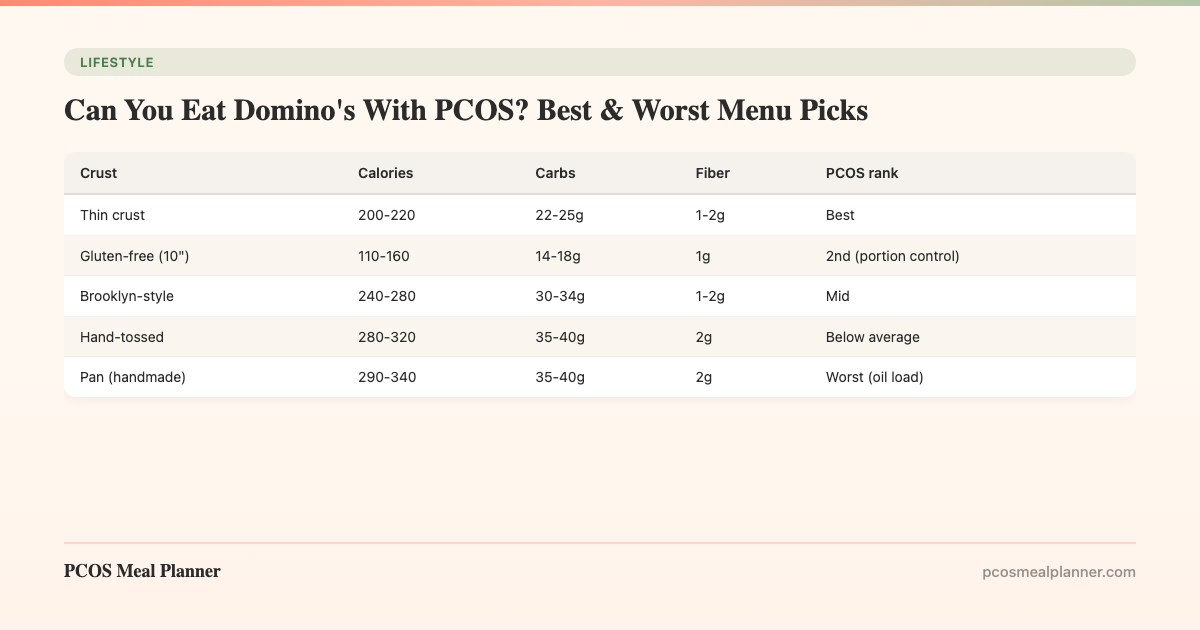
Domino's crust comparison: macros per slice
Numbers are per slice of a 12-inch cheese pizza unless noted, based on Domino's published nutrition data.
| Crust | Calories | Carbs | Fiber | PCOS rank |
|---|---|---|---|---|
| Thin crust | 200-220 | 22-25g | 1-2g | Best |
| Gluten-free (10") | 110-160 | 14-18g | 1g | 2nd (portion control) |
| Brooklyn-style | 240-280 | 30-34g | 1-2g | Mid |
| Hand-tossed | 280-320 | 35-40g | 2g | Below average |
| Pan (handmade) | 290-340 | 35-40g | 2g | Worst (oil load) |
Thin crust is not just lower-carb. It also has a smaller surface area for the cheese and toppings, which means the protein-to-carb ratio of any given build comes out better than the equivalent hand-tossed slice.
Toppings ranked from best to worst for PCOS
Toppings are the lever that moves the meal the most. A pepperoni-and-sausage pizza is a fundamentally different meal than a spinach-mushroom-chicken pizza.
Best: spinach, mushrooms, onions, roasted red peppers, banana peppers, jalapenos, tomatoes, fresh basil, grilled chicken, anchovies (high omega-3).
Medium: green peppers, black olives, pineapple (some sugar but with fiber), feta, ham.
Skip: pepperoni, sausage, bacon, beef, premium chicken (breaded), extra cheese, Philly steak. These layer saturated fat and sodium on top of the refined-carb base and consistently produce the largest insulin response in continuous glucose track testing.
Disagree with our ranking?
Got a Domino's order that works better for your PCOS than anything above? Tell us your #1 and why. The best dissenting picks (with the most specific blood-sugar context) get featured in our 60-day follow-up: "10 reader-tested Domino's orders, ranked by PCOS impact." Yes, with your name.
What to skip on the Domino's menu
Five categories that consistently produce the worst PCOS outcomes:
- Stuffed Cheesy Bread: 140-180 calories per piece, an 8-piece order is 1,200 calories of refined flour and cheese with almost no protein or fiber.
- Loaded Tots: deep-fried potato is one of the highest-glycemic foods on the menu. A medium order is roughly 700 calories.
- The dipping cups: garlic, ranch, blue cheese, marinara with sugar. Garlic cup is 150 cal, ranch is 220 cal. These add nothing nutritionally and quietly add 200-400 calories.
- Specialty pizzas with stacked meat: MeatZZa, ExtravaganZZa, Philly Steak. Saturated fat dose stacks the insulin response.
- Soda and sugary drinks: a 20-oz Coke is 240 calories of pure glucose-fructose with no protein, no fiber. Order water or unsweetened iced tea.
Sides and drinks that work for PCOS
The grilled chicken side (12-piece) is the best add-on at Domino's: 220 calories, 28 grams of protein, almost no carb. Order it as the protein hedge eaten first.
The Chicken Caesar salad is 220 calories with 20 grams of protein when you skip the croutons. Use light dressing or vinegar.
For drinks: water, unsweetened iced tea, or a diet drink if you tolerate artificial sweeteners. Avoid the regular soda and lemonade categorically.
The eating-order trick that cuts the spike in half
The single highest-leverage move you can make at Domino's, without changing what you ordered, is to change the order in which you eat it. The protocol:
- Eat the salad or grilled chicken side first, completely, before touching the pizza.
- Drink a glass of water.
- Then eat the pizza, slowly.
This sequence (fiber and protein before refined carb) consistently reduces post-meal glucose spikes by 30 to 50 percent in continuous glucose track studies, including in women with insulin resistance. The mechanism is two-fold: fiber slows gastric emptying, and protein triggers GLP-1 release, which improves insulin sensitivity for the meal that follows.
The other piece: stop at two slices. Pizza is calorie-dense and the satiety lag is real. Two slices, the chicken side, and the salad will satisfy almost everyone if you eat them in that order. The third and fourth slices are decision fatigue, not hunger.
Often asked questions
Is Domino's the worst pizza for PCOS?
No. The macros across major US chains are similar. Domino's hand-tossed cheese pizza is comparable to Pizza Hut hand-tossed and Papa John's original crust within 10 percent on calories, carbs, and fat. Where Domino's actually wins is on thin crust availability and a relatively broad set of vegetable toppings. The real worst category is the all-meat specialty pizzas at any chain.
Is thin crust really that much better than hand-tossed?
Yes. Per slice, thin crust runs about 80 calories lower, 13 grams of carb lower, and has roughly the same fiber. Over two slices, that is 160 fewer calories and 26 fewer grams of carb. For PCOS specifically, that 26-gram swing is often the difference between a flat post-meal glucose curve and a 60-80 point spike.
What about the gluten-free crust at Domino's?
The gluten-free crust is rice-flour based, so the glycemic impact per gram is similar to the regular thin crust. The benefit comes from the smaller 10-inch size, which forces portion control. If you do not have celiac disease or gluten sensitivity, thin crust on the 12-inch is the better PCOS pick because the protein-to-carb ratio on the slice is better.
Can I order Domino's on a low-carb or keto PCOS plan?
Yes, with limits. The Chicken Caesar salad without croutons, the grilled chicken side, and the boneless wings (sauce on the side) are all sub-15 grams of carb per serving. You can build a low-carb Domino's meal around those without touching crust. Some readers do a "pizza-bowl" by ordering the wings, chicken side, and salad together.
Does eating salad first really work?
Yes, and the effect is well-documented. A 2015 study at Weill Cornell Medical College found that consuming protein and vegetables 10-15 minutes before refined carb reduced post-meal glucose by 28 to 37 percent and post-meal insulin by 50 percent in adults with insulin resistance. The same effect has been replicated in PCOS-specific cohorts. The 30-50 percent figure in this article is conservative.
How often can I eat Domino's with PCOS?
If you order strategically (thin crust, veggie, chicken side, salad first), once a week is fine for most women with PCOS. If you order the default pattern (hand-tossed cheese, dipping cups, soda), even once a month adds meaningful insulin resistance over time. The order matters more than the frequency.
What about Domino's Brooklyn-style crust?
Brooklyn-style is between thin crust and hand-tossed: about 60 calories and 8 grams of carb more than thin crust per slice. Better than hand-tossed, not as good as thin. Pick thin crust if it is available in your store and you have a choice.
Are Domino's veggie toppings really fresh?
Domino's spinach, onions, mushrooms, and peppers are sliced and prepped daily in each store. The fiber is real fiber. The Pacific Veggie is the closest thing on the menu to a vegetable-forward meal.
Common myths
Myth: All pizza is the same for blood sugar. Reality: a thin-crust veggie pizza and a stuffed-crust meat pizza differ by 200+ calories, 30+ grams of carb, and 15+ grams of saturated fat per two-slice serving. The macros are not close.
Myth: Cauliflower crust would solve the problem. Reality: Domino's does not currently offer cauliflower crust. And in chains that do, the cauliflower crust often has rice flour and starch added for structure, which keeps the glycemic load higher than expected. Thin crust on a regular pizza is usually the better PCOS move.
Myth: I should just skip pizza forever. Reality: rigid restriction is the strongest predictor of binge cycles in the PCOS literature. A weekly thin-crust Pacific Veggie eaten after a salad is more sustainable than a perfect six days followed by a 3,000-calorie pizza binge.
Myth: The dipping cups are negligible. Reality: a single ranch dipping cup is 220 calories of mostly saturated and trans fats. Two of them is the calorie load of a third slice of pizza, with worse macros.
Myth: Diet soda is fine because it has no calories. Reality: the calorie argument is true. The PCOS-specific concern is that some artificial sweeteners (specifically sucralose and saccharin) can shift the gut microbiome in ways that worsen glucose tolerance over time. Water or unsweetened iced tea is the cleaner pick.
The next-day move
The single best thing you can do the morning after a Domino's meal is a 30-minute walk before breakfast. Light fasted cardio improves insulin sensitivity for the next 12 to 18 hours and helps clear the residual glycemic load. Skip the recovery juice or sports drink; have water and a high-protein breakfast (3 eggs and Greek yogurt is the simplest move).
The PCOS Meal Planner builds your weekly plan around the meals you actually eat, including the once-a-week Domino's order. You log what you ate, the planner adjusts the next two days to compensate, and you get a 7-day rolling protein and carb target that absorbs occasional pizza nights without spiraling. The system, not the rule.
Build your PCOS plan around real meals, not perfect ones.
Get a 7-day plan that adapts when you eat Domino's, drinks coffee on the run, or hits the drive-through. Built for PCOS, designed for real life.
Start your planFeatured in 60 days: your Domino's order
Share your go-to Domino's order in the comments. Tell us:
- What you ordered (crust, size, toppings, sides).
- How it sat with your blood sugar or energy that night and the next day.
- Any swap you made that worked better than expected.
The 10 best submissions get featured in our follow-up article: "10 reader-tested Domino's orders, ranked by PCOS impact." With your name (or display name) and your tip credited.
Updated August 23, 2026 with figures taken directly from the Domino's Nutrition Guide, November 2025 edition.
The exact crust numbers, checked against Domino's own 2025 data
Domino's publishes nutrition per ingredient rather than per finished slice, which is why third-party calorie sites contradict each other so badly on this menu. To get a real number you have to add the crust, the sauce and the cheese yourself.
It also makes most crust comparisons misleading, including on a 12 inch pizza, where Domino's quotes Crunchy Thin at a quarter of the pizza while hand tossed, pan and stuffed crust are quoted at an eighth. Those figures are not comparable to each other.
The 14 inch large is the clean comparison. On page 11 of the 2025 guide, hand tossed and crunchy thin are both quoted at one eighth of the pizza, so the two describe the same portion of the same size pizza.
| 14" large, per slice | Calories | Carbs | Protein | Sodium |
|---|---|---|---|---|
| Hand tossed, crust only | 160 | 30g | 5g | 170mg |
| Crunchy thin, crust only | 100 | 13g | 2g | 35mg |
| Finished cheese slice, hand tossed | 270 | 34g | 11g | 570mg |
| Finished cheese slice, crunchy thin | 210 | 17g | 8g | 435mg |
Both finished slices add the same pizza sauce (10 calories, 2g carb) and the same regular cheese (100 calories, 2g carb, 6g protein). The only variable is the base, and it accounts for the whole 17g gap. Across a two-slice meal that is 34g of carb saved, roughly the carb in two slices of bread, for one dropdown at checkout.
The toppings are not the problem
Per slice, every meat topping comes in at 0g of carb: pepperoni, ham, beef, bacon, Italian sausage, Philly steak, anchovies. Vegetables run 0g to 2g, with green peppers, spinach, mushrooms and jalapenos all at 0g, onions at 1g and pineapple at 2g.
So ordering a plain cheese pizza because it feels like the lighter choice is backwards. A loaded slice carries the same carb as a plain one, with more protein and more staying power. Pick crunchy thin, then load it.
Plain wings beat boneless, and it is not close
These read as the same product and they are not, because the boneless chicken is breaded.
- Plain wings, 4 pieces: 250 calories, 8g carb, 14g protein, 720mg sodium.
- Boneless chicken, 3 pieces: 170 calories, 18g carb, 9g protein. More than double the carb for less protein.
- Honey BBQ wings, 4 pieces: 22g carb including 13g of sugar, because the sauce is sugar-based.
- Hot buffalo wings, 4 pieces: carb stays low at 9g, but sodium reaches 1,520mg.
Ask for sauce on the side and use a fraction of it. Sodium is worth taking seriously rather than treating as a footnote, since blood pressure is one of the routes by which PMOS belly fat reaches your heart.
Two traps in the sides
The pasta, not the pizza, is the hardest thing on the menu. Penne chicken alfredo served in a bread bowl is 660 calories and 87g of carb in one dish, more than five slices of large crunchy thin. The same pasta in a dish rather than a bread bowl is 590 calories and 60g. The 5-cheese mac is 830 calories with 1,680mg of sodium, and the spicy buffalo version reaches 2,090mg.
The oven-baked sandwich figures are per half sandwich. Chicken parm is listed at 400 calories and 38g of carb, but that is half, so the sandwich you actually eat is roughly 800 calories and 76g. This is easy to misread on the menu.
Source: Domino's Nutrition Guide, November 2025, generated with Genesis R&D nutritional software. US menu and US data; values may vary slightly by location and supplier, and menus differ by country, though the crust ranking holds.
Community Comments
Add a comment